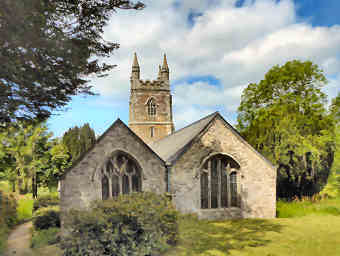
Creed, St. Crida and St. Andrew
I visited Creed church a couple of times in June 2016, the first on my own just to see the church, the second with Jane for a garden opening day at Creed House. I have a particular personal interest in Creed because my father's cousin Bertie - the Rev. A.E. Coulbeck - was rector there from 1947 to 1950, before he moved on to St. Just in Roseland. His home was the Rectory, now known just as Creed House. Oddly, while you might expect that tiny Creed, a mile south of Grampound, would be no more than an adjunct to it, it is Creed which is the original settlement, with the major church, while Grampound's church is no more then a Chapel of Ease. There is very little to Creed, just the handsome airy church, the big house, Creed House, and its lodge east of the church, Creed Farm, one of it's barns now converted to a dwelling, and a small but handsome old square barn with tallet steps abutting the churchyard. Creed House has a pleasant garden with fine specimen trees. I had always known that my father's cousin Bertie had, as Rev. A. E. Coulbeck, been rector of St. Just in Roseland. In 2016 it came as a surprise to me that he had previously been rector here and that Creed House had been his rectory. Notable figures linked with Creed were William Gregory, discoverer of titanium, and Parliamentarian John Hampden representing Creed and Grampound in the time of Charles I and Cromwell.
Creed Revisited
From A390 in Grampound, follow small sign R for 1 mile
St. Andrew's, Creed
I had been to Creed on several previous occasions, first in 2006 for an NGS Open Gardens day for the garden at Creed House, once the rectory when my father's cousin Bertie Coulbeck was rector there before he moved on to St. Just in Roseland. and then in 2016 for a first view of the interior of the church. This occasion was in late September 2018 on a Saturday when I also visited the churches in Grampound, Ladock and Probus. Pevsner clearly likes this church, devoting almost a whole page to it. I like it greatly, too. You approach through wrought iron gates and face the east end. Much enlarged and altered since its Norman origins St. Crida's now consists of Nave, South Aisle. porch and three-stage tower. The first thing that strikes you is the unexpected richness of the 16th century porch with its variety of stonework. Inside, the church is light, spacious and airy. There are wagon roofs, that of the south aisle 15th century, that of the nave late 19th century, part of the late Victorian restoration by J P St. Aubyn. Glazing is largely plain but there are traces of medieval glass in the windows of the south aisle. A piscina in the north transept has a fragment of a medieval fresco above it. The 13th century font is of blue Catacleuse stone. A little of the rood screen remains and has elaborate tracery. A chest tomb of 1589 has a slate top commemorating Thomas and Margaret Denys; it incorporates a coat of arms. A marble wall monument with a Latin inscription remembers Roberto Quarme. The elaborately carved pulpit is probably Victorian. At the west end is a catafalque (coffin cart), something I have not seen in another church. The unusual simple modern altar is dedicated to farmers and fishermen.
Creed Catafalque
Creed Pulpit
Creed Screen made of Bench Ends
Photographs
More in Churches & Holy Sites
Crowan
, St. Crewenna's
Crowan
, More St. Crewenna's Church
Cubert, St. Cubert's Church
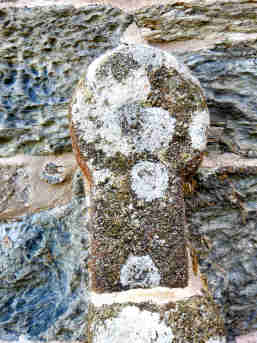
Cubert lies a mile or so south of Crantock, to the south of the Gannel Estuary that defines the southern boundary of Newquay. St. Cubert's church is to the south of the main street, Holywell Road, at the eastern end of the village. It stands in a large, but largely empty, graveyard, raised above the surrounding land, an example of the typical Cornish lann; a roofless lych gate leads up to the churchyard, in which there are some good table tombs. Look back from inside the lych gate and you will see a cottage with a round cloam oven projecting from it. The first thing about the church itself to take your eye is the, unusual for Cornwall, broach spire, rising directly from the body of the tower. Next thing to notice, before you enter the church, is the Cornish Crosshead by the porch; it stands on the top of an originally unconnected granite upright. Inside, the church consists of nave, south aisle and north transept. The north transept is particularly striking, the columns of its arched entrance of blue Catacleuse stone (an Elvan stone). Inside the north transept is the font, also made of Catacleuse stone, with a central pillar and four slim supporting pillars in the Bodmin style, and a wooden font cover in the shape of four transepts and a tower. The pulpit is made up from medieval bench ends. The chancel ceiling has carved wooden bosses. Other features to note are carved capitals to some pillars, a St. Cubert banner and the glass figure of a soldier with rifle and bayonet.