Crowan
, St. Crewenna's
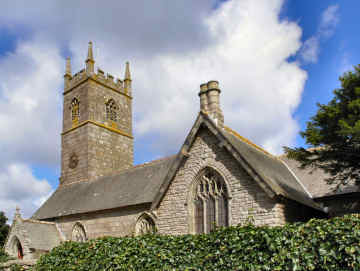
Crowan is an attractive little village with buildings speaking of its former importance as the St. Aubyn family's 'churchtown'. Victorian gothic Church House, presumably the former rectory, is now divided in two. Coverack House (that might be a new name) is handsomely Georgian with a plain porch. Down the hill towards Praze is an attractive converted mill building, still complete with its waterwheel. St. Crewenna is thought to have come from Ireland, possibly with St. Breaca (of Breage) but nothing is known of him/her. Crowan village (as a 'chuchtown') was once the focus of the great Clowance estate of the St. Aubyn family. The family have departed for St. Michael's Mount (as Lords St. Levan) and Pencarrow (as the Molesworth-St. Aubyns). Clowance itself is a now a timeshare, country club and golf club. From the outside the (probably) 14th century church looked rather dull when I visited it on a Land's End Trail walk from Beacon to Clowance. The interest is in the memorials to the St. Aubyns inside. Earliest is the remnant of brasses of around 1420. Most elaborate is that of 1772 to Sir John St. Aubyn by sculptor Joseph Wilton. I liked the delightful collage tapestry telling the story of the village and neighbouring estate villages such as the mining settlement of Praze-an-Beeble.
Crowan, St. Crewenna's church
Crowan is signed off B3303 Camborne-Helston More St. Crewenna
More in Churches & Holy Sites
Crowan
, More St. Crewenna's Church
Cubert, St. Cubert's Church
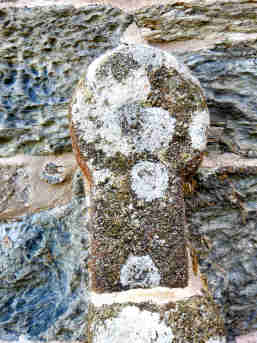
Cubert lies a mile or so south of Crantock, to the south of the Gannel Estuary that defines the southern boundary of Newquay. St. Cubert's church is to the south of the main street, Holywell Road, at the eastern end of the village. It stands in a large, but largely empty, graveyard, raised above the surrounding land, an example of the typical Cornish lann; a roofless lych gate leads up to the churchyard, in which there are some good table tombs. Look back from inside the lych gate and you will see a cottage with a round cloam oven projecting from it. The first thing about the church itself to take your eye is the, unusual for Cornwall, broach spire, rising directly from the body of the tower. Next thing to notice, before you enter the church, is the Cornish Crosshead by the porch; it stands on the top of an originally unconnected granite upright. Inside, the church consists of nave, south aisle and north transept. The north transept is particularly striking, the columns of its arched entrance of blue Catacleuse stone (an Elvan stone). Inside the north transept is the font, also made of Catacleuse stone, with a central pillar and four slim supporting pillars in the Bodmin style, and a wooden font cover in the shape of four transepts and a tower. The pulpit is made up from medieval bench ends. The chancel ceiling has carved wooden bosses. Other features to note are carved capitals to some pillars, a St. Cubert banner and the glass figure of a soldier with rifle and bayonet.
Cury, St. Gunwalloe's Church
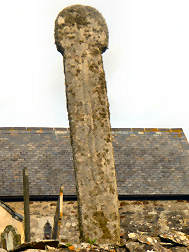
Leaving the Helston to Lizard Town road, Cury is halfway to delightful Poldhu Cove. There is not much to the village: thirty or forty houses, a primary school, St. Gunwalloe's church, a Methodist chapel, a football ground and allotments. I was there primarily to see and to photograph a tall Cornish Cross in the churchyard. You cannot miss it, standing tall beside the steps up to the mound that the church, as so often in Cornwall, stands on. While outside, look also at the two-stage tower with its stair turret. Entering the church, I was struck immediately by the porch where, under a wagon roof, is an elaborate decorated Norman doorway. Inside the church, what strikes you most are the ceilings: the nave has a sort of Cornish hammer-beam, the aisle a panelled wagon roof with carved bosses. There is a small south transept, connected to the chancel by a squint. Above is the exit to a missing rood loft. An elaborate font stands on pillars of the local serpentine. Pevsner describes it as "a variety of the Bodmin type". A Christ figure stands in a window opening.