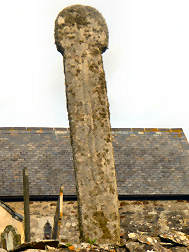
Cury, St. Gunwalloe's Church
Leaving the Helston to Lizard Town road, Cury is halfway to delightful Poldhu Cove. There is not much to the village: thirty or forty houses, a primary school, St. Gunwalloe's church, a Methodist chapel, a football ground and allotments. I was there primarily to see and to photograph a tall Cornish Cross in the churchyard. You cannot miss it, standing tall beside the steps up to the mound that the church, as so often in Cornwall, stands on. While outside, look also at the two-stage tower with its stair turret. Entering the church, I was struck immediately by the porch where, under a wagon roof, is an elaborate decorated Norman doorway. Inside the church, what strikes you most are the ceilings: the nave has a sort of Cornish hammer-beam, the aisle a panelled wagon roof with carved bosses. There is a small south transept, connected to the chancel by a squint. Above is the exit to a missing rood loft. An elaborate font stands on pillars of the local serpentine. Pevsner describes it as "a variety of the Bodmin type". A Christ figure stands in a window opening.
Cury Cornish Cross
Cury Church
Cury Church Nave & Chancel Ceiling
Photographs
More in Churches & Holy Sites
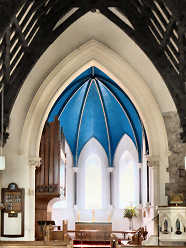
Devoran, St. John
A charming village, tucked quietly away from the busy Truro to Falmouth road, Devoran's present belies its past. Now a quiet and beautiful creek-side village, boasting a fair number of small-boat sailors, Devoran was once a very busy commercial port, shipping copper ore from mines on the Great Flat Lode around Redruth, linked by the horse drawn Redruth and Chacewater Railway, now part of a Coast to Coast trail. When you see how the creek has silted up - ironically with mine spoil - it is hard to imagine how any cargo boats ever got as far as Devoran - let alone Bissoe further upstream. St. John's Church was built in 1855-7; it is by J L Pearson, architect of Truro Cathedral. The style is restrained Early English, the first of the Gothic styles. Unusually the chancel is in the form of a semi-circular apse with lancet windows. Inside, the chancel is notable for its blue windows and ceiling. The white Caen stone pulpit has gothic niches containing holy figures. The white font is of three octagonal stages. There are simple pine pews. Stained glass is mostly grisaille. In the village, the Old Quay Inn has an enjoyable local atmosphere; food is fairly ambitious in the gastro-pub style. We have eaten there on several occasions and have always liked it. If there is no space in the pub's small car park, you should be able to park by the village hall at the start of Quay Street.
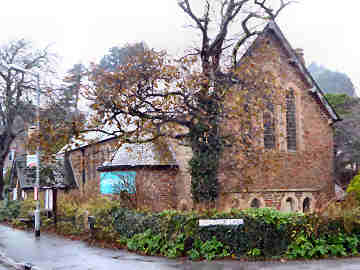
Downderry, St. Nicholas Church
On a soaking wet late November Saturday in 2018 I had an outing down south-east. I went to Millbrook first where I had hoped to look inside All Saints Church. Unfortunately it was firmly locked so I had to content myself with exterior photos, the church looking very gloomy and foreboding on such a dark and rainy day. Millbrook is quite an interesting village, centred as it is around a large lake. It has quite a history, having once had a fishing fleet, a tide mill, a gunpowder factory, a ropewalk, lime kilns, boat building and a large brewery. I took some dull photos but shall revisit in better weather. From Millbrook I continued west to Downderry, on the south coast just east of Seaton. There I not only found the church open but, outside, it had a banner proclaiming its opening and inviting me in. From the outside, St. Nicholas church, built in 1883-4 by J P St. Aubyn, is unusual, having at its east end a semi-circular apse. Inside there is only a nave, no aisles. Pevsner has few words about it, indeed only one - "dull". That view may be encouraged by the fact that there are no pews, only simple chairs. The pulpit is simple and made up of quite nicely carved bench ends. There is a good litany desk and chair and a quite attractive small organ, its pipes exposed. There is quite a good collection of varied stained glass but the most striking feature is the gilded reredos panels.
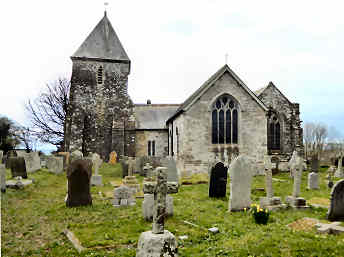
Duloe, St. Cuby & St. Leonard
Unusually, this entry appears on three different pages: here under churches but also on my antiquities page and my towns and villages page. The reason is that, for such a small village, there is so much variety of interest. The form of the church, while not unique to Cornwall, is most unusual. It consists of nave, north aisle, south transept and a strange leaning tower attached to the south transpept. The tower was once taller but the top stage was replaced by a pyramidal roof in the 19th century. It leans northwards at a sharper angle than the Leaning Tower of Pisa; fortunately the rest of the church holds it up. Inside, behind an elaborate parclose screen, bearing names of past rectors and vicars, and possibly made from the former rood screen, the chancel was built as the Colshull family chapel and contains Sir John Colshull's tomb, his recumbent effigy on it, and several elaborate slate memorials. The rood loft may be gone but the stair and loft doors remain. About 600 yards south of the church, alongside the road to Looe, is St. Cuby's Holy Well. What is claimed to be his original font was moved from the well site and now stands in the church. A few yards north of the church a sign directs you to Duloe Stone Circle, a small circle of 8 stones, believed by some once to have enclosed a cairn. There is a storyboard.