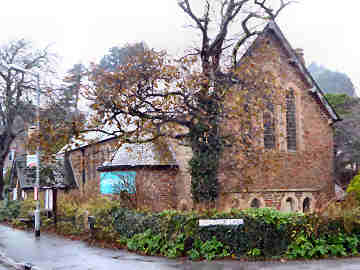
Downderry, St. Nicholas Church
On a soaking wet late November Saturday in 2018 I had an outing down south-east. I went to Millbrook first where I had hoped to look inside All Saints Church. Unfortunately it was firmly locked so I had to content myself with exterior photos, the church looking very gloomy and foreboding on such a dark and rainy day. Millbrook is quite an interesting village, centred as it is around a large lake. It has quite a history, having once had a fishing fleet, a tide mill, a gunpowder factory, a ropewalk, lime kilns, boat building and a large brewery. I took some dull photos but shall revisit in better weather. From Millbrook I continued west to Downderry, on the south coast just east of Seaton. There I not only found the church open but, outside, it had a banner proclaiming its opening and inviting me in. From the outside, St. Nicholas church, built in 1883-4 by J P St. Aubyn, is unusual, having at its east end a semi-circular apse. Inside there is only a nave, no aisles. Pevsner has few words about it, indeed only one - "dull". That view may be encouraged by the fact that there are no pews, only simple chairs. The pulpit is simple and made up of quite nicely carved bench ends. There is a good litany desk and chair and a quite attractive small organ, its pipes exposed. There is quite a good collection of varied stained glass but the most striking feature is the gilded reredos panels.
Downderry St. Nicholas on a wet November day
Downderry St. NIcholas, simple interior
Photographs
More in Churches & Holy Sites
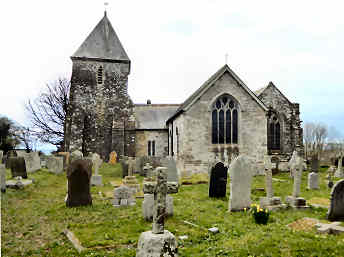
Duloe, St. Cuby & St. Leonard
Unusually, this entry appears on three different pages: here under churches but also on my antiquities page and my towns and villages page. The reason is that, for such a small village, there is so much variety of interest. The form of the church, while not unique to Cornwall, is most unusual. It consists of nave, north aisle, south transept and a strange leaning tower attached to the south transpept. The tower was once taller but the top stage was replaced by a pyramidal roof in the 19th century. It leans northwards at a sharper angle than the Leaning Tower of Pisa; fortunately the rest of the church holds it up. Inside, behind an elaborate parclose screen, bearing names of past rectors and vicars, and possibly made from the former rood screen, the chancel was built as the Colshull family chapel and contains Sir John Colshull's tomb, his recumbent effigy on it, and several elaborate slate memorials. The rood loft may be gone but the stair and loft doors remain. About 600 yards south of the church, alongside the road to Looe, is St. Cuby's Holy Well. What is claimed to be his original font was moved from the well site and now stands in the church. A few yards north of the church a sign directs you to Duloe Stone Circle, a small circle of 8 stones, believed by some once to have enclosed a cairn. There is a storyboard.
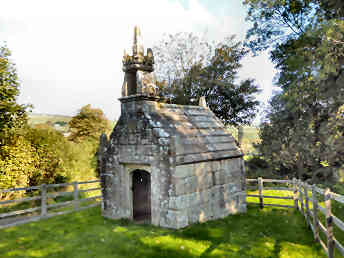
Dupath Well
Dupath Well (the Cornish "Fenton Hynsladron" means "Spring by the Robber's Path") is dedicated to St. Ethelred. The Well House is Grade I listed and built of local granite. It has a steeply pitched granite roof, at whose corners are heavily weathered pinnacles. A small bell turret has a highly elaborate canopy. A circular trough collects the spring water. Dupath Well House was probably built in about 1510 by the Augustinian canons of nearby St Germans priory. It is typical of the late 15th and early 16th centuries and its 'Celtic' style has much in common with well houses and chapels in Brittany and Ireland. At one time the spring water was believed to cure whooping cough, and it is thought to also have been used for baptisms. Legend has it that two Saxons – Colan (Cornish for heart or courage) and Gottlieb (Saxon for God's Love) – fought a duel there for a lady’s hand. Colan was killed outright and Gottlieb fatally wounded, though some versions say he died later of "impatience". The lady remained unmarried. On my way to Dupath Well I stopped in West Harrowbarrow. Here was once Western Shaft of Harrowbarrow Mine producing, amongst other minerals, silver. There are substantial remains of the old mine buildings, including two engine houses, one now part of a private house.
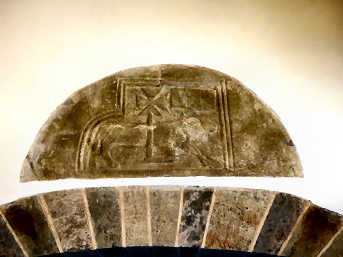
Egloskerry, St. Keria's Church
I chose an interesting day, at the end of August 2018, to visit Egloskerry's church. When I had been there in July the church was still being restored following a fire which, happily, mostly did only smoke damage. By happy coincidence my August visit coincided with Egloskerry's "Church Mouse" day. In addition to my usual photos of the interior of the church itself, I also took some thirty or more photos of mouse tableaux, most really quite amusing. I think my favourites were two life-size (human life-size, that is) tableaux, one of a mouse-vicar in his pulpit, the other of a bride and groom. I gathered from the small attribution cards by each tableau that most of the village must have contributed to the show. As to the church itself, the first thing to note is the height of the churchyard above the road, almost certainly suggested an Iron Age lann. The church's origins are in Norman times, evidenced by the north wall and south transept. An unusual feature, and probably of that date, is the tympanum over the blocked north door with a dragon snapping its own tail. The nave has a most attractive wagon roof with carved, but not painted, ceiling bosses. The simple font has cable decoration round the rim. The church was heavily restored in 1887 and stained glass dates from that time.