Herodsfoot, All Saints Church
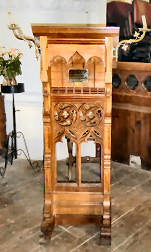
I visited this small early Victorian church in late April 2018. Oddly, the church and the former rectory are up a steep hill well above the village with nothing else nearby. Views from the churchyard are to the former mining village nestling below and across to densely wooded hills. The church, completed by John Hayward in 1850 is in the Early English Gothic style, a firm favourite of Victorian architects. So impressed was John Betjeman by the architecture that he was convinced it was actually by G E Street. As you enter, note the colourful door with its elaborate ironwork and gothic stone arch surround. Internally the church is essentially simple. The chancel is at a higher level than the nave and reached by four steps. There is a two-centred chancel arch. The font is 14th century and believed to be from St. Winnow; its cover is Victorian. The pulpit is of simple white stone; the lectern is of elaborately carved oak. Stained glass was redesigned in 2007.
Herodsfoot Lectern
Herodsfoot Church
Herodsfoot Glass
Photographs
More in Churches & Holy Sites
Hessenford, St. Anne's Church
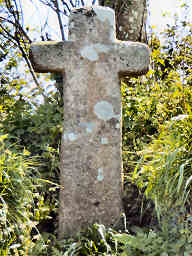
In early May 2018, I headed east to visit Herodsfoot. Feeling peckish I first continued along A38 as far as the Trerulefoot roundabout, where I indulged myself with Kernow Mill's early bargain two bacon rolls for �4, before heading for Hessenford. Had I not stopped at Kernow Mill, I would not have taken the lane by Bake Lane End and would have missed an impressive roadside Cornish Cross, shown neither on OS108 nor on Cornwall Council's Mapping Website. A church, St. Anne's Chapel, had been founded in Hessenford in the 15th century but this was closed in the Reformation in 1539. A new church was built in 1833 and extended in 1855. Architect was the ubiquitous J P St. Aubyn and the church is very much in his simple Early English Gothic style. The boot scrapers outside the porch are also clearly his. Inside is fairly simple: nave and two aisles with a raised chancel. Choir stalls are of oak. Behind the cloth covered altar is a reredos with mosaic inlay. Stained glass is by St. Aubyn's favourites, Clayton & Bell. The pulpit is of Caen stone and alabaster and features four carved figures in recessed arches and small columns of serpentine. The lectern is of carved oak with a carved statue of St. Joseph.
Hill, St. Sampson's Church
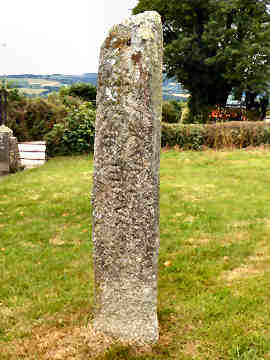
An unusual dedication, this; there are only two St. Sampson's in Cornwall, the other at Golant, north of Fowey, overlooking the Fowey River. South Hill lies about a mile south-east of Linkinhorne on the road to Callington. It consists of little more than a couple of farms, a few cottages and the church. After entering the churchyard through an ordinary but attractive iron gate (no lych gate here) look to your left to see a tall stone of no little significance, a Romano-British pillar, its Latin inscription reading "Cumregni/Fili Mauci" translating as "Cumregnus, son of Maucus." An early church by Cornish standards, St. Sampson's was re-dedicated in 1333. The usual Victorian restoration was by J D Sedding in 1872. The church consists of a buttressed three-stage tower with carved heads on its west door, a porch, south aisle and nave. The porch dates from the 15th century and has a wagon roof with attractive carved bosses. Inside, the church feels lofty and spacious. Chancel and south aisle also have wagon roofs. There are good stained glass windows and a couple of less common plain etched glass; the stained glass east window in the chancel, of the Decorated period, is particularly fine. The archway to the north transept (the Manaton Chapel) ia quite striking. The Norman font is of the St. Austell type, with corner faces, trees of life and animal carving. There is some nice tile work on the chancel floor.
Holywell
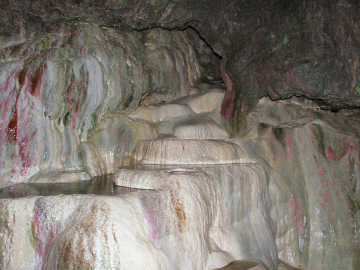
, The Two Holy Wells