Holywell
, The Two Holy Wells
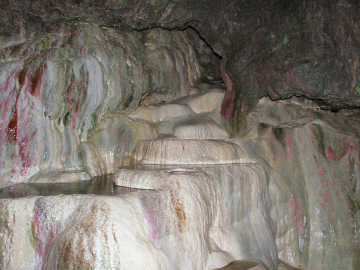
When a village is named Holywell you would certainly expect to find one holy well but this Holywell has two. One is in a cave at the northern end of the superb beach and is accessible only at lowish tide. The cave is just before the mussel covered rocks. Don't go straight in but climb the rocks on the left-hand side; beware, they are very slippery. You then come to the calcified rock steps, water running down and leaving small cool pools. The spring is at the top of the steps. If unsure of the location, ask Mike in the NT car park. The other is by the bottom pond on the golf course and is easily accessed by a path though Trevornick Holiday Park. This one was only rediscovered in 1916 and restored in 1936. The ground within the gothic enclosure is very wet. Experts argue about which site was the holy well that attracted medieval pilgrims. My guess is the golf course one as the coastline will have receded and the spring in the cave might only have become visible relatively late on.
The calcified steps of the spring in the cave
The restored holy well on the golf course
Photographs
More in Churches & Holy Sites
Illogan, St. Illogan
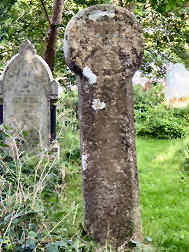
At the end of August 2017 I was in Illogan, which lies to the north of the A30, halfway between it and the coast at Portreath. To the south, the mass of Carn Brea is topped by the Basset Monument. I had previously only passed through Illogan, on my way either to the sea at Portreath or on walks from Portreath on the trail that runs through Tehidy Woods. On this occasion, however, I was there to visit the parish church of St. Illogan. I forgot that Saturday is wedding day so I had to kill some time by an expedition to the church at Chacewater which was of little interest except for its external stair turret. At Illogan church I looked for a Cornish Cross; I failed to find it as I had expected it to the south of the church when it actually lies to the north. I returned a week later and found it. What also stands to the north of the church is the intact tower of the previous (now demolished) church. The present church has no tower, just nave and two aisles. This was a church of the mining and banking Basset family and their monuments and memorials are everywhere, starting with a massive sarcophagus in the graveyard and continuing with handsome wall monuments to John Basset and his wife Frances, for whom several mines around the Great Flat Lode Trail are named. Also noteworthy is the Bodmin type font, standing on four columns and with heads at each corner.
Jacobstow, St. James Church
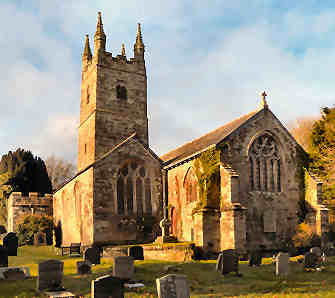
Towards the end of January 2019 I headed to the far North of Cornwall to visit a trio of churches new to me - St. James Jacobstow, St. Marwenne Marhamchurch and St. Andrew Stratton. First port of call was Jacobstow, where Frankie Franklyn had kindly arranged for the church to be open. I had been to Jacobstow previously, in May 2017, but had taken few photos then. This time I must have photographed just about everything in and out of the church, delightfully situated in a hollow in its own little Churchtown. When I was there snowdrops proliferated in the south-east corner of the churchyard and daffodils were almost ready to bloom. The striking late 15th century three stage tower has octagonal turrets and crocketed pinnacles. You enter the south porch to be greeted by a slate floor and a substantial door with en empty statue niche above it. The body of the church is probably late 14th or early 15th century and consists of nave and north and south aisles. The chancel was rebuilt in 1886 by Otho Peter of Launceston and complements the light and dignified interior. The nave ceiling is of closely spaced curved wooden rafters; the aisle ceilings are of the Cornish wagon type. In the quire simple wooden benches face each other across a tiled floor. The chancel floor is tiled, patterned and colourful. There are two altars; the High Altar is an Elizabethan communion table, the chancel chapel has a stone table with consecration crosses. Either side of the chancel east window are paintings, probably of the late 19th or early 20th century. On the east wall of the chancel is a good slate memorial to Susannah and Mary Clerk. The north door dates from the 15th century. The font is Norman and is a good example of the Altarnun type with a face at each corner. The pulpit stands on a white stone base and is made up from 16th century bench ends. A list of rectors begins in 1270.
Juliot
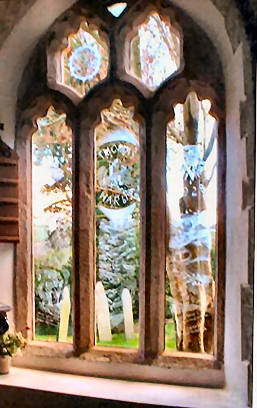
Hannett near Boscastle, St. Juliot Church