
Kenwyn, St. Keyne's Church
Kenwyn is on the northern outskirts of Truro and its church of St. Keyne is the mother church of the city. High above Truro, from the south side of the church there are views of the city, including viaduct, cathedral and river. I visited primarily to see St. Keyne's Holy Well, something of a disappointment since Elfin Safety has provided a metal cover through which you cannot see the water below. Originally consecrated in 1259, the church has undergone numerous extensions and alterations, most particularly in the 15th, 16th and 19th centuries. The church is approached by a lych gate under Church House which may date from the 14th century and may once have been a schoolroom. The church consists of Nave, South Aisle and Chapel. Chancel and aisle roofs are of the Cornish wagon variety. There is some good 19th century stained glass, some by Alexander Gibbs. As you approach the church you pass first, on a bank above you, a four sided tomb stone, then a war memorial and, next to that the Holy Well. Outside the south-east corner of the church a 1769 chest tomb is that of Agnes Jenney. To the NE of the church is the 1869 headstone of Joseph Emidy, a freed slave who became the first black African composer in England. Also to the NE is a pinnacle which was the top of the spire of St. Mary's church, now part of Truro Cathedral.
Kenwyn aisle ceiling
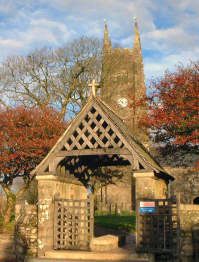
Kenwyn lych gate & church tower
St. Keyne's holy well
Photographs
More in Churches & Holy Sites
Kilkhampton
, St. James
Kilkhampton
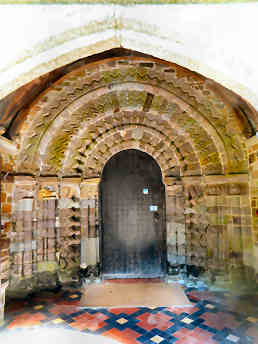
On the final Saturday in January 2019 I visited yet two more churches in the far north of Cornwall, St. James in Kilkhampton and St. Marwenna's in Morwenstow. I had previously been through Kilkhampton on many occasions and had visited the church briefly in 2016. On this occasion I spent some time in the church and took a good number of photos. I have little to add to the above piece about the church but I did note particularly the impressive full width rood screen, complete with rood, and the unusual stone altar with linenfold panelling behind and a gilded reredos above. There is a large plasterwork Royal Arms; confusingly Pevsner says it is the arms of Charles I but there is a "G" in the top left corner, suggesting George I. Attractive stained glass windows in the north aisle are late nineteenth century, mostly by Clayton and Bell; below one is a figure of a horseman.
Ladock, Church of St. Ladoca
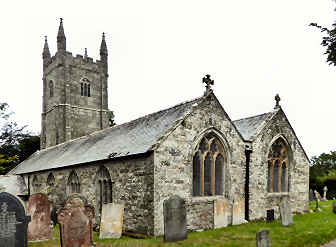
Driving through Ladock on the way to Truro you see only part of it, a village hall, the Falmouth Arms pub and a tiny post office and shop on a large car park. Pevsner devotes more than a page to St. Ladoca's church, up a steep path from the main part of the village on the former A39, and part of a small group including Ladock House (the former rectory) and the School. Just inside the churchyard is a tall War Memorial to your left. Ahead of you is the porch, to its left a tall three stage tower. The door from the porch into the church is quite striking, its four-centred arch surround set into rough stonework. Over the door is a primitive face. Inside the church consists of nave and south aisle. Both have conventional Cornish wagon roofs. The church was restored 1864 by G F Street; he embellished the chancel with an elaborate roof and an east window with shafts of polished serpentine. The altar has three painted panels. A parclose screen is very Gothic. The font is of sharply carved blue Catacleuse stone. The rood screen survives across nave and aisle. There are no medieval bench ends in place but a few were used to make up the lectern. The stained glass is some of the finest in Cornwall after St. Neot and is the best of Morris & Co's work in Cornwall.