Laneast Church
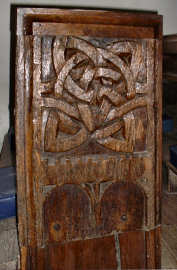
Encountered whilst walking the Inny Valleys Trail, Laneast (2 miles north of Altarnun) is another of those churches about which I have been able to find out very little. Even the name Laneast is the subject of dispute although I would take it to mean the enclosure or church of Justus or St. Justus. Outside are a roofless lych gate with filled-in coffen stile and a handsome four-hole cross by the porch. The porch has a fine wagon roof with carved bosses and a handsome doorway. The church was restored in Victorian times but not ruined as so many were by such restoration. Inside there is a good collection of medieval carved bench ends, some in poor condition, an intriguing Norman font with corbel heads at each corner, and some fragments of rare medieval glass in the east window. There is a carved screen and altar rail and some fine box pews in the south aisle chapel. Inside the door, to your left, is an early carved alms box. The 16th century pulpit was preached from by John Wesley on at least 6 occasions. Note the black marble plaque on the north wall of the nave commemorating internationally admired Cambridge University astronomer John Couch Adams, discoverer of the planet Neptune. John Betjeman greatly liked this church; I understand why, it is charming.
A carved bench end
More images of Laneast Church
The Norman font
Laneast Cornish Cross Green Man Bench End Colourful Owl Kneeler; another is of pheasants
Photographs
More in Churches & Holy Sites
Lanhydrock, St. Hydroc's Church
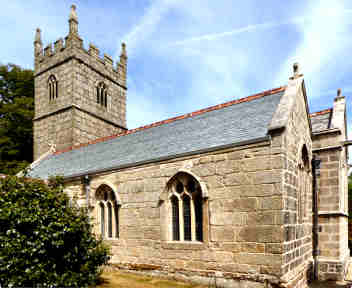
I must have been in the Lanhydrock Estate on dozens of occasions, mostly walking and dog walking with Jane. We have been around the house - both above and below stairs - have walked in the woodland and along the Fowey River, and have been around the gardens. However, until the very beginning of June 2019, I had never been in the church. A serious omission, since I found it quite unexpectedly interesting. There was a chapel of Bodmin Priory here by 1299 but the present church dates from the mid 15th century. It was, however, much restored in the 1880s by George Vialls of London. The three stage tower is noticeably offset from the nave. Pevsner thinks that the restoration of the 1880s may well have amounted to a virtual re-building. Ceilings are all of the Cornish Wagon type, including that over the chancel. Mosaic floor is of the 1880s by Burke and Co. Of the same period are the font and pulpit and a striking alabaster reredos of the Last Supper. Staained glass in the chancel east window is by Clayton and Bell, responsible for so much stained glass in Cornish churches. The unpainted Royal Arms is unusual in that it is of 1621 of James I. Of the several memorials, perhaps the most noteworthy is that 1689 of Lady Essex Specot, identified by Pevsner as of local Cornish workmanship. Outside, notice the tall Cornish Cross; not in original position or condition, it was re-erected here in the early 1800s.
Lanihorne, St. Rumon's Church
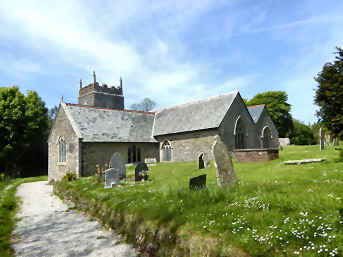
Towards the end of September 2017 I headed down to the Roseland to pay visits to three churches, at Philleigh, Ruan Lanihorne and Lamorran. My memories of Ruan Lanihorne [not to be confused with Ruan High Lanes on the St. Mawes road, or with the many Ruans on the Lizard] are of an early meeting there with Jane and of lunching there with her at the attractive and excellent King's Head. On this occasion I just had a coffee in the King's Head before taking a look at the church. Almost opposite the pub, and a bit below, is St. Rumon's church, mostly 14th century, with a tower of the late 17th century. Pevsner suggests that the font is 14th century, its cover made of wall plates of a previous roof. The pulpit is made of old bench ends and dates from around 1530. A monument of a praying priest is 13th century. Two wall-mounted boards carry the Ten Commandments. Where the ceiling springs from the nave wall there are several painted shields, one noting the restoration of 1866, others with unfamiliar coats of arms. When I was there a tapestry was on display, depicting "Historical Ruan." I was there again in mid-May 2019, taking the opportunity for a visit while Jane was lunching at the Roseland Inn at Phllleigh with her old school friends. It was the first time I had been inside the church and I had two surprises: the first to see such a collection of painted shields around the church at wall plate height, the second to discover later that Pevsner makes no mention of them.
Lanivet Church near Bodmin
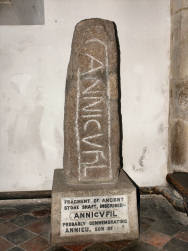
I found Lanivet church when walking the Saints Way. Its dedication is odd. The church's own guide leaflet suggests the dedication is to St. Nivet, daughter of Welsh King Brychan, or to St. Nevet, a Breton. On the other hand the Church of England officially declares it dedicated to St. Ia, who gave her name to St. Ives. Sadly the church is also a something of a disappointment; a handsome, typically Cornish, 15th century church in the Decorated style, ruined by over improvement by the Victorians, who scraped many frescoes and removed original stained glass. The reason to visit Lanivet church is the wonderful collection of stonework dotted around inside and out. By the porch is a 10th century 'hogback' tomb slab. Behind the church are a 13th century four-hole Cornish cross and a 10th century wheel cross. Inside the church are some fascinating memorials. One from the 5th or 6th century commemorates 'Annicu'. A portrait tomb slab in the vestry to a Courtney (perhaps related to the Earls of Devon) dates from 1560; another Courtney was added to it in 1632, surely not the brother the guide leaflet claims. A nearby tomb slab features gilded angels. Pulpit and reredos are both Victorian but attractive. St. Benet's Abbey