Linkinhorne, Stoke Climsland and Lezant
At the very end of December 2017 I made a trip down east to the general area between Launceston and Callington in order to take a look at the churches in Linkinhorne, Stoke Climsland and Lezant. I had been in the first two of these villages back in May 2007 when walking the Cornish section of the Land's End Trail heading west from the River Tamar at Horsebridge to Land's End. On this occasion I had gone to visit the churches in each village.
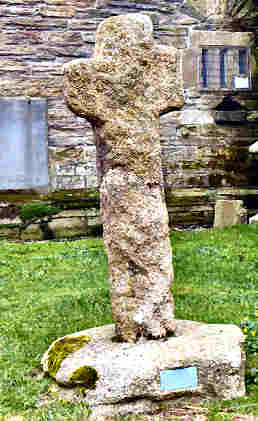
At Linkinhorne, the churchyard and path down to the church had suffered from December gales. Trees were down but had been chain-sawed back to give access to the church. I was pleased to see that the Cornish Cross by the lych-gate, the first Cornish Cross I ever saw, was still there and undamaged. Last time I was here I didn't look in the church but on this occasion I spent some time inside. Before entering, I noticed an old sundial on the tower wall by the porch. The other side of the porch is what appears to be a mass grave with four wheel crosses on it. Inside the porch the handsome doorway contains a door bound with iron straps. Inside the church the south and north aisles both have white wagon roofs with carved bosses. The nave has a wooden wagon roof. In the blue-ceilinged chancel are a handsome altar table, and a good priest's chair and lectern with seat (litany desk)). The granite font stands on a granite base and pillars. The woodwork of the pulpit and its stairs are both nicely carved. Oldest, and most interesting, is the pillar on the south wall bearing a fresco. I think the Church House Inn, opposite, has re=opened (mostly evenings) and appears to have received some good reviews, and I was glad to see that it no longer appears to be for sale.
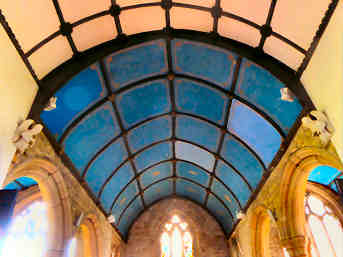
Next I took a look around Stoke Climsland. I parked by the green and walked down past the village hall and attractive post office to take a look at the church. As at Linkinhorne, the interior of the porch is striking with a fine slate tombstone dedicated to one Thomas Calvert who died in 1781. Again, as at Linkinhorne, the very Cornish ceilings in the south aisle and chancel catch one's eye with their blue panels and carved bosses.
Finally, I paid a visit to the church in Lezant. This one is a little unusual in that it stands on a raised site, some 6 feet higher than the surrounding road. The very first thing to catch one's eye is the lych gate where, remarkably the side walls are of linen-fold panelling, perhaps previously in the church but more likely from a local grand house. The porch has a wagon roof with carved bosses and this is repeated by ceilings inside the church.
Stoke Climsland Chancel Ceiling
Linkinhorne Cross
Lezant Lych Gate Linenfold Panelling
Photographs
More in Churches & Holy Sites
Liskeard, St. Martin's Church
In early March 2019 I headed down east again, this time to visit St. Lalluwy's church in Menheniot village and St. Martin's church in the major town of Liskeard The most striking feature of St. Martin's is the way it stands out on its hill, south of the town centre. The next thing that strikes you is how ugly the church is on the outside, its dark stone repelling rather than enticing. Before entering do first look for the two Cornich Crosses in the churchyard: one you pass on your way from the south lych gate to the church entrance in a two-storey height porch, the other is in the graveyard on the south east side of the church. What I missed was the Consecration Crosses on the outer waslls of the north and south aisles, apparently unique in Cornwall. Except for services the church is normally locked tight so I was fortunate to arrive at the same time as a churchwarden, who not only allowed me in but also provided some helpful information, including the fact that St. Martin's is Cornwall's second largest parish church after St. Petroc's in Bodmin. The interior has a lofty and airy feel though the chancel, separated by a chancel arch, is lower than the nave. With one exception, the east window, all chancel windows are original Perpendicular. A fragment of medieval glass is displayed in a niche in the south aisle. The plain font is probably 16th century; its cover, probably Victorian, is very elaborate. In the chancel both altar and reredos are elaborate, the latter quite colourful. A royal coat of arms is of George II. The elaborate organ, its pipes colourful, is topped by a trumpeter. A nicely carved lectern stands by the quire parclose screen. The octagonal pulpit, made in 1646 by Peter Short, is beautifully carved.
Little
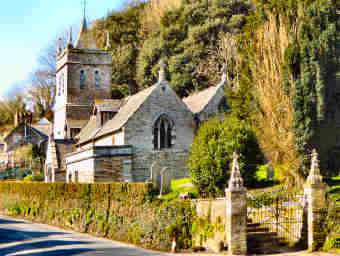
coming to it for the first time from the Wadebridge direction, by the time you see the church you are probably too late to pull into the village hall car park. Coming from Padstow, you are so busy looking for traffic approaching the bridge that you probably don't even spot the church. A great pity because it is a delight and well worth an extended visit. Attractive from the outside, with its tower,.porch, nave, aisle and small south chapel, it is the inside which really impresses. Most striking are the two colourful and highly detailed rood screens. Altar, reredos and stained glass in a south window also impress and there are some fine carved bench ends - one topped by a pheasant - good memorials and an unusually simple clock. A colourful royal coat of arms is set into the floor and a slate wall plaque lists rectors and patrons of "St. Petroc Minor of Nansfounteyn, Little Petherick" Despite Pevsner, I believe thet Little Petherick church is well worth going out of your way for. Or, if you are walking the Saints Way, it is handily right alongside the first stage from Padstow.
Looe, St.Martin-by-Looe and Morval
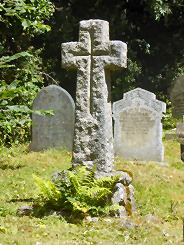
The town of Looe has no Anglican church of its own. Instead there are two a little way north of the town, St. Martin about a quarter mile north, Morval a mile or so further. St. Martin's church is dedicated to St. Keyne and St. Martin. The south gate is simple but attractive. The doorway from the porch is late Norman zig-zag. The church is probably basically 13th century and the tower 14th and 15th. Inside, the unusual font is decorated with a tree of life. Altar rails are probably early 17th century as is the parclose screen. Monuments include a tomb chest of 1590 and a wall tablet of 1667 to Walter Langdon and his wife. There are some carved bench ends, probably Victorian; original bench ends seem to have been used in making one screen, the other elaborately carved screen is presumably Victorian. There is some William Morris glass. In the graveyard is a Cornish Cross of dubious authenticity. Morval church is dedicated to St. Wenna. Seen from the road it is low but most attractive, standing, as does the house to which it belonged, in a small landscaped park and with rhododendrons in the churchyard. Inside is an octagonal 13th century font, a seventeenth century alms box and a 1637 monument to Walter Coode. More Looe, St. Martin and Morval.