Looe, St.Martin-by-Looe and Morval
The town of Looe has no Anglican church of its own. Instead there are two a little way north of the town, St. Martin about a quarter mile north, Morval a mile or so further. St. Martin's church is dedicated to St. Keyne and St. Martin. The south gate is simple but attractive. The doorway from the porch is late Norman zig-zag. The church is probably basically 13th century and the tower 14th and 15th. Inside, the unusual font is decorated with a tree of life. Altar rails are probably early 17th century as is the parclose screen. Monuments include a tomb chest of 1590 and a wall tablet of 1667 to Walter Langdon and his wife. There are some carved bench ends, probably Victorian; original bench ends seem to have been used in making one screen, the other elaborately carved screen is presumably Victorian. There is some William Morris glass. In the graveyard is a Cornish Cross of dubious authenticity. Morval church is dedicated to St. Wenna. Seen from the road it is low but most attractive, standing, as does the house to which it belonged, in a small landscaped park and with rhododendrons in the churchyard. Inside is an octagonal 13th century font, a seventeenth century alms box and a 1637 monument to Walter Coode. More Looe, St. Martin and Morval.
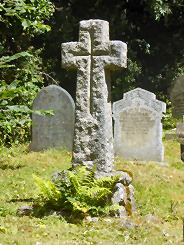
Morval Churchyard Cross
Morval Church
St. Martin Porch Doorway
Photographs
More in Churches & Holy Sites
Ludgvan, St. Ludgvan & St. Paul
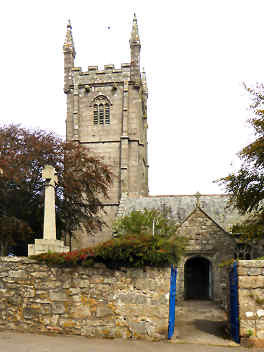
I first encountered Ludgvan's church only in passing in 2006. My mid-year project was walking St. Michael's Way from Lelant to Marazion and St. Michael's Mount. I must confess that, at that time, I had not yet developed an interest in Cornwall's churches so I passed by, lingering only for a photograph of what I then wrongly thought was Ludgvan's only Cornish Cross. I eventually returned at the very end of August 2019 for a thorough look at the church and first discovered that there were, in fact, three crosses. After the crosses, the first thing to note is the porch. This has an unusual four-light window in its east side and a wagon roof with carved wooden bosses. Apart from the porch and the tower, there is little that is original as the church was heavily restored in 1912 by H J Wadling, an associate of J. P. St. Aubyn. The result is an unexpectedly severe interior. The font is a 19th century copy of a Norman design. There are monuments and memorials to John South and family, 1636; to Christopher Borlase, 1749; to antiquarian William Borlase who was rector here 1720 to 1772; and to the parents of Sir Humphrey Davy who invented the miner's safety lamp. Quire stalls are surprisingly colourfully decorated.
Luxulyan, St. Ciricius & St. Julitta Church
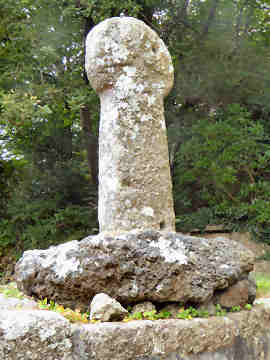
As with Lanlivery, I was first in Luxulyan in 2006 when I passed through when walking the Saints Way from Padstow to Fowey. On that occasion I was walking a section, linking the two alternative southbound routes, between Lanlivery and Luxulyan. Passing the church, I noted a fine Cornish Cross on the wall by the lych gate. Also in the churchyard is an ancient sundial. I revisited Luxulyan in August 2018, this time to view and photograph the interior of the church. Luxulyan's church certainly existed in the mid 12th century, as a chapel of Lanlivery, and was rebuilt in the 15th and 16th centuries. The first thing of note is the porch, unusually elaborate for Cornwall, with a traceried, tunnel-vaulted ceiling. The north aand south aisles retain their original wagon roofs with carved bosses. Noted Cornish architect Silvanus Trevail worked on the church early in the 20th century. The chancel screen is by him and the stained glass of the east window is his memorial. The font is Norman, of the Bodmin type and boldly carved with heads at each corner. Fine monuments include that (1728) to vicar Joseph Carveth. The pulpit, wood over granite, is carved with coats of arms. There is an elaborate carved screen above the internal entrance to the tower. Two 17th century chairs stand in the chancel. The altar has some nice carved woodwork. A marble wall memorial is to members of the local Rashleigh family. An odd figure holding a shield is set into a granite wall. Nearby, you can enjoy a lovely walk in the Luxulyan Valley. Park at Pont's Mill, walk up the valley on a well made track following the Par River, and passing on your left Mid Cornwall China Clay Dries, to the Treffry Viaduct. Go under it and climb the steep path on your right to reach the beginning of the viaduct. Then follow the former tramway south, past Carmears Waterwheel, back down to Ponts Mill.
Mabe
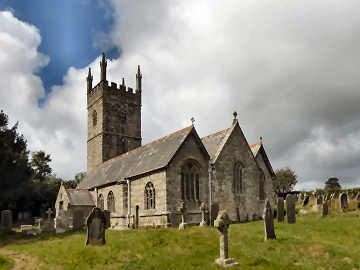
The Mabe in question is Mabe Burnthouse, a couple of miles from Falmouth. Oddly Mabe Church is almost a far from Mabe as Mabe is from Falmouth. Approached from a big car park down a long driveway and through a large lych-gate, the church overlooks Argol Lake, one of a pair of reservoirs. The church consists of a three stage tower, a nave and two aisles. Near the porch are two surprises, neither shown on OS103. First is a fairly massive 8-foot tall standing stone, second is a fine example of a small Cornish Cross. Disappointingly, when I was there the church was locked, so I must again rely on Pevsner who found much to admitre here, particularly the fine porch , its doorways having cable decoration and repeated lily motifs. Inside, either side of a modern reredos are fragments of a 15th century alabaster altar.