Luxulyan, St. Ciricius & St. Julitta Church
As with Lanlivery, I was first in Luxulyan in 2006 when I passed through when walking the Saints Way from Padstow to Fowey. On that occasion I was walking a section, linking the two alternative southbound routes, between Lanlivery and Luxulyan. Passing the church, I noted a fine Cornish Cross on the wall by the lych gate. Also in the churchyard is an ancient sundial. I revisited Luxulyan in August 2018, this time to view and photograph the interior of the church. Luxulyan's church certainly existed in the mid 12th century, as a chapel of Lanlivery, and was rebuilt in the 15th and 16th centuries. The first thing of note is the porch, unusually elaborate for Cornwall, with a traceried, tunnel-vaulted ceiling. The north aand south aisles retain their original wagon roofs with carved bosses. Noted Cornish architect Silvanus Trevail worked on the church early in the 20th century. The chancel screen is by him and the stained glass of the east window is his memorial. The font is Norman, of the Bodmin type and boldly carved with heads at each corner. Fine monuments include that (1728) to vicar Joseph Carveth. The pulpit, wood over granite, is carved with coats of arms. There is an elaborate carved screen above the internal entrance to the tower. Two 17th century chairs stand in the chancel. The altar has some nice carved woodwork. A marble wall memorial is to members of the local Rashleigh family. An odd figure holding a shield is set into a granite wall. Nearby, you can enjoy a lovely walk in the Luxulyan Valley. Park at Pont's Mill, walk up the valley on a well made track following the Par River, and passing on your left Mid Cornwall China Clay Dries, to the Treffry Viaduct. Go under it and climb the steep path on your right to reach the beginning of the viaduct. Then follow the former tramway south, past Carmears Waterwheel, back down to Ponts Mill.
Luxulyan Cornish Cross
Luxulyan Church
Luxulyan Pulpit Panels
Photographs
More in Churches & Holy Sites
Mabe
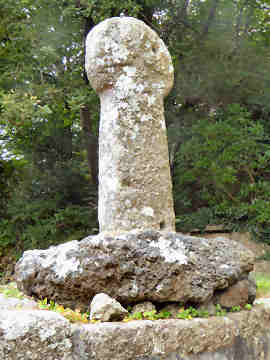
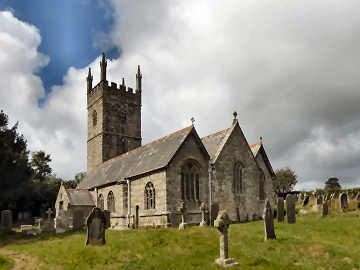
The Mabe in question is Mabe Burnthouse, a couple of miles from Falmouth. Oddly Mabe Church is almost a far from Mabe as Mabe is from Falmouth. Approached from a big car park down a long driveway and through a large lych-gate, the church overlooks Argol Lake, one of a pair of reservoirs. The church consists of a three stage tower, a nave and two aisles. Near the porch are two surprises, neither shown on OS103. First is a fairly massive 8-foot tall standing stone, second is a fine example of a small Cornish Cross. Disappointingly, when I was there the church was locked, so I must again rely on Pevsner who found much to admitre here, particularly the fine porch , its doorways having cable decoration and repeated lily motifs. Inside, either side of a modern reredos are fragments of a 15th century alabaster altar.
Mabyn
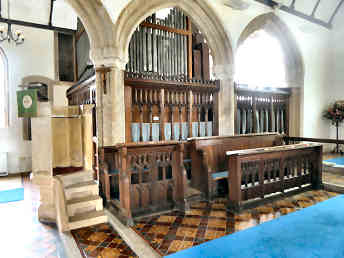
I have been in St. Mabyn on several occasions: in the course of walks, solo and with Jane; for lunch on several occasions at the excellent St. Mabyn Inn; and to photograph the church in September 2016 and in April 2019. Before entering, do look out for the Cornish Cross at the eastern end of the churchyard. The plan of this largely 15th and 16th century church is typically Cornish with nave, two aisles and a three stage pinnacled tower. As you enter, you are greeted (or, at least, I was) by a colourful St. Mabena banner where you might expect St. Christopher. Inside are three fine wagon roofs with carved bosses. Rood stairs remain intact though, of course, the rood loft is long gone. The font, which Pevsner suggests is of Purbeck stone, dates from Norman times. Sadly, chairs have replaced the pews so, in this instance no chance of any carved bench ends, though the choir stalls are attractive. The Norman font is of Purbeck stone. An attractive pulpit may be of Portland stone. A credence table has a 16th century panel which Pevsner suggests is from an earlier pulpit, though the church's website disagrees. The east window, though Victorian, is in 16th century style and there are fragments of medieval glass in the aisle windows.
Madron, St. Maddern
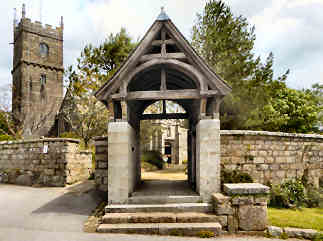
Madron lies a little to the north of Penzance, just off the road to Bosullow Common, Lanyon Quoit, Men-an-Tol and Nine Maidens Common. As you drive through you are hard put to decide where to park but, if you head for the church and school, there is ample parking. There is more here than just an impressive church, within the churchyard are two impressive memorials - a great mausoleum to Rose Price and a globe-bestriding statue with an unreadable dedication - and two Cornish Crosses (there are two others nearby). Inside, the roofs have carved wooden bosses, there are two attractive screens and the south chapel has an alabaster plaque of saints and some ancient bench ends topped by beasts. High on a wall is the "Nelson Banner", carried in the procession that celebrated Nelson's victory at Trafalgar. In addition to the two Cornish crosses in the churchyard, there are two others nearby, one in a field to the south of the church at 45436/31503, the other on a lane near Madron Well and Chapel, at about 44512/32541. Well and Chapel are worth visiting, the former a spring identified by trees adorned with strips of cloth, interceding for family or friends, the latter substantial but roofless. Both sites are cared for by the admirable Cornwall Heritage Trust. Nearby is the National Trust's lovely Trengwainton Garden.