Maker and the Rame Peninsula
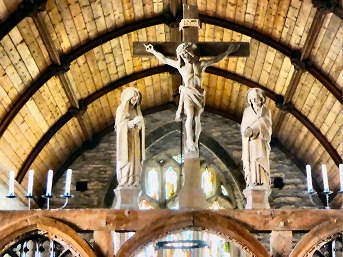
In July 2017 I had an outing to the Rame Peninsula in far south-east Cornwall. My purpose was to visit churches in five villages altogether: Antony, St. John, Sheviock, Maker and Rame. I found the churches in Antony and St. John closed but found plenty of interest in the other three. Maker church stands isolated, except for a lodge cottage, high above Mount Edgcumbe Park. It is a substantial building with pinnacled tower, nave, two aisles and an additional Edgcumbe family chapel attached to the south aisle. Ceilings are of the Cornish "wagon" type; the nave one being quite elaborate. The Norman font was originally at St. Merryn (I wonder how it came here). Best of the Edgcumbe monuments is that of 1752 to Richard Lord Edgcumbe. In the nearby former Maker Barracks a Nissen hut houses the excellent Canteen restaurant; we have enjoyed meals there on many occasions. There is ample parking near Maker church and access to the vast Mount Edgcumbe Estate, where we have enjoyed many good walks and the occasional meal in the Edgcumbe Arms, the Orangery or the cafe by the house. Rame church is a little less isolated; nearby are the Old Rectory and Rame Barton and Penmillard farms. The church is built of rough slatey stone and, unusually for Cornwall, has a broach spire. An Ashton memorial dates from 1677. Screen and wooden pulpit are well carved. A rood, relatively unusual for Cornwall, stands atop the screen. Not far away, at the furthest point the Rame Peninsula, a small Norman chapel stands on a 330 foot point with superb views in both directions. Sheviock church is in the middle of the village, opposite it the Rectory. Much of the building is of the 13th and 14th centuries but, unfortunately the tower has been grey plastered. Inside, tombs of a knight and a lady, probably of the Courtenay family, are late 14th century, A brass cross commemorates Alphonse Charles de Morel. There are some fairly elaborate carved bench ends.
The rood in Rame church
Maker pulpit
Sheviock church bench ends
Photographs
More in Churches & Holy Sites
Manaccan, St. Manacca's Church
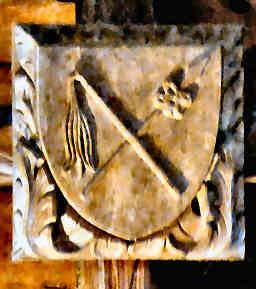
Although the Lizard is the best part of an hour and a half's journey from Wadebridge I decided it was high time I visited and reported on several churches down there. I was in Manaccan and St. Anthony in mid February 2019. In addition to these I propose to report on Mawgan in Meneage and St. Martin-in-Meneage. An odd word "Meneage", it means "Monk's land" so would have been the property of a monastic settlement. Manaccan is a pleasant small village on a hill not far from the eastern end of Gillan Creek. At one time the village had pub, shop and post office. All closed in 2014 but, in a remarkable show of co-operation, the villagers got together to save and re-open the pub. After some more ups and downs, the New Inn is open again and is a pleasant spot, serving good food; on an adjacent wall are mounting steps. A couple of hundred yards away is St. Manacca's church. The first thing you notice is a fig tree growing out of the west end of the south wall, believed to be 250 years old and surely unique in Cornwall. The next thing you notice is the unusual south doorway, essentially Norman although the arch above has been remodelled. Inside is a plain font, believed by Pevsner to be a late-medieval copy of a Norman original. Stained glass appears medieval but is late Victorian. A simple pulpit may be 20th century. In the chancel two chairs are made from 15th century timber, taken from the former rood screen. A surprise is the carved and colourful ceiling bosses, undoubtedly modern since they include a butterfly and a terrier.
Marhamchurch, St. Marwenna's Church
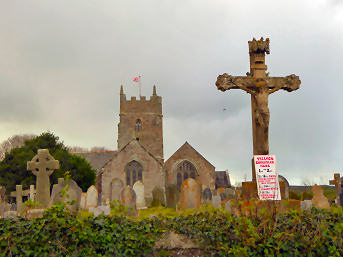
Towards the end of January 2019 I headed to the far North of Cornwall to visit three churches - St. James Jacobstow, St. Marwenna Marhamchurch and St. Andrew Stratton. Second port of call was Marhamchurch. I had been in the village before, when walking a route from Bude, via the canal and Helebridge, to Dexbeer, Burmsdon and Tamar Lakes, but I had not previously been inside the church. Some Norman work survives but the greater part of the church is of the 14th and 15th centuries. The south porch has a typical Cornish roof with some carving; its floor is made of squares of small upright slates, reminiscent of Lutyens. The door, of studded vertical planks, with massive iron hinges, is unusual and very sturdy. Inside, the impressive nave has a 19th century Cornish wagon roof, while the north aisle roof is mostly of the 15th and 16th centuries. The seating in the quire, though probably Victorian, is attractively carved. The font is believed to be a late 19th century re-cutting of a Norman original. The pulpit dates from the 17th century. In the chancel is a small Cornish Cross, probably an early original. An unusual brass memorial to Maria Scott Maskell is set into a worn stone slab. There is quite a lot of attractive stained glass. mostly of the mid-19th to early 20th century. Below the chancel step are four 17th century slate memorial slabs. There are no Cornish Crosses in the churchyard, much to my disappointment.
Martin-in-Meneage
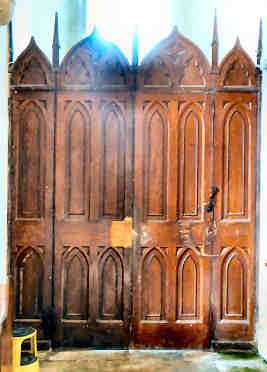
On a sunny Saturday in late February I headed down to the Lizard peninsula to take a close look at a couple of churches, that of St. Mawgan in Mawgan-in-Meneage and that of St. Martin-in-Meneage. St. Martin's church is south of the village but at St. Martin I had a pleasant surprise: I knew that, remotely situated, the church would be locked and I was just planning on exterior photos. However, while I was sitting there enjoying my soup and sandwich before leaving, who should arrive but a lady churchwarden, so I was able to take my photographs inside as well. The tower is original, of the 15th century, but the rest of the church was rebuilt after a fire in 1830; note the use of serpentine blocks in the external walls. As the church is essentially a simple rectangle it feels more like a Methodist chapel of the period. Entrance is through an unusual blue door in the tower. One font is perhaps the oldest thing about St. Martins, while the other is Norman with corner shafts and foliate decoration. Pews are simple unornamented benches, relieved by a few colourful kneelers. There are a couple of attractive hangings, one of the Lord's Prayer, the other a pictorial of the village by local schoolchildren. In the churchyard I noticed a white camellia and a sundial minus its gnomon.