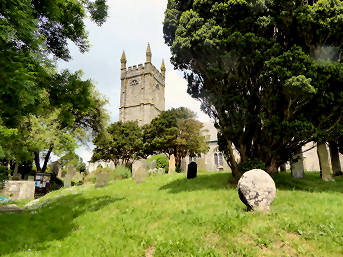
Mawnan, Mawnan Smith, Budock & Constantine
In early June 2017 I made a couple of expeditions down to the other side of Falmouth. I was actually looking for a memorial stained glass window by Glenn Carter, commemorating someone named Steve. Jane's sister, who spotted the item in a newspaper, thought it was in Mawnan Smith church. This is a Victorian church just off the road to Mawnan. Although there was some passable Victorian glass, the Glenn Carter window was not there. I wonder where? Except for an odd little bell tower at the west end, the church was otherwise of little interest. On to Mawnan, where the first thing to take your notice is the lych gate, complete with coffin rest and a Cornish inscription which translates as "It is good for me to draw nigh unto God". The next thing to strike me was the lovely view from the south side of the churchyard over the mouth of the Helford River to Nare Head. Inside is a 15th century octagonal Font, a 17th century Alms Box and part of a 15th century Screen. There is a Cornish Cross in the churchyard. I was in the area on a couple of occasions and also visited churches at Budock and Constantine. At Budock there are three Cornish Crosses and some interesting tomb markers. There are, unusually, two lych gates; the rear one has collections of primitive lawn mowers and watering cans. The church at Constantine has panelling from a former screen, a simple font and a finely carved pulpit. Rood stairs are still in place.
Mawnan
Mawnan Smith
Budock
Constantine
Photographs
More in Churches & Holy Sites
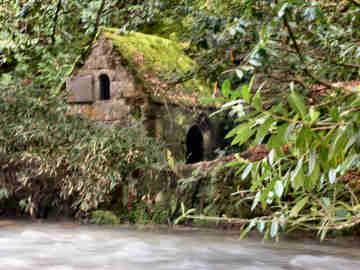
Menacuddle Holy Well, near St. Austell
As so often with Cornish names, you can take your choice of what this one means. A. L. Rowse, who was born just a couple of miles away, was sure Menacuddle means Rock Well, Craig Wetherhill opts for Hillside Thicket, and Cheryl Straffon goes for St. Guidel's Well. It would be nice to think it was the latter so that it could truly be a holy well. Whatever it means, it seems to be a fact that the well house was built in the 14th or 15th century, was incorporated in a pleasure ground by Charles Rashleigh in 1820 and was restored by Admiral Sir Charles Sawle in 1921 and given to St. Austell as a memorial to his only son, lost in action at Ypres in 1914. It is thought that a chapel (sometimes referred to as a baptistry) stood next to the well house, in which a spring still rises. I made a walk of it, parking at Wheal Martyn and walking a clay trail to the edge of St. Austell. If you are coming by car, you leave St. Austell on B3274 towards Bodmin, pass under the railway viaduct and take the first little turning on the left; beware, it's awkward to get out again. It is a peaceful spot, the well house reached by a small footbridge over the White River (or St. Austell River) which rises in the clay fields and has a lovely soft blue-green colour. A 'Druid's Seat' on the opposite bank was presumably made for Sir Charles Rashleigh.
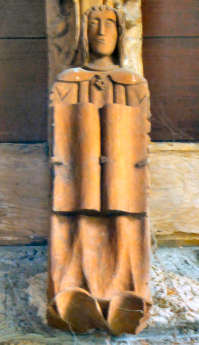
Meneage, St. Mawgan's Church
On a sunny Saturday in late February I headed down to the Lizard peninsula to take a close look at two churches, that of St. Mawgan in Mawgan-in-Meneage and that of St. Martin-in-Meneage. The daffodil festival.had been held over for an extra week at St. Mawgan; delightful as it was, I had hoped for a clear un-daffodilled view of the interior of the church, so I shall have to visit again at a later date. At. St. Martin I had a pleasant surprise. I expected that, remotely situated, the church would be locked and I was just planning on exterior photos. However, while I was enjoying my soup and sandwich before leaving, who should arrive but a lady churchwarden so I was able to take my photographs inside as well. St.Mawgan's church is in a fairly isolated position away from the main part of the village. The extensive graveyard, raised as ir is, suggests a lann. The three stage tower is of the 15th century but thwe body of the church is mostly 13th century and conssts ofnave, north aisle and north and south transepts, the latter linked to the chancel by a squint. There are Cornich wagon roofs to the porvh, nave, north transept and north aisle, the latter richly carved. There are two fonts in the south transept, one circular, the other hexagonal. In the south rtansept is a fine recesed tomb with the marble figures of Sir Roger Carminow and his wife. There are several good monuments to members of the Vyell family. In the north aisle the wagon roof the wagon roof is supported by angels and has a variety of carved bosses. The lectern is a delight, of red and green serpentine, found only on The Lizard. Stained glass is late Victorian.
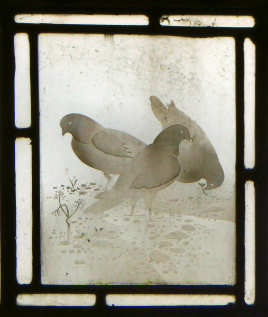
Menheniot, St. Lalluwy's Church
In early March 2019 I headed down east again, this time to visit St. Lalluwy's church in Menheniot village and St. Martin's church in the major town of Liskeard. I only discovered Menheniot [the name means Hyniet's land according to Craig Weatherhill, St. Neot's place according to Julyan Holmes - take your choice] towards the end of April 2016. Jane wanted to see an exhibition of Norman Hartnell's designs and materials, being held in the church. I drove her there and quite liked the look of the village so, a week later, I had an outing to explore the village. However this item is about the church, unusual for Cornwall in that it boasts a spire. The church was restored in 1866 by J P St. Aubyn and further restored by G H Fellowes Prynne in 1922. Perpendicular windows are mostly of the 15th and 16th centuries. There is good stained glass but, to my mind, the outstanding glass is the engraved glass, depicting a Cornish Cross and grains of wheat, by David Pearce, set in the south wall of the south aisle. The pulpit is from 1891 by the noted Harry Hems of Exeter and is of intricately carved dark wood. Set in the floor, at the base of the pulpit, is a beautifully engraved brass inscription of 1386 to Sir Ralph Carmynow and there are several monuments to members of the Trelawney family, below one of which are a pair of handsome chairs. Seating in the quire is a carved delight. A large black marble slab has superb lettering and remembers Augustine Question (that's what it says!). The font is simple, square with a central pillar, four columns supporting it and with a carved Victorian cover.