Menheniot, St. Lalluwy's Church
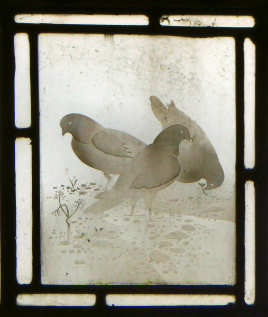
In early March 2019 I headed down east again, this time to visit St. Lalluwy's church in Menheniot village and St. Martin's church in the major town of Liskeard. I only discovered Menheniot [the name means Hyniet's land according to Craig Weatherhill, St. Neot's place according to Julyan Holmes - take your choice] towards the end of April 2016. Jane wanted to see an exhibition of Norman Hartnell's designs and materials, being held in the church. I drove her there and quite liked the look of the village so, a week later, I had an outing to explore the village. However this item is about the church, unusual for Cornwall in that it boasts a spire. The church was restored in 1866 by J P St. Aubyn and further restored by G H Fellowes Prynne in 1922. Perpendicular windows are mostly of the 15th and 16th centuries. There is good stained glass but, to my mind, the outstanding glass is the engraved glass, depicting a Cornish Cross and grains of wheat, by David Pearce, set in the south wall of the south aisle. The pulpit is from 1891 by the noted Harry Hems of Exeter and is of intricately carved dark wood. Set in the floor, at the base of the pulpit, is a beautifully engraved brass inscription of 1386 to Sir Ralph Carmynow and there are several monuments to members of the Trelawney family, below one of which are a pair of handsome chairs. Seating in the quire is a carved delight. A large black marble slab has superb lettering and remembers Augustine Question (that's what it says!). The font is simple, square with a central pillar, four columns supporting it and with a carved Victorian cover.
Menheniot Etched Glass
Menheniot Linenfold Panelling
Menheniot Carved Pulpit
Photographs
More in Churches & Holy Sites

Merther and Eglosmerther
These tiny hamlets lie to the east of the Tresillian River, not very far from Truro. It is very strange countryside with almost none of the narrow lanes actually going anywhere of any consequence, most simply ending at one of several rivers, Fal, Truro and Tresillian. The names of these two places are a little odd. Merther, in both old Cornish and Welsh, means Martyr, so Eglosmerther is the church (or perhaps burial place) of a martyr. But who was the martyr? Perhaps St. Cohan to whom the ruined church is dedicated From 1620 the manor of Merther has been part of what is now the vast estate of the Boscawens, Lords Falmouth, the Tregothnan Estate. The ruined church at Merther (oddly, there is no church at Eglosmerther, only a Methodist chapel) was dedicated to St Cohan or Coan; it is said that he was martyred but I can find no trace of him. In 1904 a new church was built at Tresillian Bridge and the 12th century Pentewan stone font, the 17th-century polygonal oak pulpit, the bells and the statue of St. Anthony were moved there. St. Cohan's at Merther became a mortuary chapel but fell into disuse and gradually deteriorated; now only the tower and some walls are substantially intact. Apparently the old church bells were melted down in 1970 and made into 2 new bells for St Clement church, just over the Tresillian River. To the east of Merther church, in a field called St Coan (grid reference SW866448), is the site of St Cohan's Chapel and well. The chapel was destroyed in about 1750 and by 1860 the last stones removed. Eglosmerther is a Grade II listed farm building on the site of a former manor house, recorded as being held in 1311 by the Reskymers. It is now a farm, and the farmhouse including the courtyard wall, was a rebuilding in 1806–8 of an earlier house.
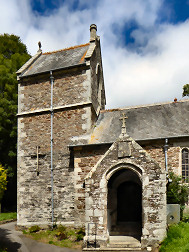
Mevagissey, St. Peters
Mevagissey is a village of two distinct parts. The picturesque harbour is surrounded by attractive cottages on one side, by commerce on a second with restaurants, cafes and shops, and on the third by buildings relating to the surprisingly large fishing fleet. Behind the harbour is a narrow through street. Leading off it are largely residential streets, some of them steep and narrow. Church Hill heads steeply north-west up to St. Peter's Church, an awkward spot for worshippers with a steep climb and little or no parking. I thought traffic wardens up here unlikely so I parked on a yellow line by the most convenient entrance to the churchyard. At some point the tower collapsed; it was rebuilt with, for Cornwall, un unusual saddleback roof. The west wall has a blocked doorway with a tympanum bearing the figure of (I think) a horse. Inside is a handsome pulpit, carved with different scenes on each face, an elaborate memorial to Otwell Hill with recumbent figures in relief, another simpler in slate to the Dart family with 10 kneeling figures. There is also a nicely carved Norman stone font. To judge by the bootscraper outside the porch, the church was probably restored by J P St. Aubyn in the 19th century. All in all, I felt that St. Peter's, Mevagissey was of sufficient interest to justify a steep walk up the hill. If interested, you may be able to park by the harbour; there is ample parking elsewhere.
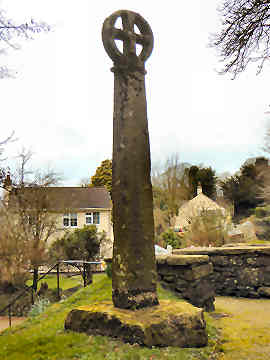
Michaelstow, St. Michael's Church
On the same Saturday in mid-February that I re-visited St. Endelienta's church, I also visited St. Michael's at Michaelstow. I had been there before but only to photograph the Cornish Cross and Holy Well in the churchyard. On this occasion I was there to see the inside of the church, which consists of nave, north and south aisles, tower and porch and dates in part from the 13th century. You approach St. Michael's up steep steps from an ample parking area, through either side of a double lych gate and past a very tall Cornish wheel cross. Off to your right is an uncared for Holy Well. You enter the porch to a handsome door surround and a roof with carved bosses on the timbers. Inside, nave and aisles have standard Cornish wagon roofs. The plain 15th century font stands on a Norman base. The exceptionally good benches and bench ends were rescued from St. Tudy church. The pulpit, with Gothic carving, stands on a stone base. The Royal Arms are of 1727 and are presumably of George II. There are fragments of medieval stained glass, some good Arts and Crafts glass and a banner of St. Michael. Slate monuments stand against the west wall, one obscured by a radiator. A small stone cross stands on a window sill.