More on St. Ia's Church
Ia's Church
New report following a visit at the end of May 2018
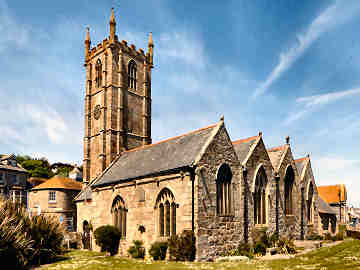
On the same day that I visited uninteresting Morvah church I also took a look at St. Ia's church in St. Ives, a totally different, and rather grand, kettle of fish, its tall tower visible from many parts of town. Do walk around the outside first to admire the four east gables - nave, two aisles and a Trenwith family chapel - each slightly different, and to note the unusual Cornish Cross on the south side. Remarkably, this church was once merely a "chapel of ease" to St. Uny, Lelant. Inside, note the roofs, all wagon roofs in the Cornish style. The chancel roof is the finest with a network appearance with richly carved bosses; below it is a fine rood. A panelled aisle ceiling is supported by two regal figures. A little unexpectedly in so grand a church, there are a number of good bench ends and a couple of benches bear figures of saints with angelic shield-bearers. The altar is of local stone and the reredos is illuminated. The pulpit is of dark oak, deeply carved. The unusual granite font has a carved base, hexagonal column and bowl with strap-work and heads at the four corners. A "Madonna and Child" sculpture by Barbara Hepworth remembers her son Paul. Stained glass in the chancel is by C E Kempe. Fragments of a 1463 brass are to Oto Trenwyth. A low screen is made of old bench ends.
St. Ia's, the four east gable ends
Pulpit
Rood and chancel ceiling
St. Just-in-
Photographs
More in Churches & Holy Sites
More St. Petroc's Bodmin
Petroc's Bodmin
More St. Uny, Lelant
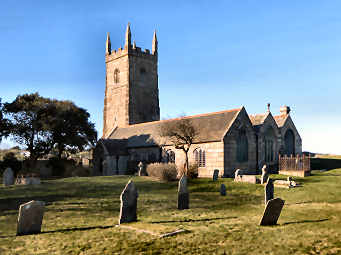
In January 2017 I had an expedition down west. First I went to see Towednack church, closed when I was there recently but happily open this time. Then I continued to Lelant where a little research in Langdon had suggested the existence of several Cornish Crosses. I checked on Cornwall Council's excellent Mapping Website and was able to confirm that I should find crosses in the churchyard of St.Uny Lelant, in the large cemetery and even on the main street. Previously I had only been in Lelant when on the Cornish Coast Path between Hayle and St. Ives. On that occasion I had taken the path between the church and its separate cemetery and not lingered at the church. On this occasion I stopped in the town first where, opposite the Badger Inn (formerly the Praed Arms) a Cornish Cross had been built into the wall next to Cross Cottage. There is now a War Memorial on the site but it looks as if the cross head is mounted on top of the memorial. In the cemetery I found 3 crosses; in the churchyard I found a further 2. The church is delightfully situated, next to a golf course and overlooking Hayle and the Hayle Estuary. Of interest in the church are 2 ancient slate memorials, an octagonal font, panelling from a medieval screen and a good reredos. More images

More St. Uny, Lelant Images
I was back at St. Uny, Lelant in late September 2018 and thought to add a few more notes and images. In medieval times Lelant was a seaport of more importance than St. Ives and the Church of St. Uny was the mother church of St. Ives. While it is hard to imagine Lelant's former importance, there are few churches in a more attractive setting than St. Uny Lelant, not to be confused with St. Euny, Redruth's parish church. The church stands on a large grassy plot, woodland to its south, a view over the Hayle estuary, looking as far as Godrevy Light, to its north--east. Within meadow and woodland, to the south of the church are three Cornish Crosses, a fact nicely echoed by one of the kneelers inside, picturing a Cornish cross. There are three more of these crosses in the graveyard, to the west of the church. A hedge and a path, heading for the Coast Path, separate churchyard from the graveyard. You enter the church through a fine porch; inside are nave and north and south aisles. Extensive restoration was carried out by J D Sedding in 1872-3. Roofs are fine, that of the south aisle being original and richly decorated. Sadly there are no original bench ends; these disappeared in Sedding's restoration. The unusual octagonal font, supported on nine slim supporting shafts, was found in a farmyard and restored to the church in 1889. Slate monuments on a wall near the font commemorate William Praed and family, 1620, and Stephen Pawley, 1635.