
More St. Uny, Lelant Images
I was back at St. Uny, Lelant in late September 2018 and thought to add a few more notes and images. In medieval times Lelant was a seaport of more importance than St. Ives and the Church of St. Uny was the mother church of St. Ives. While it is hard to imagine Lelant's former importance, there are few churches in a more attractive setting than St. Uny Lelant, not to be confused with St. Euny, Redruth's parish church. The church stands on a large grassy plot, woodland to its south, a view over the Hayle estuary, looking as far as Godrevy Light, to its north--east. Within meadow and woodland, to the south of the church are three Cornish Crosses, a fact nicely echoed by one of the kneelers inside, picturing a Cornish cross. There are three more of these crosses in the graveyard, to the west of the church. A hedge and a path, heading for the Coast Path, separate churchyard from the graveyard. You enter the church through a fine porch; inside are nave and north and south aisles. Extensive restoration was carried out by J D Sedding in 1872-3. Roofs are fine, that of the south aisle being original and richly decorated. Sadly there are no original bench ends; these disappeared in Sedding's restoration. The unusual octagonal font, supported on nine slim supporting shafts, was found in a farmyard and restored to the church in 1889. Slate monuments on a wall near the font commemorate William Praed and family, 1620, and Stephen Pawley, 1635.
Lelant Cornish Cross
View from Lelant Churchyard
St. Uny Lelant Cornish Cross Kneeler
Photographs
More in Churches & Holy Sites
More St. Veep Church
Veep Church
Morvah, St. Morveth
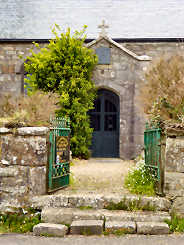
This little church, in the tiny village of Morvah, beyond Zennor on the West Penwith peninsula, which I visited in May 2018, is probably the least interesting of all the Cornish churches I have researched so far. The tower dates from the 14th century but the body of the church was rebuilt in 1828, so just pre-Victorian. The approach is attractive, up three steps and through a pair of iron gates to a green outer porch door. Inside, the nave is simple and pews are unornamented with no carved bench ends. The ceiling is a simple ribbed barrel vault. The octagonal font is unusual with painted decoration on its shaft. The pulpit is simple oak with no decoration. The altar is of local stone with an incised cross. The reredos has three simple panels with a fretted top rail. Window glass is also simple with centre panels carrying a cross motif.
Morwenstow, St. John the Baptist and St. Morwenna
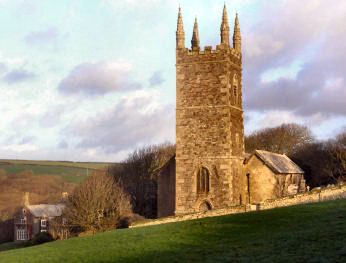
Morwenstow's church, dedicated to St. John the Baptist and to its putative founder St. Morwenna, possibly a daughter of Welsh King Brychan, is unusual in more ways than one. It must be just about Cornwall's least accessible church, a full five miles from the nearest road of any significance and in the county's most northerly parish. Of Norman origin (though there must have been an earlier church here), although restored in Victorian times, it retains a fair amount of Norman work, notably in the porch and the north arcade. And finally, for 40 years from 1834, it had as its vicar the remarkable Robert Stephen Hawker, poet and free spirit, who was responsible for much of the restoration of the church and who chose to bury shipwrecked sailors, of whom there were many in these dangerous seas, in his churchyard rather than, as was the custom at that time, on the shore where they were washed up. Hawker also wrote the Cornish anthem, Trelawny, Song of the Western Men. Worth noting inside the church are the unusual and very early Norman font, the screen and rood which Hawker restored, and a degraded wall painting believed to represent St. Morwenna. Outside, look at the lych gate and its adjacent lych house, at the figurehead of the Caledonia (original in the church) and, in early spring, the most amazing display of daffodils. And do walk to the cliff, turn left and seek out Hawker's Hut, where Parson Hawker wrote his poetry.