Padstow
. St.Petroc,
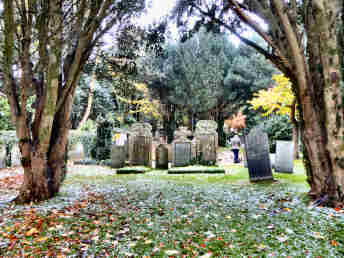
It had surprised me to realise that, although I had been in Padstow on so many occasions, usually in the course of a walk, I had never actually been inside St. Petroc's Church. Walks had included one of our favourites, bus to Trebetherick, walk down to Daymer Bay, visit St. Enodoc Church, continue on golf course or dunes to Rock, ferry to Padstow and bus back home to Wadebridge. Another much enjoyed had been a round walk by Stepper Point and Trevone. Jane and I had also visited Prideaux Place, Padstow's 'big house'. So in November 2016 I parked in the big Link Road car park and walked down the path to the church through a hailstorm, the results seen in the photo on the left. Initial interest was in the churchyard, an early Cornish Cross near the south porch and a massive cross base and part of a shaft by the south-east gate. There is also a Cornish Cross in the grounds of nearby Prideaux Place. St. Petroc's, almost entirely 15th century, consists of nave and two aisles and a substantial tower. Inside the church at the west end is another, rather unusual, cross head and a fine 14th century font of blue Cataclews stone, carvings of three apostles on each face. The nave has a wagon roof with carved bosses and angel supporters. There are several fine Prideaux Brune memorials. Along the norrth wall are carved "Stations of the Cross". Petroc was a Welshman, educated in Ireland. Arriving in Cornwall, he founded a monastery on the Camel - Petroc Stow, Petroc's holy place. Later he founded churches in Little Petherick, Bodmin, Wales and Brittany.
Autumnal scene in the graveyard, hail on the ground
Park in the top Link Road car park and walk down (signed)
More in Churches & Holy Sites
Padstow, St. Petroc - Father of the Cornish Church
Petroc - Father of the Cornish Church
Paul
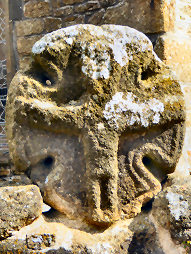
Paul tends to be ignored by visitors, inland as it is from well known destinations such as Penzance, Newlyn and Mousehole. The first three things that strike you are the roofless lych gate, the Cornish Cross head to the left of it and the memorial to Dolly Pentreath of Mousehole who died in 1777 and was believed to be the last person to speak Cornish as a first language. Inside there is a reasonable amount of interest. The font is unusual with octagonal base and square bowl supported by four slim pillars. The octagonal pulpit is unusual, too, entirely of carved stone and supported on slim stone pillars. Box pews are unexpected though disappointingly there are no carved bench ends. However the lectern is quite striking with its carved wood and angel finials. The screen between chancel and aisle is unusual, its centrepiece depicting the 1595 Spanish raid on Penzance, Mousehole and Paul. There is an elaborate memorial to Captain Stephen Hutchens and another to Lieutenant General Robyns. Opposite is a large car park, at one end of it the Kings Arms where we enjoyed coffee. A path off the car park leads to the former graveyard, now a pleasant spot with views to Mount's Bay and St. Michael's Mount.
Pendeen, St. John the Baptist
Towards the end of March 2019 I headed down to the far west, to the Penwith Peninsula beyond St. Ives, to visit my next church as I work my way alphabetically through Pevsner. This church is something of a surprise in more ways than one. You tend to expect the church to be the focal point of a village. And you expect Cornish Anglican churches to be of the 12th to 16th centuries. Not so here; St. John Baptist dates from 1851 and was the brainchild of Rev. Robert Aitken, who designed it and enlisted the aid of his parishioners to build it, the previous wooden church having burned down. Because the village was already built up there was no room for the church at its centre so a new road was built heading towards Trewellard Common and the church was built at its end, Aitken's vicarage next to it. The church wall is highly unusual and was likened by Betjeman to a "Toy Fort". There is an extensive graveyard at the far left corner of which is a small but distinct Cornish Cross. The church is in a cruciform plan with the crenellated tower on its northwest side. The exterior is in the Early English style with tall lancet windows and a steeply pitched roof. The interior has an airy and lofty feel. The chancel arch is narrow and pointed and leads to a chancel with tall lancet windows, some of their stained glass inset with original Flemish roundels. The tall pointed theme is continued in the organ housing. Pews are essentially simple with no traditional carved bench ends though the litany desk is a little more elaborate as is the traditional looking carved pulpit. There is some attractive and colourful tiling in the chancel and some nicely worked altar kneelers. Most unusually the altar rail posts are of serpentine from the Lizard Peninsula. By no means an exceptional church but, nonetheless, a pleasant place to visit with ample parking.