Paul
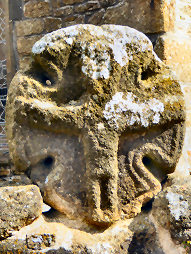
Paul tends to be ignored by visitors, inland as it is from well known destinations such as Penzance, Newlyn and Mousehole. The first three things that strike you are the roofless lych gate, the Cornish Cross head to the left of it and the memorial to Dolly Pentreath of Mousehole who died in 1777 and was believed to be the last person to speak Cornish as a first language. Inside there is a reasonable amount of interest. The font is unusual with octagonal base and square bowl supported by four slim pillars. The octagonal pulpit is unusual, too, entirely of carved stone and supported on slim stone pillars. Box pews are unexpected though disappointingly there are no carved bench ends. However the lectern is quite striking with its carved wood and angel finials. The screen between chancel and aisle is unusual, its centrepiece depicting the 1595 Spanish raid on Penzance, Mousehole and Paul. There is an elaborate memorial to Captain Stephen Hutchens and another to Lieutenant General Robyns. Opposite is a large car park, at one end of it the Kings Arms where we enjoyed coffee. A path off the car park leads to the former graveyard, now a pleasant spot with views to Mount's Bay and St. Michael's Mount.
Paul Cornish Cross
Paul Church and its roofless Lych Gate
Dolly Pentreath Memorial
Photographs
More in Churches & Holy Sites
Pendeen, St. John the Baptist
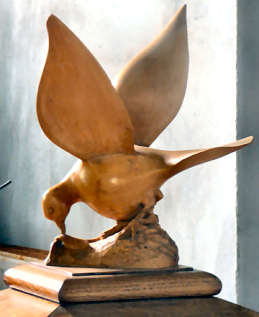
Towards the end of March 2019 I headed down to the far west, to the Penwith Peninsula beyond St. Ives, to visit my next church as I work my way alphabetically through Pevsner. This church is something of a surprise in more ways than one. You tend to expect the church to be the focal point of a village. And you expect Cornish Anglican churches to be of the 12th to 16th centuries. Not so here; St. John Baptist dates from 1851 and was the brainchild of Rev. Robert Aitken, who designed it and enlisted the aid of his parishioners to build it, the previous wooden church having burned down. Because the village was already built up there was no room for the church at its centre so a new road was built heading towards Trewellard Common and the church was built at its end, Aitken's vicarage next to it. The church wall is highly unusual and was likened by Betjeman to a "Toy Fort". There is an extensive graveyard at the far left corner of which is a small but distinct Cornish Cross. The church is in a cruciform plan with the crenellated tower on its northwest side. The exterior is in the Early English style with tall lancet windows and a steeply pitched roof. The interior has an airy and lofty feel. The chancel arch is narrow and pointed and leads to a chancel with tall lancet windows, some of their stained glass inset with original Flemish roundels. The tall pointed theme is continued in the organ housing. Pews are essentially simple with no traditional carved bench ends though the litany desk is a little more elaborate as is the traditional looking carved pulpit. There is some attractive and colourful tiling in the chancel and some nicely worked altar kneelers. Most unusually the altar rail posts are of serpentine from the Lizard Peninsula. By no means an exceptional church but, nonetheless, a pleasant place to visit with ample parking.
Penponds, Holy Trinity
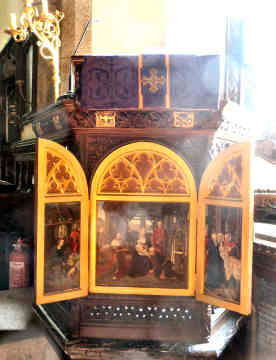
Holy Trinity was built in 1854 to a design by J P St. Aubyn. The architect may have been born in Powick in Worcestershire but was of the Cornish St. Aubyn family, Lords St. Levan and owners of St. Michaels Mount. John Betjeman, the great expert on Victorian buildings and particularly churches, described Holy Trinity as "a gem", a surprising thing for Betjeman to say as he was usuially a fierce critic of St. Aubyn's work. Betjeman's description was "a complete period piece of High Church good taste". My puzzlement at this unexpected praise of St. Aubyn seemed to me good enough reason for a visit. The church is normally closed but I was able to visit on a "free coffee" morning in early April 2019. Perhaps the reason for Betjeman's favourable view is that the church was apparently extensively refitted by Canon Carah between 1896 and 1935. In style it is Early English with simple lancet windows with trefoil heads. Betjeman noted that there is much in the way of gilding, marble and rich furnishings. An entertaining collection of bench ends, described by Betjeman as "spirited," feature biblical figures and are by Hunt of Plymouth and a dado is by local man William Mitchell of Penponds. The aumbry incorporates a fragment of medieval bench end. Early 20th century stained glass is by Clayton and Bell.
Pentewan, All Saints Church
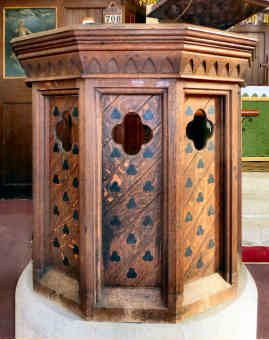
Once, but no longer, a small fishing port, at the mouth of the St. Austell River, Pentewan came to handle cargoes of tin, stone, sand and grain. A proper harbour was constructed in 1744 and it was the first port to handle the local china clay. However, when the Rashleighs built their new port at nearby Charlestown in 1801, Pentewan's Hawkins family owners struggled to keep Pentewan open, eventually closing. The harbour remains intact and still has its sea-lock in place but access to the sea is blocked by sand build-up. Remains of industrial buildings moulder to the south of the harbour. Substantial houses and cottages line the main street. Walk up Pentewan Hill and follow the coast path sign to find the colonial looking Terrace and a Georgian church. From the exterior, I had expected much of the church but was more than a little disappointed. All Saints is distinctly unambitious inside, witness the lack of benches, replaced by chairs. There are two rather ordinary Jesus paintings, one walking on water. The altar cloth is rather featureless. The square font is simple but no worse for that. Modern stained glass is quite attractive and there are some good kneelers, particularly the badger and the entwined fish. The pulpit is unusual and attractive.