Penponds, Holy Trinity
Holy Trinity was built in 1854 to a design by J P St. Aubyn. The architect may have been born in Powick in Worcestershire but was of the Cornish St. Aubyn family, Lords St. Levan and owners of St. Michaels Mount. John Betjeman, the great expert on Victorian buildings and particularly churches, described Holy Trinity as "a gem", a surprising thing for Betjeman to say as he was usuially a fierce critic of St. Aubyn's work. Betjeman's description was "a complete period piece of High Church good taste". My puzzlement at this unexpected praise of St. Aubyn seemed to me good enough reason for a visit. The church is normally closed but I was able to visit on a "free coffee" morning in early April 2019. Perhaps the reason for Betjeman's favourable view is that the church was apparently extensively refitted by Canon Carah between 1896 and 1935. In style it is Early English with simple lancet windows with trefoil heads. Betjeman noted that there is much in the way of gilding, marble and rich furnishings. An entertaining collection of bench ends, described by Betjeman as "spirited," feature biblical figures and are by Hunt of Plymouth and a dado is by local man William Mitchell of Penponds. The aumbry incorporates a fragment of medieval bench end. Early 20th century stained glass is by Clayton and Bell.
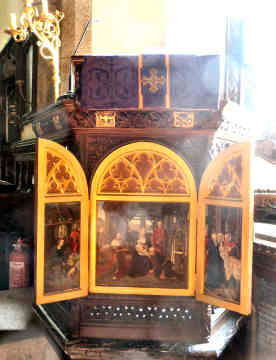
Pulpit Triptych
Penponds, Holy Trinity Church
Carved Bench End
Photographs
More in Churches & Holy Sites
Pentewan, All Saints Church
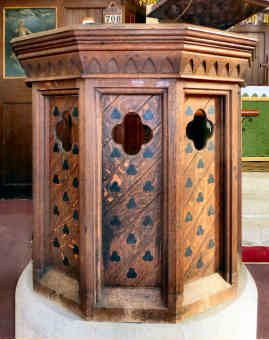
Once, but no longer, a small fishing port, at the mouth of the St. Austell River, Pentewan came to handle cargoes of tin, stone, sand and grain. A proper harbour was constructed in 1744 and it was the first port to handle the local china clay. However, when the Rashleighs built their new port at nearby Charlestown in 1801, Pentewan's Hawkins family owners struggled to keep Pentewan open, eventually closing. The harbour remains intact and still has its sea-lock in place but access to the sea is blocked by sand build-up. Remains of industrial buildings moulder to the south of the harbour. Substantial houses and cottages line the main street. Walk up Pentewan Hill and follow the coast path sign to find the colonial looking Terrace and a Georgian church. From the exterior, I had expected much of the church but was more than a little disappointed. All Saints is distinctly unambitious inside, witness the lack of benches, replaced by chairs. There are two rather ordinary Jesus paintings, one walking on water. The altar cloth is rather featureless. The square font is simple but no worse for that. Modern stained glass is quite attractive and there are some good kneelers, particularly the badger and the entwined fish. The pulpit is unusual and attractive.
Perranarworthal, St. Piran's Church
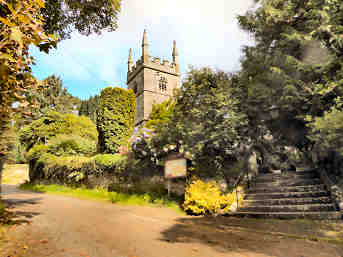
Perranarworthal, what little there is of it, lies on the main road from Truro to Falmouth. Most notable feature along the main road is the former Perran Foundry, now (2021) being converted to fairly expensive housing. The foundry was owned by the ship-owning Fox family of Falmouth. It operated from 1791 to 1879, produced high quality large machinery, mostly related to the mining industry. Acquired by the Williams family of Scorrier, it was immediately closed, presumably to stifle competition. The site, all Grade II lsited, is now being converted and further developed as expensive housing. Perrenarworthal church is tucked away at the eastern extremity of the village, next to Churchtown Farm. It is Victorian, by J P St. Aubyn who, although of a notable Cornish family, was born in Worcestershire. He designed houses and churches mostly in Devon and Cornwall but also in Surrey and Yorkshire. His design for Truro Cathedral failed to be adopted. St. Piran's church is in an attractive setting, surrounded by trees and shrubs. Near the porch is what appears to be a Cornish Cross, but of indeterminate age. Pevsner describes the church as "indifferent". I am unable to contradict him as St. Piran's, like too many Cornish churches, was closed when I was there. However, I got in touch with the vicsr, who kindly arranged for the church to be open for me to visit. So see St. Piran's revisited
Perranuthnoe, St. Piran & St. Michael
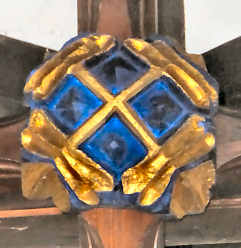
I had previously only known Perranuthnoe from passing through on the coast path, between Marazion and Porthleven, and from a round walk that Jane and I did from Porth-en-Alls near Prussia Cove. On this occasion, in late March 2018, I was there to visit St. Piran's church which stands high above the rest of the village but, surprisingly, with no view of the sea. First thing I noticed as I entered the churchyard, perched above the lane, was a modern Cornish cross-head, set against a low wall and surrounded by daffodils. Next thing to catch my attention was a large funerary urn to the right of the porch. Best feature of the little church is the chancel where, beneath the wagon roof, a late 19th century reconstruction by J P St. Aubyn (who else?) was later enriched in the early 20th century. Chancel screen, choir stalls, altar, reredos and altar rails all have fine woodwork. There is some good late Victorian stained glass. However, to my mind the most interesting feature requires one to look up to see a few carved, coloured and gilded ceiling bosses, below.