Perranuthnoe, St. Piran & St. Michael
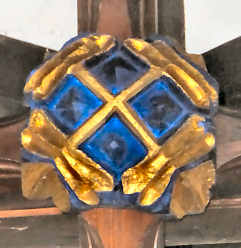
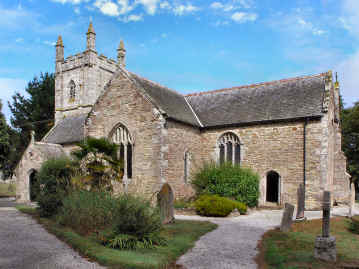
I had previously only known Perranuthnoe from passing through on the coast path, between Marazion and Porthleven, and from a round walk that Jane and I did from Porth-en-Alls near Prussia Cove. On this occasion, in late March 2018, I was there to visit St. Piran's church which stands high above the rest of the village but, surprisingly, with no view of the sea. First thing I noticed as I entered the churchyard, perched above the lane, was a modern Cornish cross-head, set against a low wall and surrounded by daffodils. Next thing to catch my attention was a large funerary urn to the right of the porch. Best feature of the little church is the chancel where, beneath the wagon roof, a late 19th century reconstruction by J P St. Aubyn (who else?) was later enriched in the early 20th century. Chancel screen, choir stalls, altar, reredos and altar rails all have fine woodwork. There is some good late Victorian stained glass. However, to my mind the most interesting feature requires one to look up to see a few carved, coloured and gilded ceiling bosses, below.
Perranuthnoe Ceiling Boss
Perranuthnoe Chancel
Perranuthnoe Ceiling Boss
Photographs
More in Churches & Holy Sites
Perranzabuloe
, St. Piran's
Phillack
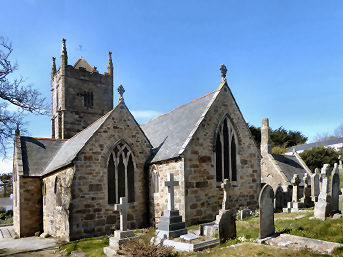
In early February 2017 I had a busy Saturday, visiting not only Phillack but also Gwithian and Gwinear, all essentially for their churches. Phillack is one of those places which it is easy to miss, sandwiched as it is between Hayle's Copperhouse Pool and the dunes of Hayle and Riviere Towans and the Cornish Coast Path. However, it is a community in its own right.with church, village hall, pub and Spar shop. The pub is the gruesomely named the Bucket of Blood. Legend has it that, in smuggling days, a brutally murdered customs officer was discovered at the bottom of the pub's well. My purpose in Phillack was to look around the church and see the two Cornish Crosses and the inscribed stone in the churchyard, where I also spotted a tombstone to the delightfully named Constance Everett Faithfull. Inside the church there is little of note though I liked the modern lectern, the delicate chancel screen and the colourful reredos.
Philleigh, St. Fili's Church
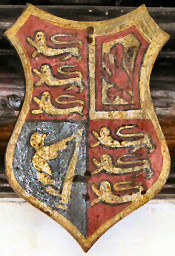
Situated halfway between the Tregony to St. Mawes road and King Harry Ferry across the River Fal, Philleigh is an attractive small village boasting a "big house," The Glebe, a striking mid 18th century rectory, standing four-square at the end of its curving driveway and seen through gateless gate posts; a popular pub, the Roseland Inn; and the 13th century church of St. Philleigh (or Fili) at the end of a longish tree and shrub lined driveway. Interesting cottages include Court Cottage, The Round Cottage and The Old Forge. St. Fili's church (or, if you prefer, St. Philleigh's church) was originally of the 13th century but has a 14th century tower; and the body of the church was extensively restored in 1867 by the Reverend C W Carlyon who was also responsible for St. Anthony-in-Roseland and St. Just-in-Roseland. The door to the body of the church is 13th century and windows vary from original 15th and 16th century to 19th century of the Victorian restoration period. 19th century roofs are arch braced and have dog-tooth moulding to the trusses. The font is octagonal, its sides with arcading. Painted on the tower screen are the royal arms of George III, dated 1735. In the chancel, the fairly simple reredos is of 1915. There is some simple stained glass; below it window sills have biblical tableaux. There is a very good collection of kneelers, my favourite is the colourful pheasant. Unmentioned by Pevsner, to my surprise, is the comprehensive collection of decorative wall plates, where wall joins roof. These take the form of shields with real or imagined coats-of-arms.