Perranzabuloe
, St. Piran's
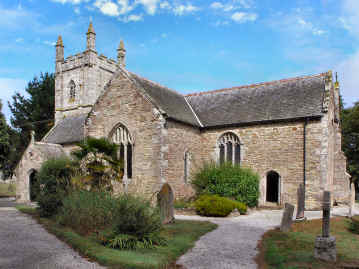
This is effectively the fourth church of St. Piran in the Perranporth area. A chapel, probably built by St. Piran himself in the late 5th century, on Penhale Sands above Perranporth beach, was replaced in the following century by a small oratory. Sometime around 1250, encroaching sand led to abandonment and a new church was built further inland and higher up. The oratory was lost under the sand, excavated in 1843, protected by a concrete shell in 1910 and reburied in 1980. The new church was itself lost to the sand in 1804 - it was re-excavated in 2005 - and yet another church was then built further inland at Perranzabuloe (meaning Piran in the sands, odd since there are no sands here). From the outside you would think you were looking, not at an early 19th century church, but at a genuinely medieval one. Perhaps the builders were constrained by re-using a lot of material from the church on the sands. Anyway, the result is very much in the perpendicular style. Inside is tall, light and airy with a few features from the old church - a 15th century granite font, rood screen panels, bench ends and a couple of worn slate memorial slabs. You may wonder at the enormous graveyard, but it serves the whole of Perranporth. It is a pity that the church is only open for a few hours each Wednesday in summer only.
See also St Piran & Piran church archaelogical dig
St. Piran's church seen from the lych gate
I revisited Perraenzbuloe in August 2017, on my way to see the church and some Cornish Crosses at the nearby hamlet of St. Allen. My purpose was to take some interior photographs. By happenstance, I was also able to add to my ever expanding portfolio of Cornish Crosses. No cross is shown, on OS 104, nor is one mentioned in Pevsner, but there is indeed a small one, on the left soon after entering the churchyard.
More in Churches & Holy Sites
Phillack
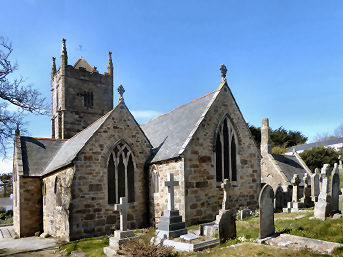
In early February 2017 I had a busy Saturday, visiting not only Phillack but also Gwithian and Gwinear, all essentially for their churches. Phillack is one of those places which it is easy to miss, sandwiched as it is between Hayle's Copperhouse Pool and the dunes of Hayle and Riviere Towans and the Cornish Coast Path. However, it is a community in its own right.with church, village hall, pub and Spar shop. The pub is the gruesomely named the Bucket of Blood. Legend has it that, in smuggling days, a brutally murdered customs officer was discovered at the bottom of the pub's well. My purpose in Phillack was to look around the church and see the two Cornish Crosses and the inscribed stone in the churchyard, where I also spotted a tombstone to the delightfully named Constance Everett Faithfull. Inside the church there is little of note though I liked the modern lectern, the delicate chancel screen and the colourful reredos.
Philleigh, St. Fili's Church
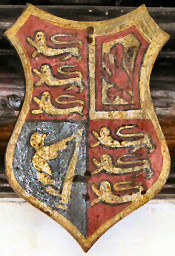
Situated halfway between the Tregony to St. Mawes road and King Harry Ferry across the River Fal, Philleigh is an attractive small village boasting a "big house," The Glebe, a striking mid 18th century rectory, standing four-square at the end of its curving driveway and seen through gateless gate posts; a popular pub, the Roseland Inn; and the 13th century church of St. Philleigh (or Fili) at the end of a longish tree and shrub lined driveway. Interesting cottages include Court Cottage, The Round Cottage and The Old Forge. St. Fili's church (or, if you prefer, St. Philleigh's church) was originally of the 13th century but has a 14th century tower; and the body of the church was extensively restored in 1867 by the Reverend C W Carlyon who was also responsible for St. Anthony-in-Roseland and St. Just-in-Roseland. The door to the body of the church is 13th century and windows vary from original 15th and 16th century to 19th century of the Victorian restoration period. 19th century roofs are arch braced and have dog-tooth moulding to the trusses. The font is octagonal, its sides with arcading. Painted on the tower screen are the royal arms of George III, dated 1735. In the chancel, the fairly simple reredos is of 1915. There is some simple stained glass; below it window sills have biblical tableaux. There is a very good collection of kneelers, my favourite is the colourful pheasant. Unmentioned by Pevsner, to my surprise, is the comprehensive collection of decorative wall plates, where wall joins roof. These take the form of shields with real or imagined coats-of-arms.
Pillaton, St. Odulph's Church
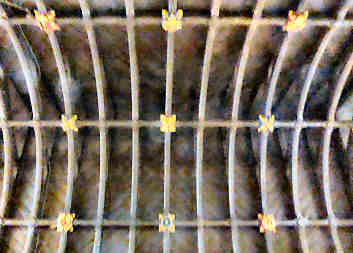
At the very beginning of March 2019 I headed down east, beyond Liskeard to visit a couple of fairly remote churches in Pillaton and Quethiock. St. Odulph is an unfamiliar name but odolphie.com suggests It is probably fair to assume that the name derives from St Odulph also Odolphus. He was an Augustinian canon born in Oirschot, North Brabant, in what is now the Netherlands, became a missionary and followed St Boniface in bringing Christianity to the Frisians. He died in 855AD and his saint’s day is June 2nd. Pillaton is most easily approached from the A338 near St. Mellion. The church stands next to a pub, the delightfully named Weary Friar. St. Odulph's consists of tower, porch, nave, north aisle, chancel and south transept. The first thing you notice, even before entering the church, is the fine wagon roof of the porch. The doorway to the body of the church is probably Tudor; beside it stands a small slate cross. Inside, the most noticeable feature is in the south transept, where rood stair openings remain in place. Wagon roofs in the north aisle and south transept are of the 15th century; nave and chancel roofs are replacements from 1878. Unusually there are two boards carrying the Royal Arms, one dated 1663 of Charles II, the other dated 1729 of George III. Oddly there are monuments to the Tillies of Pentillie, though that is some miles away, on the banks of the River Tamar. Stained glass is mostly late 19th century. An octagonal pulpit stands on an octagonal shaft. a hexagonal pulpit stands on a light granite base; the adjacent eagle lectern is of a similar medium oak. The chancel is worth lingering over; its wagon roof has a variety of carved and gilded bosses and its floor has good tiling. I enjoyed coffee in the Weary Friar.