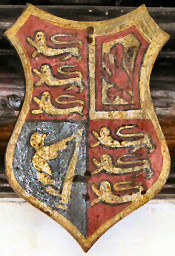
Philleigh, St. Fili's Church
Situated halfway between the Tregony to St. Mawes road and King Harry Ferry across the River Fal, Philleigh is an attractive small village boasting a "big house," The Glebe, a striking mid 18th century rectory, standing four-square at the end of its curving driveway and seen through gateless gate posts; a popular pub, the Roseland Inn; and the 13th century church of St. Philleigh (or Fili) at the end of a longish tree and shrub lined driveway. Interesting cottages include Court Cottage, The Round Cottage and The Old Forge. St. Fili's church (or, if you prefer, St. Philleigh's church) was originally of the 13th century but has a 14th century tower; and the body of the church was extensively restored in 1867 by the Reverend C W Carlyon who was also responsible for St. Anthony-in-Roseland and St. Just-in-Roseland. The door to the body of the church is 13th century and windows vary from original 15th and 16th century to 19th century of the Victorian restoration period. 19th century roofs are arch braced and have dog-tooth moulding to the trusses. The font is octagonal, its sides with arcading. Painted on the tower screen are the royal arms of George III, dated 1735. In the chancel, the fairly simple reredos is of 1915. There is some simple stained glass; below it window sills have biblical tableaux. There is a very good collection of kneelers, my favourite is the colourful pheasant. Unmentioned by Pevsner, to my surprise, is the comprehensive collection of decorative wall plates, where wall joins roof. These take the form of shields with real or imagined coats-of-arms.
Philleigh Heraldic Shield
Philleigh, St. Fili's Church
Philleigh Heraldic Shield
Photographs
More in Churches & Holy Sites
Pillaton, St. Odulph's Church
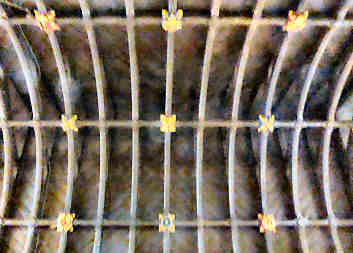
At the very beginning of March 2019 I headed down east, beyond Liskeard to visit a couple of fairly remote churches in Pillaton and Quethiock. St. Odulph is an unfamiliar name but odolphie.com suggests It is probably fair to assume that the name derives from St Odulph also Odolphus. He was an Augustinian canon born in Oirschot, North Brabant, in what is now the Netherlands, became a missionary and followed St Boniface in bringing Christianity to the Frisians. He died in 855AD and his saint’s day is June 2nd. Pillaton is most easily approached from the A338 near St. Mellion. The church stands next to a pub, the delightfully named Weary Friar. St. Odulph's consists of tower, porch, nave, north aisle, chancel and south transept. The first thing you notice, even before entering the church, is the fine wagon roof of the porch. The doorway to the body of the church is probably Tudor; beside it stands a small slate cross. Inside, the most noticeable feature is in the south transept, where rood stair openings remain in place. Wagon roofs in the north aisle and south transept are of the 15th century; nave and chancel roofs are replacements from 1878. Unusually there are two boards carrying the Royal Arms, one dated 1663 of Charles II, the other dated 1729 of George III. Oddly there are monuments to the Tillies of Pentillie, though that is some miles away, on the banks of the River Tamar. Stained glass is mostly late 19th century. An octagonal pulpit stands on an octagonal shaft. a hexagonal pulpit stands on a light granite base; the adjacent eagle lectern is of a similar medium oak. The chancel is worth lingering over; its wagon roof has a variety of carved and gilded bosses and its floor has good tiling. I enjoyed coffee in the Weary Friar.
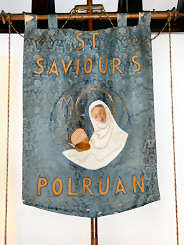
Polruan, St. Saviours Church
Although I had been in Polruan on several occasions in my Coast Path walking days, I had not only never been inside St. Saviours Church, I had never seen it and didn't even know where it was. When I went to visit it in late February 2018, it took me some while to find it and, lacking any convenient car park, I parked in the forecourt of the next door Institute, happily causing no inconvenience. St. Saviours is a late Victorian church by W. Smith of Truro, considered of so little consequence that the original 1951 Pevsner made no mention of it. However, Peter Beacham's 2014 revision does include it. Of red brick, it stands high above Fore Street but is best seen from the lawns behind it on the west side. I have to agree with Beacham's derscription ..... "spacious, dignified interior, wide and lofty". Four windows are by Kempe, the two circular windows by William Morris's company. I particularly liked two of the windows, one a modern version of a rose window, the other a simple wavescape.
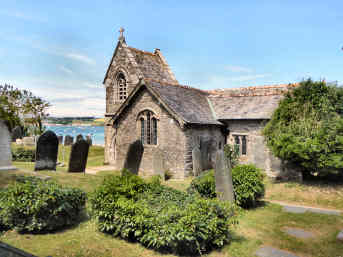
Porthilly
, St. Michaels Church