Porthilly
, St. Michaels Church
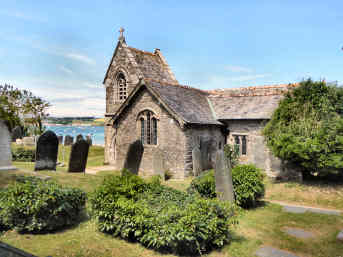
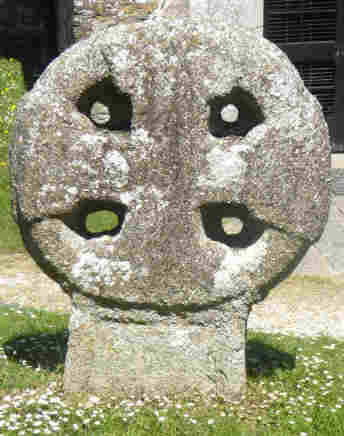
Jane remembers this little church at Porthilly from her early days when she was raised in nearby Trebetherick. I have been here on several occasions in the course of walks but June 2016 was the first time I had lingered and been inside the church, which is one of three in St. Minver Parish, the others being St. Enodoc and St. Minver itself.. The situation is a delight best appreciated when the tide is in on the Camel Estuary and the view to Rock is dottted with small sailing boats. Across the broad Camel Estuary is the bustling tourist town of Padstow. A ferry runs there from Rock. The first thing you notice as you approach the porch from the lych gate is a truncated four-hole Cornish Cross; this was apparently brought here from the mother church at St. Minver. Then look up at the tower to see an unusual - for Cornwall - saddleback roof. Inside are an unusual simple bowl font, the framework of a rood screen, an early 16th century linenfold panelled pulpit and a nicely decorated slate memorial to William Rouncevall, A window is etched with a memorial to Marian Chilcott Miller. The tiny village has a couple of attractive houses and an art gallery featuring the work of Jethro Jackson. There is a car park but time allowed in it is restricted.
St. Michael, Porthilly
More about St. Michael's Porthilly
More in Churches & Holy Sites
Porthilly
, more about St. Michaels Church
Porthleven, St. Bartholemew's Church
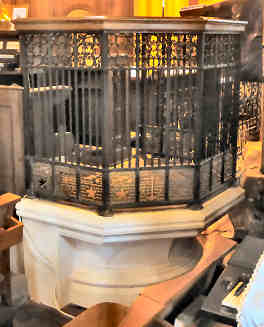
On a fairly sunny day in mid-December I headed down west to visit three churches: St. Germoc's in Germoe for its Holy Well and St. Germoc's Chair, St. Breaca's in Breague for its remarkable collection of frescoes, and St. Bartholemew's in the harbour town of Porthleven for its slightly unusual Victorian layout. St. Bartholemew's is located behind and above the main car park and looks out over town and harbour. You might think that being Victorian, it would be of no great interest. However, it is well worth taking a look at this 1842 church by Sampson Kempthorne, restored in 1891 by H Fellowes Prynne who added the baptistery. The church is unusual in that both east and west ends finish with a semi-circular apse, the east end the baptistery with a massive granite font, the west end the chancel. There is a certain Norman Revival feeling to the church, so many openings are round-arched. There is also a strong Anglo-Catholic feeling, notably from the images of the Stations of the Cross around the walls. It is a pity that there are no pews, only chairs, but the colourful tiled floor, similar to the baptistery, tends to keep one's eyes off the chairs. There is no Rood Screen but the Rood, in the form of an anchor, is both unusual and appropriate to a fishing port. The low finely-wrought-iron chancel screen is unusual and attractive. The altar is simple, behind it a reredos with figures in each of three round-headed arches. There is a rectangular Lady Chapel where an oak pew has carving representing fishing and farming interests. The pulpit is highly unusual, a stone base carries the wrought-iron pulpit which has brass stencils of fish, starfish and anchors. A figure of Christ depicts him as carpenter, with mallet and chisel. Altogether an unusual and enjoyable Victorian church.
Porthpean, Higher Porthpean, St. Levan's Church
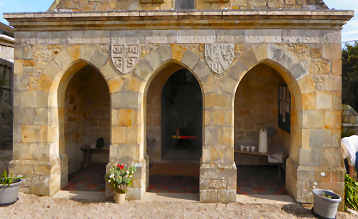
This is an unusual and attractive small church, in the centre of the little village of Higher Porthpean. Built in 1884 by J Reeves for Lady Graves-Sawle of nearby Penrice, its front is quite unexpected, an arcade bearing coats of arms, presumably including those of the Graves-Sawles, and a bell-cote above. I know of no other church in Cornwall with a similar arched loggia for its west front. It's on a pretty tight site, the lane on the south side running down steeply to Lower Porthpean and St. Austell Bay. The interior is of local Pentewan stone, un-plastered, colourful and attractive and nicely sets off the three-light east wndow by Clayton and Bell. No pews, instead chairs. The altar is simple; when I was there flowers stood on the altar-cloth. A reredos is of Devon marble. The font at first looks simple but on closer inspection is quite complex, incorporating seven different bands of shaping. A St. Levan's Sunday School banner hangs on one wall.