Polruan, St. Saviours Church
Although I had been in Polruan on several occasions in my Coast Path walking days, I had not only never been inside St. Saviours Church, I had never seen it and didn't even know where it was. When I went to visit it in late February 2018, it took me some while to find it and, lacking any convenient car park, I parked in the forecourt of the next door Institute, happily causing no inconvenience. St. Saviours is a late Victorian church by W. Smith of Truro, considered of so little consequence that the original 1951 Pevsner made no mention of it. However, Peter Beacham's 2014 revision does include it. Of red brick, it stands high above Fore Street but is best seen from the lawns behind it on the west side. I have to agree with Beacham's derscription ..... "spacious, dignified interior, wide and lofty". Four windows are by Kempe, the two circular windows by William Morris's company. I particularly liked two of the windows, one a modern version of a rose window, the other a simple wavescape.
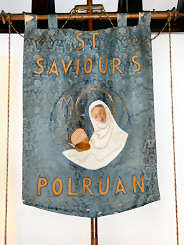
St. Saviours Banner
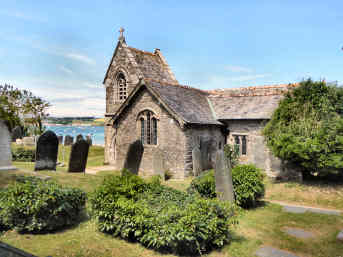
St. Saviours Church, Polruan
Wavescape Window
Photographs
More in Churches & Holy Sites
Porthilly
, St. Michaels Church
Porthilly
, more about St. Michaels Church
Porthleven, St. Bartholemew's Church
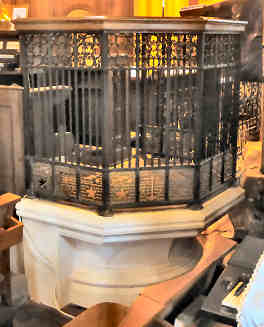
On a fairly sunny day in mid-December I headed down west to visit three churches: St. Germoc's in Germoe for its Holy Well and St. Germoc's Chair, St. Breaca's in Breague for its remarkable collection of frescoes, and St. Bartholemew's in the harbour town of Porthleven for its slightly unusual Victorian layout. St. Bartholemew's is located behind and above the main car park and looks out over town and harbour. You might think that being Victorian, it would be of no great interest. However, it is well worth taking a look at this 1842 church by Sampson Kempthorne, restored in 1891 by H Fellowes Prynne who added the baptistery. The church is unusual in that both east and west ends finish with a semi-circular apse, the east end the baptistery with a massive granite font, the west end the chancel. There is a certain Norman Revival feeling to the church, so many openings are round-arched. There is also a strong Anglo-Catholic feeling, notably from the images of the Stations of the Cross around the walls. It is a pity that there are no pews, only chairs, but the colourful tiled floor, similar to the baptistery, tends to keep one's eyes off the chairs. There is no Rood Screen but the Rood, in the form of an anchor, is both unusual and appropriate to a fishing port. The low finely-wrought-iron chancel screen is unusual and attractive. The altar is simple, behind it a reredos with figures in each of three round-headed arches. There is a rectangular Lady Chapel where an oak pew has carving representing fishing and farming interests. The pulpit is highly unusual, a stone base carries the wrought-iron pulpit which has brass stencils of fish, starfish and anchors. A figure of Christ depicts him as carpenter, with mallet and chisel. Altogether an unusual and enjoyable Victorian church.