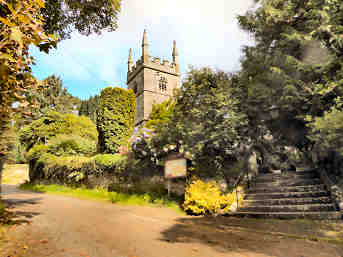
Perranarworthal, St. Piran's Church
Perranarworthal, what little there is of it, lies on the main road from Truro to Falmouth. Most notable feature along the main road is the former Perran Foundry, now (2021) being converted to fairly expensive housing. The foundry was owned by the ship-owning Fox family of Falmouth. It operated from 1791 to 1879, produced high quality large machinery, mostly related to the mining industry. Acquired by the Williams family of Scorrier, it was immediately closed, presumably to stifle competition. The site, all Grade II lsited, is now being converted and further developed as expensive housing. Perrenarworthal church is tucked away at the eastern extremity of the village, next to Churchtown Farm. It is Victorian, by J P St. Aubyn who, although of a notable Cornish family, was born in Worcestershire. He designed houses and churches mostly in Devon and Cornwall but also in Surrey and Yorkshire. His design for Truro Cathedral failed to be adopted. St. Piran's church is in an attractive setting, surrounded by trees and shrubs. Near the porch is what appears to be a Cornish Cross, but of indeterminate age. Pevsner describes the church as "indifferent". I am unable to contradict him as St. Piran's, like too many Cornish churches, was closed when I was there. However, I got in touch with the vicsr, who kindly arranged for the church to be open for me to visit. So see St. Piran's revisited
Perranarworthal Church
Cornish Cross
Churchtown Cottages
You pass through Perranarworthal on the busy A39 between Truro and Falmouth. You may notice the expensive housing development at the old Perran Foundry site. What you don't realise is that the original settlement is up the hill to the west of the road. I had previously been to try to see inside St. Piran's church - and had failed. At last, in mid-August 2018, I was able to see inside the church, thanks to the kind help and co-operation of churchwarden Paul Stuart. Jane and I met Paul at St. Piran's and he showed us around and told us some of the church's history. The tower is of the 16th century but the body of the church was rebuilt by J P St. Aubyn in late Victorian times; Pevsner calls it "indifferent". The nave has a rather unusually vaulted ceiling with a lot of exposed woodwork. There is an attractive litany desk and a fine altar cloth. The royal coat of arms hangs on a wall. An octagonal font is simple. Two attractive chairs stand in the chancel. There are several stained glass windows of no especial merit. A small wooden pulpit stands on a stone plinth. To my mind the most attractive feature is a hanging which refers to St. Piran as Patron Saint of Tin Miners. Thereby hangs a tale. Piran is supposed to have discovered tin when his fire melted the tin in a rock. A nice tale but Cornish tin dates from the Bronze Age; Piran was 6th century. He certainly came to Cornwall from Ireland, allegedly floating across on a stone. He founded a church on Perran Sands near Perranporth and remains of his oratory have recently been excavated. Another hanging is of Mary and the infant Jesus.
Perranarworthal Banner
Perranarworthal Altar Cloth
Stained Glass
Photographs
More in Churches & Holy Sites
Perranuthnoe, St. Piran & St. Michael
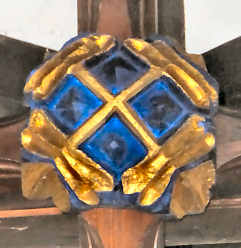
I had previously only known Perranuthnoe from passing through on the coast path, between Marazion and Porthleven, and from a round walk that Jane and I did from Porth-en-Alls near Prussia Cove. On this occasion, in late March 2018, I was there to visit St. Piran's church which stands high above the rest of the village but, surprisingly, with no view of the sea. First thing I noticed as I entered the churchyard, perched above the lane, was a modern Cornish cross-head, set against a low wall and surrounded by daffodils. Next thing to catch my attention was a large funerary urn to the right of the porch. Best feature of the little church is the chancel where, beneath the wagon roof, a late 19th century reconstruction by J P St. Aubyn (who else?) was later enriched in the early 20th century. Chancel screen, choir stalls, altar, reredos and altar rails all have fine woodwork. There is some good late Victorian stained glass. However, to my mind the most interesting feature requires one to look up to see a few carved, coloured and gilded ceiling bosses, below.
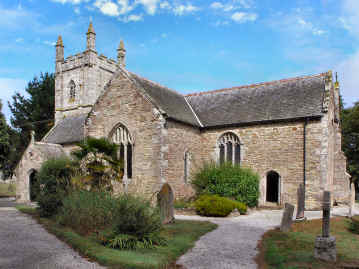
Perranzabuloe
, St. Piran's
Phillack
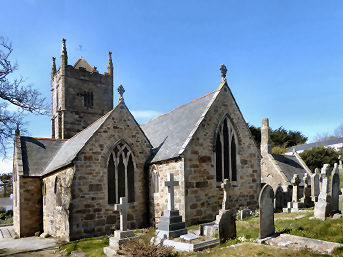
In early February 2017 I had a busy Saturday, visiting not only Phillack but also Gwithian and Gwinear, all essentially for their churches. Phillack is one of those places which it is easy to miss, sandwiched as it is between Hayle's Copperhouse Pool and the dunes of Hayle and Riviere Towans and the Cornish Coast Path. However, it is a community in its own right.with church, village hall, pub and Spar shop. The pub is the gruesomely named the Bucket of Blood. Legend has it that, in smuggling days, a brutally murdered customs officer was discovered at the bottom of the pub's well. My purpose in Phillack was to look around the church and see the two Cornish Crosses and the inscribed stone in the churchyard, where I also spotted a tombstone to the delightfully named Constance Everett Faithfull. Inside the church there is little of note though I liked the modern lectern, the delicate chancel screen and the colourful reredos.