Poughill, St. Olaf's Church
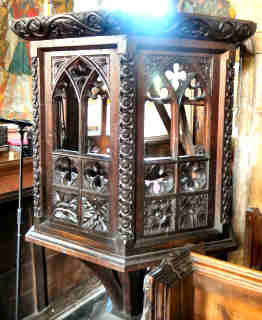
Poughill - pronounced Puffle - is tucked away on a quiet lane, leading to Northcott Mouth, on the north side of Bude. It is a steep village and the lane is narrow but, fortunately, there is a good sized car park below the church. There are some attractive cottages, particularly Church Cottage and St. Olaf's Cottage. St. Olaf's Church, dedicated to the Norwegian King and Martyr, stands on a knoll, perhaps suggestive of an ancient site. The oak tower door has an impressive surround. The porch, in it a slate memorial in Latin, has an ancient studded oak door. Inside, wagon roofs have carved bosses. The frescoes of St. Christopher are a remarkable survival: whitewashed at the Reformation, they were only rediscovered in 1894. The elaborately carved pulpit is unusual for its open fretwork. A wall plaque commemorates Sir Goldsworthy Gurney, Wadebridge doctor, builder of Bude Castle and inventor of a steam road carriage. His limelight illuminated the House of Parliament for 60 years. As at Kilkhampton, there is a fine collection of early bench ends. The attractive looking Preston Gate Inn, which also calls itself a cafe, is open 11 to 11 daily and does interesting sounding food lunchtime and evening. There is fish and chips on Friday and roasts on Sunday.
Poughill Carved Pulpit
Poughill Church from the south-east
Poughill Fresco
Photographs
More in Churches & Holy Sites
Poundstock, St. Winwaloe's Church
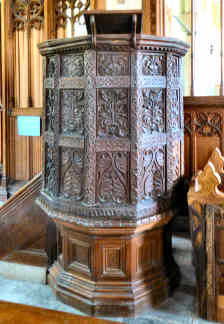
Less than half-a-mile from the busy A39, the so-called Atlantic Highway, Poundstock is a remarkable little hamlet. A lane loops through it from the A39 but otherwise goes nowhere. Yet this was once an important place, mentioned in Domesday Book but in existence as a manor for long before that. Even if you include nearby Trekinnard and Bangors the population is tiny yet the impressive church, set in a lovely sloping churchyard, might seem to belong to a much larger village than this. The church as it is today dates largely from the fifteenth century, though there are scant Norman remains. It is dedicated to St. Winwaloe; can this really be the same Winwaloe as on the Lizard, at Towednack and at St. Germans? Confusingly, a nearby well is dedicated to St. Neot, as in Bodmin Moor. There are some treasures inside: a late Norman font, an octagonal Jacobean pulpit, a panel from the original rood screen, a 16th century chest, parts of a wall painting, saved and exhibited against the north wall, and some early inscribed slate tomb slabs. Sadly there are very few bench ends but there is an interesting bench in the chancel. Perhaps the greatest treasure of all is at the south end of the graveyard, a restored late medieval gildhouse (church hall), the only example in Cornwall. In the churchyard are more early inscribed slate tomb slabs. St Neot’s Well is off a track that heads NNW to Great Wanson. Up the lane to Bangors is a large free car park.

Probus, St. Probus & St. Grace
The heart of Probus village is quite attractive, with a wide sloping triangular area at its centre, perhaps formerly a market place. Around the triangle, and up the road towards Trewithen, are a farm shop, a fish and chip shop, a couple of restaurants and the excellent Hawkins Arms pub, named for the family that acquired the nearby Trewithen estate in 1715. This is an impressive church; one's first view of it is of its 3-stage 125 foot tower, tastefully decorated and the tallest in Cornwall. Pevsner's view of St. Probus is that it is more Somerset - particularly North Petherton - than Cornwall in style and I have to agree. The nave and two aisles of the interior are spacious. The interior was restored by G E Street in 1849-51 and the chancel was elaborately embellished in 1886-8 by J P St. Aubyn, its ceiling decorated in blue, red and gold. The altar slab has five consecration crosses. A Norman piscina in the sanctuary has zig-zag decoration. The reredos is by J P St. Aubyn. The rood screen, though by St. Aubyn, incorporates 16th century bench ends, which also feature in the parclose screen, the choir stalls and the tower screen; what a pity that restoration had to effectively obliterate medieval bench ends from their original siruation. Stained glass is late Victorian and early 20th century. Monuments and memorials include a 1514 brass to the Wulvendon family. The pulpit is well carved and, unusually, includes a trio of figures. The hexagonal font is deeply carved. In the churchyard, a 1914 monument to the Hawkins family features kneeling pall-bearers at the four corners.
Pydar), St. Mawgan's Church
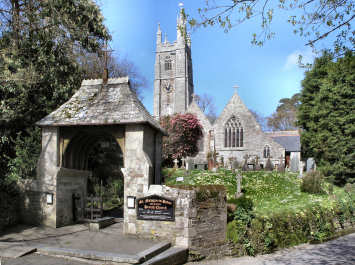
I first encountered St. Mawgan (technically Mawgan-in-Pydar, Pydar being one of the old "hundreds" of Cornwall, county divisions dating back to Saxon times) back in February 2006, when Jane and I tried the Falcon Inn, recommended by friends. We liked the Falcon but, even more, we were taken with the charming village of St. Mawgan. Since then I have been back on many occasions, most particularly in 2016 and 2017, when I was there with the camera, photographing village, church and Cornish Crosses. I have also done a couple of good coastal round walks from there. When visiting the church, do look carefully around the churchyard for the several Cornish Crosses: in addition to those in the churchyard, there is another in the grounds of adjacent Lanherne Convent church. The Church of St. Mawgan stands below Lanherne House, at the top of a sloping churchyard, and is approached through a slate roofed stone lych gate. The church dates from the 13th century with additions in the 15th and 16th centuries and restoration in 1861 by William Butterfield. It is a substantial church, consisting of nave and chancel, north and south transepts and aisles to nave and chancel. The three-stage tower is unusual in that it is not, as is normal, at the west end but rather to the south of the south transept. It has a stair turret to its north-east corner. The south chancel aisle is of local Catacleuse stone. All ceilings are of the later 19th century, the ribs of the chancel ceiling being decorated in delicate polychrome. The font is 12th century, of the Bodmin type with a circular bowl on four columns of Devon marble. The rood screen remains in place but crosses just the nave with no sign of rood or rood stairs. A parclose screen, like the rood screen, is by Butterfield. The altar table in the south chancel aisle has open cusped panels. In a corner by the chancel is a shield topped by a bishop's mitre. In the floor at the east end of the chancel aisle are 15th and 16th century brasses of the Arundell family of Lanherne. Late 19th century stained glass is by Clayton and Bell; that of the early 20th century by Percy Bacon. There are some good monuments of the 17th and 18th centuries. An excellent collection of bench ends appears to be of the Tudor period.