
Probus, St. Probus & St. Grace
The heart of Probus village is quite attractive, with a wide sloping triangular area at its centre, perhaps formerly a market place. Around the triangle, and up the road towards Trewithen, are a farm shop, a fish and chip shop, a couple of restaurants and the excellent Hawkins Arms pub, named for the family that acquired the nearby Trewithen estate in 1715. This is an impressive church; one's first view of it is of its 3-stage 125 foot tower, tastefully decorated and the tallest in Cornwall. Pevsner's view of St. Probus is that it is more Somerset - particularly North Petherton - than Cornwall in style and I have to agree. The nave and two aisles of the interior are spacious. The interior was restored by G E Street in 1849-51 and the chancel was elaborately embellished in 1886-8 by J P St. Aubyn, its ceiling decorated in blue, red and gold. The altar slab has five consecration crosses. A Norman piscina in the sanctuary has zig-zag decoration. The reredos is by J P St. Aubyn. The rood screen, though by St. Aubyn, incorporates 16th century bench ends, which also feature in the parclose screen, the choir stalls and the tower screen; what a pity that restoration had to effectively obliterate medieval bench ends from their original siruation. Stained glass is late Victorian and early 20th century. Monuments and memorials include a 1514 brass to the Wulvendon family. The pulpit is well carved and, unusually, includes a trio of figures. The hexagonal font is deeply carved. In the churchyard, a 1914 monument to the Hawkins family features kneeling pall-bearers at the four corners.
Colourful Chancel Ceiling
Probus Church from the south-east
Probus Font
Photographs
More in Churches & Holy Sites
Pydar), St. Mawgan's Church
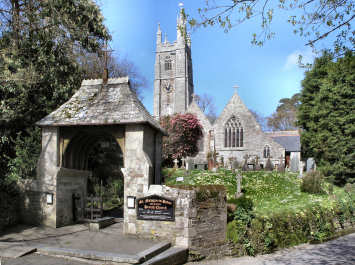
I first encountered St. Mawgan (technically Mawgan-in-Pydar, Pydar being one of the old "hundreds" of Cornwall, county divisions dating back to Saxon times) back in February 2006, when Jane and I tried the Falcon Inn, recommended by friends. We liked the Falcon but, even more, we were taken with the charming village of St. Mawgan. Since then I have been back on many occasions, most particularly in 2016 and 2017, when I was there with the camera, photographing village, church and Cornish Crosses. I have also done a couple of good coastal round walks from there. When visiting the church, do look carefully around the churchyard for the several Cornish Crosses: in addition to those in the churchyard, there is another in the grounds of adjacent Lanherne Convent church. The Church of St. Mawgan stands below Lanherne House, at the top of a sloping churchyard, and is approached through a slate roofed stone lych gate. The church dates from the 13th century with additions in the 15th and 16th centuries and restoration in 1861 by William Butterfield. It is a substantial church, consisting of nave and chancel, north and south transepts and aisles to nave and chancel. The three-stage tower is unusual in that it is not, as is normal, at the west end but rather to the south of the south transept. It has a stair turret to its north-east corner. The south chancel aisle is of local Catacleuse stone. All ceilings are of the later 19th century, the ribs of the chancel ceiling being decorated in delicate polychrome. The font is 12th century, of the Bodmin type with a circular bowl on four columns of Devon marble. The rood screen remains in place but crosses just the nave with no sign of rood or rood stairs. A parclose screen, like the rood screen, is by Butterfield. The altar table in the south chancel aisle has open cusped panels. In a corner by the chancel is a shield topped by a bishop's mitre. In the floor at the east end of the chancel aisle are 15th and 16th century brasses of the Arundell family of Lanherne. Late 19th century stained glass is by Clayton and Bell; that of the early 20th century by Percy Bacon. There are some good monuments of the 17th and 18th centuries. An excellent collection of bench ends appears to be of the Tudor period.

Quaker Meeting House
Cornwall has always been fertile ground for what the Church of England likes to call nonconformism. Some of John Wesley's greatest successes were in Cornwall where mining communities turned out in their thousands to hear him preach (see Gwennap Pit). A hundred years before Wesley an even simpler creed had taken hold in Cornwall, led by the important Falmouth ship-owning Fox family, appropriately since the founder of the Quakers was George Fox, though he was from Leicestershire. There are several Quaker Meeting Houses in Cornwall. One of the most charming is to be found just off the road to Trelissick Garden. Technically called Feock Meeting House - Feock is a pleasing small waterside village a mile or two further on - it actually stands in the almost non-existent settlement of Come-to-Good (a nice biblical ring to that). It was derelict when Jane first knew it, but has now been re-thatched and restored and is again a place of worship. The exterior is as charming as the best of meeting houses and features thatch, whitewash and leaded windows. The interior is simplicity itself and, even when empty, has a touching tranquillity. You can see other places associated with the Foxes - why not visit their gardens at Glendurgan and Trebah, both within half an hour of here.
Quethiock, St. Hugo
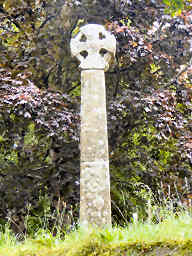
This does seem to be an oddly named village, but less oddly when you understand that it is a variation on "coit" and therefore means wood or woodland, not that there is much woodland here these days. According to Genuki, the name was originally Gwydhek and, in its present form, is pronounced "Gwithick". I was there, in mid-September 2017, essentially to see the Cornish Cross, a tall wheel-headed cross in three sections, probably medieval rather than earlier. In the event I was very pleasantly surprised by the church interior which retains some early features. Behind the altar is an elaborate and colourful reredos. The nave and aisle ceilings are wagon roofed with carved bosses; the chancel ceiling is wonderfully patterned and coloured. Most unusually the rood stairs are still in place, though the loft and screen are long gone. In the chapel in the south transept a number of brasses are displayed, the oldest, to Roger Kyngdon, of 1471. Another brass is to Johann Rooke Fletcher. The quire pew has an elaborately carved back, scenes including the crucifixion. I also visited Pillaton and Tideford, the latter so often mispronounced as spelt but really Tiddyford for its river, the Tiddy.