
Quaker Meeting House
Cornwall has always been fertile ground for what the Church of England likes to call nonconformism. Some of John Wesley's greatest successes were in Cornwall where mining communities turned out in their thousands to hear him preach (see Gwennap Pit). A hundred years before Wesley an even simpler creed had taken hold in Cornwall, led by the important Falmouth ship-owning Fox family, appropriately since the founder of the Quakers was George Fox, though he was from Leicestershire. There are several Quaker Meeting Houses in Cornwall. One of the most charming is to be found just off the road to Trelissick Garden. Technically called Feock Meeting House - Feock is a pleasing small waterside village a mile or two further on - it actually stands in the almost non-existent settlement of Come-to-Good (a nice biblical ring to that). It was derelict when Jane first knew it, but has now been re-thatched and restored and is again a place of worship. The exterior is as charming as the best of meeting houses and features thatch, whitewash and leaded windows. The interior is simplicity itself and, even when empty, has a touching tranquillity. You can see other places associated with the Foxes - why not visit their gardens at Glendurgan and Trebah, both within half an hour of here.
Come-to-Good Meeting House
Winter photo; summer view obscured by trees
Busveal,
More in Churches & Holy Sites
Quethiock, St. Hugo
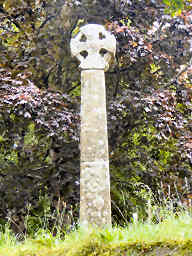
This does seem to be an oddly named village, but less oddly when you understand that it is a variation on "coit" and therefore means wood or woodland, not that there is much woodland here these days. According to Genuki, the name was originally Gwydhek and, in its present form, is pronounced "Gwithick". I was there, in mid-September 2017, essentially to see the Cornish Cross, a tall wheel-headed cross in three sections, probably medieval rather than earlier. In the event I was very pleasantly surprised by the church interior which retains some early features. Behind the altar is an elaborate and colourful reredos. The nave and aisle ceilings are wagon roofed with carved bosses; the chancel ceiling is wonderfully patterned and coloured. Most unusually the rood stairs are still in place, though the loft and screen are long gone. In the chapel in the south transept a number of brasses are displayed, the oldest, to Roger Kyngdon, of 1471. Another brass is to Johann Rooke Fletcher. The quire pew has an elaborately carved back, scenes including the crucifixion. I also visited Pillaton and Tideford, the latter so often mispronounced as spelt but really Tiddyford for its river, the Tiddy.
Ruan Lanihorne Shields
Lanihorne Shields
Saint Feoc's Church
More Images of Saint Feoc's Church