Saint Feoc's Church
More Images of Saint Feoc's Church
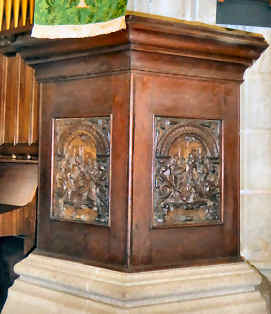
Feock Pulpit
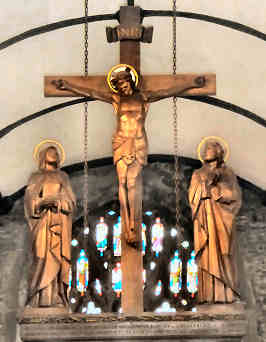
Feock Reredos
Feock Font
Photographs
More in Churches & Holy Sites
Saltash, St. Nicholas and St. Faith
When I revisited Saltash to explore the waterfront, I was pleasantly surprised to find the church open and a lady preparing it for a later funeral. So I took my chance to have a good lock inside. As the church is in the centre of town, I would have expected it to be Saltash's main church. However that honour goes to the mother church, a mile away in the former village of St. Stephen, now swallowed by Saltash. St. Nicholas and St. Faith occupies a central position, next to the Guildhall. It was originally just a chapel of ease to the area's main church, St. Stephen, a mile away in what was once the separate village of St. Stephen. Despite that, its origins are Norman and much Norman work remains. The interior, with its Cornish wagon roofs, has a lofty feel. There is a South Transept, unusually for Cornwall, connected by a squint to a chapel. There are openings where the rood stairs were and the rood itself remains in place at the entrance to the chancel. The font appears to be Norman and the pulpit has some linen-fold panelling. The altar has three carved panels. Stained glass is of the late 19th and early 20th century, much restored following war damage. A simple litany desk is probably Victorian. There is a fine memorial to three Drew brothers, drowned at sea and there is a simple but attractive hanging on the organ case. Now go to St. Stephen's, Saltash
Saltash, St. Stephen's Church
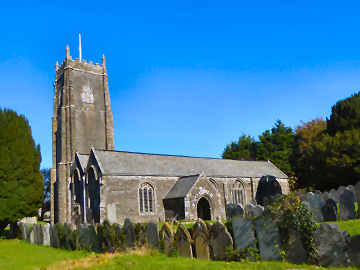
To open, I can do no better, in describing this somewhat unusual church, than to quote Pevsner - "A large and ambitious church with a stately tower standing in a most unusual position N of the W end of the nave and facing the W end of an obviously later N aisle". The church, set in a grassy but largely empty churchyard, dates from the middle of the 13th century but the present building is largely of the 15th and 16th centuries, much restored, as is the case with so many Cornish churches, in late Victorian times. The tower is impressive as is the interior when you enter the church through a massive oak door. Nave and both aisles are high ceilinged with typically Cornish wagon roofs with an abundance of carved and painted bosses. The reredos, by Harry Hems of Exeter is elaborate and colourfully painted. There are five early 20th century stained glass windows in the north aisle, some quite striking. In the chancel, monuments to the Hitchens family are painted in pastel colours. The Norman font is of the Bodmin type with a central pillar and four slim outside pillars topped with carved heads. Pews have been removed from the rear of the church; those that remain are probably Victorian and of no particular merit. A much eroded lantern cross stands in the churchyard immediately south-east of the church. Now go to St. Nicholas & St. Faith, Saltash
Sancreed, St. Sancredus Church
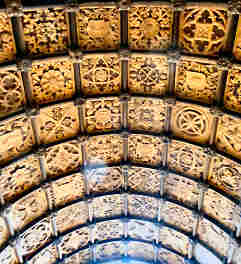
I have been in Sancreed, way down west in West Penwith, almost to Land's End, on four occasions. The first was in July 2006, the second in March 2008 then, after a gap of more than nine years, I was back there in October 2017 and again in April 2018. In 2006, in search only of antiquities, I had ignored the village and had been to Sancreed Beacon and Caer Bran. In 2008 I had concentrated on the church itself and the nearby Holy Well and Baptistery Chapel. In October 2017, the church was closed for renovation so I again concentrated on the Cornish Crosses, one of the finest church collections in Cornwall: I counted five in all, including one on the graveyard hedge to the road and one on the wall by the main steps. According to Pevsner the church of Saint Sancredus is largely of the 15th century. It consists of nave, south aisle, north transept and short pinnacled tower. The porch has an original wagon roof. Inside are rood stairs, remains of the lower part of a rood screen with amusing carvings, and a 15th century font of the St. Ives type with four angels holding shields. The nave and chancel ceilings are particularly fine, the woodwork carved and fretted. The original reredos, a Nativity scene, is now on the north wall of the chancel. Some notable artists are buried in the churchyard, including Stanhope Alexander Forbes, Elizabeth Adela Forbes and Thomas Cooper Gotch. When I was there in April 2018 the graveyard was covered in primroses; that was the occasion when I took the interior photos. A little way up the road, a holy well and baptistery are marked by a modern Cornish Cross.