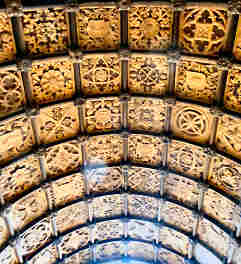
Sancreed, St. Sancredus Church
I have been in Sancreed, way down west in West Penwith, almost to Land's End, on four occasions. The first was in July 2006, the second in March 2008 then, after a gap of more than nine years, I was back there in October 2017 and again in April 2018. In 2006, in search only of antiquities, I had ignored the village and had been to Sancreed Beacon and Caer Bran. In 2008 I had concentrated on the church itself and the nearby Holy Well and Baptistery Chapel. In October 2017, the church was closed for renovation so I again concentrated on the Cornish Crosses, one of the finest church collections in Cornwall: I counted five in all, including one on the graveyard hedge to the road and one on the wall by the main steps. According to Pevsner the church of Saint Sancredus is largely of the 15th century. It consists of nave, south aisle, north transept and short pinnacled tower. The porch has an original wagon roof. Inside are rood stairs, remains of the lower part of a rood screen with amusing carvings, and a 15th century font of the St. Ives type with four angels holding shields. The nave and chancel ceilings are particularly fine, the woodwork carved and fretted. The original reredos, a Nativity scene, is now on the north wall of the chancel. Some notable artists are buried in the churchyard, including Stanhope Alexander Forbes, Elizabeth Adela Forbes and Thomas Cooper Gotch. When I was there in April 2018 the graveyard was covered in primroses; that was the occasion when I took the interior photos. A little way up the road, a holy well and baptistery are marked by a modern Cornish Cross.
Elaborate Chancel Ceiling
Sancreed Church at primrose time
Carved Wood Pulpit
Photographs
More in Churches & Holy Sites
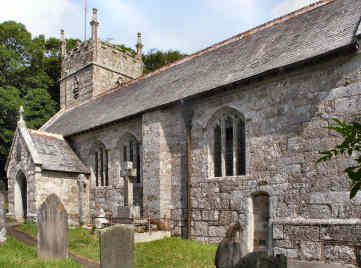
Sancreeed - Cornish Crosses and a Holy Well and Chapel
In July 2006 I had called in at Sancreed, on my way to walk on Carnyorth Common, in search of a stone circle and some boundary stones, planning just to see a couple of much admired Cornish crosses that I had read about. In the event I stayed much longer than expected as I learned there was a nearby holy well and chapel remains and then I discovered there were bronze age remains on Sancreed Beacon. The church is attractive and clearly mainly of the 14th or 15th centuries. I wasn't able to get in but, if the interior has anything as good as the carved bosses on the porch roof timbers, it should be worth seeing - I hope to return on another occasion to see the inside.
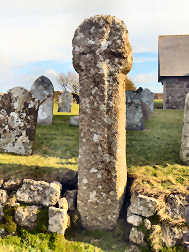
Sennen, St. Sennen's Church
Most people, when they think of Sennen, will think rather of Sennen Cove, the surfimg settlement on the beach on the lovely curve of Whitesand Bay. Attractive though that may be, and I have passed through it many times walking the Coast Path towards Land's End, now my interest is in the village on the road heading there. There is very little to Sennen village except for a few speed bumps, a few houses, the First and Last pub and the small parish church of St. Sennen, the most westerly in England. I say small but there is more to it than at first appears: nave, north transept, chancel, south aisle and, of course, tower. The church dates from mid 15th century and earlier. It was restored in 1867 by the ubiquitous J P St. Aubyn. The internal fittings are a mix of old and relatively new. The small font, with its Victorian cover, bears the date of 1442. Chancel pew ends are topped by carved angels. The 1920s oak pulpit carries carvings of biblical figures and, according to Pevsner, fish, crabs and lobsters, but I didn't spot them. Stained glass is from 1878-9 by Clayton & Bell. In the churchyard are two Cornish Crosses, a tall one overlooking the road and a cross-head by the entrance steps to the churchyard. In the porch is an entertaining welcome message; don't miss it.
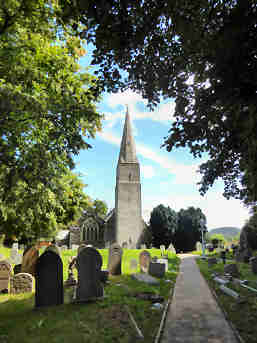
Sheviock, Church of the Blessed Virgin Mary
In mid-August 2019 I headed way down east to the Torpoint peninsula, across the broad Tamar from Devonport. I took a look at Torpoint itself but was singularly unimprerssed. My main port of call was to be Antony for St. James Church, Maryfield but I also took the opportunity to see the church of the Blessed Virgin Mary in Sheviock. The majority of Cornish village churches were largely built or rebuilt in the 15th century. That in Sheviock is unusual in that much of the fabric is of the late 13th and early 14th centuries. It is also unusual in that the tower is narrow compared to the nave, and that it has a "broach" spire, starting from a square base but developing into octagonal form. In the 15th century a north transept was converted to a north aisle. In the south transept are funeral recesses; a knight and a lady of about 1375 lie on plain tomb chests, Sir Edward Courtney(1371), presumably related to the Courtney Earls of Devon, and his wife Emmeline, daughter of the local great family, the Dawnays. On the north wall is another tomb chest bearing another knight of similar date. There are three plain sedilia and piscinas in the chancel and south transept. The Minton tiles in the chancel floor date from an 1850 restoration by G E Street. Slate tablets of the Lord's Prayer and the Creed are in the north aisle. There is an elaborately decorated triple panel pew back and a particularly fine collection of bench ends. There are good 19th century stained glass windows.