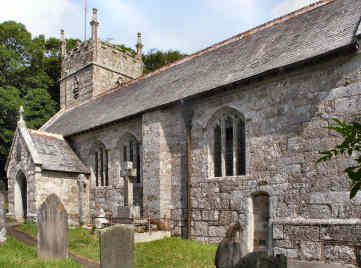
Sancreeed - Cornish Crosses and a Holy Well and Chapel
In July 2006 I had called in at Sancreed, on my way to walk on Carnyorth Common, in search of a stone circle and some boundary stones, planning just to see a couple of much admired Cornish crosses that I had read about. In the event I stayed much longer than expected as I learned there was a nearby holy well and chapel remains and then I discovered there were bronze age remains on Sancreed Beacon. The church is attractive and clearly mainly of the 14th or 15th centuries. I wasn't able to get in but, if the interior has anything as good as the carved bosses on the porch roof timbers, it should be worth seeing - I hope to return on another occasion to see the inside.
The Cornish crosses are amongst the very best, with surprisingly clear detail for their thousand year age. There are also cross heads embedded in the churchyard walls. Just up the road, through what looks like a garden gate on the left, is a holy well, steps leading down to it, a 'prayer' tree to its left, relics of those for whom prayers are offered hanging from it, and ruins of a chapel to its right. All that spoils the peace is a rather ugly modern pastiche of a Cornish cross. If you continue up the hill, on your right you find Sancreed Beacon with bronze age remains and impressive views.
From Penzance, right at the end of Drift village
Saint Credan's Church
October 2014: The church has been placed on English Heritage's 'Buildings at Risk' register, needing urgent repairs to the roof and fabric. The major cross in the churchyard, in danger of toppling, has also been added to the register. Work completed when I visited in April 2018.
Trewint,
More in Churches & Holy Sites
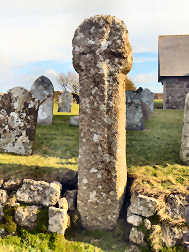
Sennen, St. Sennen's Church
Most people, when they think of Sennen, will think rather of Sennen Cove, the surfimg settlement on the beach on the lovely curve of Whitesand Bay. Attractive though that may be, and I have passed through it many times walking the Coast Path towards Land's End, now my interest is in the village on the road heading there. There is very little to Sennen village except for a few speed bumps, a few houses, the First and Last pub and the small parish church of St. Sennen, the most westerly in England. I say small but there is more to it than at first appears: nave, north transept, chancel, south aisle and, of course, tower. The church dates from mid 15th century and earlier. It was restored in 1867 by the ubiquitous J P St. Aubyn. The internal fittings are a mix of old and relatively new. The small font, with its Victorian cover, bears the date of 1442. Chancel pew ends are topped by carved angels. The 1920s oak pulpit carries carvings of biblical figures and, according to Pevsner, fish, crabs and lobsters, but I didn't spot them. Stained glass is from 1878-9 by Clayton & Bell. In the churchyard are two Cornish Crosses, a tall one overlooking the road and a cross-head by the entrance steps to the churchyard. In the porch is an entertaining welcome message; don't miss it.
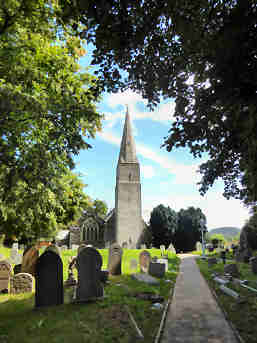
Sheviock, Church of the Blessed Virgin Mary
In mid-August 2019 I headed way down east to the Torpoint peninsula, across the broad Tamar from Devonport. I took a look at Torpoint itself but was singularly unimprerssed. My main port of call was to be Antony for St. James Church, Maryfield but I also took the opportunity to see the church of the Blessed Virgin Mary in Sheviock. The majority of Cornish village churches were largely built or rebuilt in the 15th century. That in Sheviock is unusual in that much of the fabric is of the late 13th and early 14th centuries. It is also unusual in that the tower is narrow compared to the nave, and that it has a "broach" spire, starting from a square base but developing into octagonal form. In the 15th century a north transept was converted to a north aisle. In the south transept are funeral recesses; a knight and a lady of about 1375 lie on plain tomb chests, Sir Edward Courtney(1371), presumably related to the Courtney Earls of Devon, and his wife Emmeline, daughter of the local great family, the Dawnays. On the north wall is another tomb chest bearing another knight of similar date. There are three plain sedilia and piscinas in the chancel and south transept. The Minton tiles in the chancel floor date from an 1850 restoration by G E Street. Slate tablets of the Lord's Prayer and the Creed are in the north aisle. There is an elaborately decorated triple panel pew back and a particularly fine collection of bench ends. There are good 19th century stained glass windows.
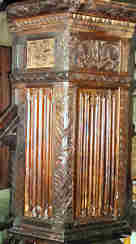
South Petherwin and Lawhitton
At the beginning of January 2018 I made another trip to the Launceston area, this time primarily to visit the village of South Petherwin and to take a good look at its church. On the way I made a detour to Lawhitton, to the south-east of Launceston. It was a bit of a wasted journey as the church was firmly locked. However I did note one unusual feature; attached to the east side of the three-stage tower was a stair turret, itself in an unexpected three stages of square turret. Next, in South Petherwin, I found car parking for the church and village hall. The latter is quite entertaining, built of corrugated iron, painted green, and with a nice name plaque, probably designed by local children. The church is quite impressive, standing high on a raised enclosure, not uncommon in Cornwall and possibly of pre-Christian origin. Most unusually, the entrance to the church is by a north porch. The first thing you notice, before entering, is a short massive pillar to the right of the porch; Pevsner explains this as a relic of the Norman church that stood here previously. Several things took my eye inside. Wooden ceilings are barrel-vaulted with ribs and carved bosses. The octagonal Jacobean (1631) pulpit is carved with fine linen-fold panelling. The lectern has somewhat similar panelling. Elaborate bench-ends carry figures of angels. The altar table is decorated with panels of embroidered flowers. An octagonal Norman font stands on a central column, surrounded by narrower columns. A chair in the chancel appears to be of early date. A wall monument to Ambrosius Manaton de Trecarrel is somewhat degraded but appears to date from 1651. There are rood stairs but both openings are blocked by later wooden doors.