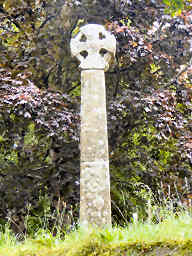
Quethiock, St. Hugo
This does seem to be an oddly named village, but less oddly when you understand that it is a variation on "coit" and therefore means wood or woodland, not that there is much woodland here these days. According to Genuki, the name was originally Gwydhek and, in its present form, is pronounced "Gwithick". I was there, in mid-September 2017, essentially to see the Cornish Cross, a tall wheel-headed cross in three sections, probably medieval rather than earlier. In the event I was very pleasantly surprised by the church interior which retains some early features. Behind the altar is an elaborate and colourful reredos. The nave and aisle ceilings are wagon roofed with carved bosses; the chancel ceiling is wonderfully patterned and coloured. Most unusually the rood stairs are still in place, though the loft and screen are long gone. In the chapel in the south transept a number of brasses are displayed, the oldest, to Roger Kyngdon, of 1471. Another brass is to Johann Rooke Fletcher. The quire pew has an elaborately carved back, scenes including the crucifixion. I also visited Pillaton and Tideford, the latter so often mispronounced as spelt but really Tiddyford for its river, the Tiddy.
Quethiock Cornish Cross
Quethiock Church
Quethiock Church Chancel Ceiling
Photographs
More in Churches & Holy Sites
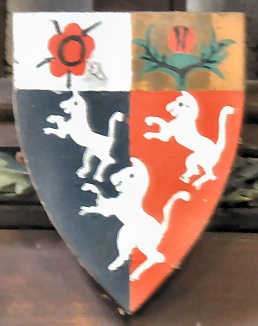
Ruan Lanihorne Shields
Lanihorne Shields
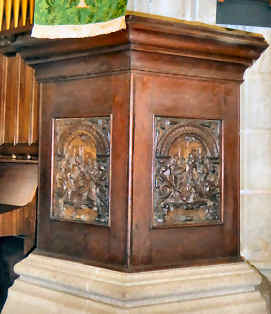
Saint Feoc's Church
More Images of Saint Feoc's Church
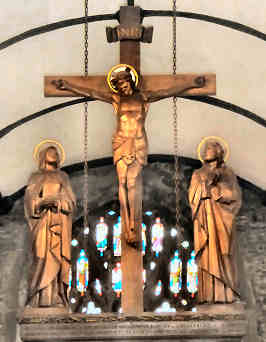
Saltash, St. Nicholas and St. Faith
When I revisited Saltash to explore the waterfront, I was pleasantly surprised to find the church open and a lady preparing it for a later funeral. So I took my chance to have a good lock inside. As the church is in the centre of town, I would have expected it to be Saltash's main church. However that honour goes to the mother church, a mile away in the former village of St. Stephen, now swallowed by Saltash. St. Nicholas and St. Faith occupies a central position, next to the Guildhall. It was originally just a chapel of ease to the area's main church, St. Stephen, a mile away in what was once the separate village of St. Stephen. Despite that, its origins are Norman and much Norman work remains. The interior, with its Cornish wagon roofs, has a lofty feel. There is a South Transept, unusually for Cornwall, connected by a squint to a chapel. There are openings where the rood stairs were and the rood itself remains in place at the entrance to the chancel. The font appears to be Norman and the pulpit has some linen-fold panelling. The altar has three carved panels. Stained glass is of the late 19th and early 20th century, much restored following war damage. A simple litany desk is probably Victorian. There is a fine memorial to three Drew brothers, drowned at sea and there is a simple but attractive hanging on the organ case. Now go to St. Stephen's, Saltash