St. Enodoc Church
Enodoc Church,
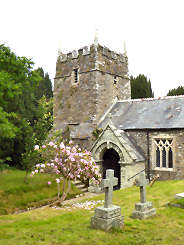
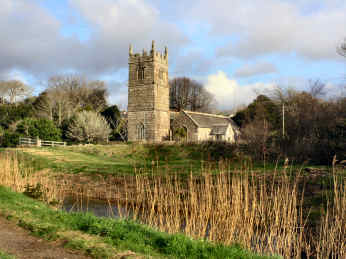
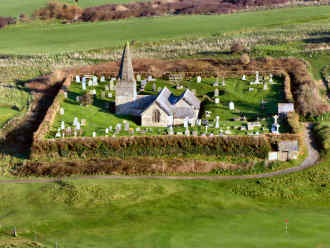
Technically a Chapel of Ease, the history of the little church of St. Enodoc is shrouded somewhat in mystery. Cornwall Calling says it was built around 1430 but Simon Jenkins in his authoritative England's Thousand Best Churches refers to its Norman interior. Its history, however, goes back much further than that. It is probably on the site of the cell of St. Gwinnodock who, during the 6th century, is said to have baptised converts in the Jesus Well on the other side of St. Enodoc golf course which surrounds the church. Architecturally it is an odd church. The south door leads into an aisle. Beyond is the nave with a north transept to which the tower, with its strange, slightly twisted broach spire, is attached. The late poet laureate, Sir John Betjeman, who had a second home nearby and who loved the church, is buried in its churchyard, as is his mother.
Standing on sand dunes, the church was almost lost at one time. In the 19th century encroaching sand buried it up to roof level and the only way the vicar could get in was through a skylight in the roof. To maintain his living he would hold one service a year. Happily in 1863 the then vicar, Rev. Hart Smith, organised its excavation and restoration. Even more happily, that restoration maintained its character. It is safe now, protected by a Cornish hedge planted with tamarisk.
St. Enodoc, the church in the sand
Accessible only on foot across the golf course.