St. Ewe
Ewe
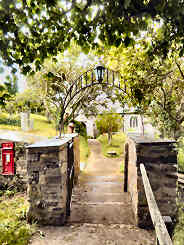
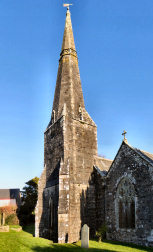
This church, in the attractive small village of St. Ewe, not far from St. Austell and Mevagissey, is relatively early for Cornwall, at least in part: the tower, spire and south aisle all being of the 13th and 14th centuries. I visited while Jane was enjoying coffee with an old friend at Grigg's Country Store at Sticker, just three miles away. After my St. Ewe visit I joined Jane for lunch at Griggs: good food and excellent value. I had been in St. Ewe village previously, to lunch at the excellent Crown Inn, to photograph the market cross, unusual for Cornwall, and to photograph a Cornish Cross on top of a scraggy hedge near the village. On this occasion, in mid-June 2018, I concentrated on the church, where there is plenty of available parking. The church, approached through wrought iron gates - or over a coffen stile - is relatively unimpressive from the outside, except for its striking tower, topped by a dark-stone hexagonal broach spire, very striking and most unusual for Cornwall. The porch has an attractive Cornish wagon roof. Inside, the south aisle roof is, according to Pevsner, a reconstruction of the19th century with bosses imported from St. Keyne. Finest feature of the church is the rood screen, three elaborate open-work carved panels each side of an equally elaborate central door. The coving at the top of the screen is elaborately carved with animals, birds and even a naked boy. The 19th century pulpit is made of late medieval bench ends. The circular font is supported by a central pillar and four narrow pillars around its edge, each topped by a crude head. There is some stained glass, including two lights set back in an attractive early window surround. The several monuments include a fine 1737 one to William Mohun (a good old Norman name, encountered also at Lanteglos by Fowey). The donation box is most unusual, a small Yale safe with a complex combination lock.
St. Ewe Church spire
Colourful kneelers in St. Ewe Church
St. Ewe Church font
St.