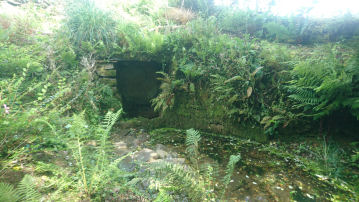
St. Nonna and her Holy Well
Nonna and her Holy Well
St. Nonna (or Non, Nonnita or Nun)
Little is known of St. Non, mother of David, the Patron Saint of Wales. She was born around 500AD and was either married to, or seduced by, Sant a local chieftain. Their issue was David, born in 520. In 527 she left Wales, settled in Cornwall and died in Brittany. Her relics were held in Cornwall until the Reformation. Legend tells other stories. One tells that she married King Caratacus of Cornwall (actually of the Catuvelauni tribe from eastern Britain and led resistance to the Romans) producing David. Another makes Sant a Cornish chieftain who seduced her and as penance founded a monastery at Lezant, 10 miles from Altarnun; interestingly Lezant (Lann Sans) means the saint’s enclosure. Another connects Davidstow, 10 miles from Altarnun with the story. Finally, 15th century chronicler William of Worcester claimed David was born at Altarnun. Non’s best known well is at St. David’s, near the sea. It is beautifully kept and clearly marked, which is more than may be said for that at Altarnun, unmarked, degraded, overgrown, presiding over a stagnant pool. The waters of St. Nonna's well were believed to be a cure for madness. Lunatics were immersed in it and brought to church for mass. To find the well, leave the church northwards uphill to a left bend. Go through a gate and a kissing gate on the right and down to the bottom of the field. It is at 22434/81542. I would have liked to include a photo but the site was disgracefully badly overgrown.
August 2020: I have received an email from Rebecca Sparey-Taylor who has visited Altarnun recently, She kindly attached a photo showing that the site has been cleared and the well-house and pool are now accessible. Photo below.
Antony, St. James Church,
More in Churches & Holy Sites
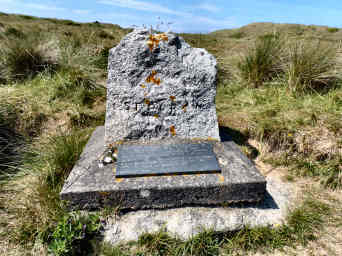
St. Piran - Patron Saint of Cornish Tin Miners
St. Piran is patron saint of Cornish tin miners. It is thought that he was born in Ireland in around AD480, schooled in South Wales and returned to Ireland to found Clonmacnoise monastery, where he was known as Ciaran. He was then captured by heathen Irish who tied him to a millstone and threw him over cliffs during a storm. The storm abated and Piran floated across the sea to Cornwall where he built a hermitage on the vast Penhale sand dunes. He died at his hermitage. St. Piran's Oratory, claimed to be his original chapel although it may date from the 7th or 8th century, was excavated in the 1830s but lost again under the sand. At one time it was hidden under concrete but was later re-excavated. Now a stone and plaque mark its position, about equidistant from a modern cross and the remains of a later St. Piran's church. The oratory was in use until around 1150 when overwhelmed by dunes. The new church was built further inland but abandoned in 1804. An old granite Cornish cross stands by its ruins, subject of an archaeological dig in September 2005. The present church is at Perranzabuloe. A mile away is Piran Round. Only the name has a connection; this is actually the remains of an iron-age farmstead. St. Piran's flag is said to represent white tin flowing from black stone in Piran's hearth.
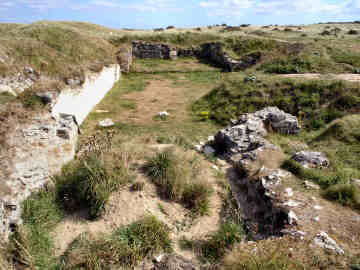
St. Piran's Church - The September 2005 Archaeological Dig
Dig
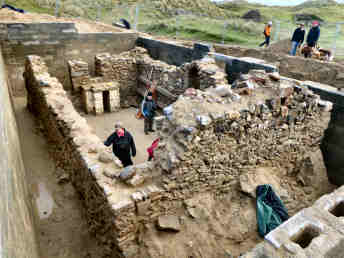
St. Piran's Oratory -The 2014 Archaeological Dig
Oratory -The 2014 Archaeological Dig