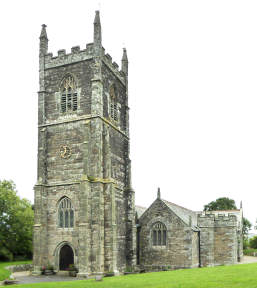
St. Newlyn East, St. Newlina's Church
Newlyn East, St. Newlina's Church
This is one of the many churches in Cornwall built on an older religious site, a raised area known as a lann. The church is best approached from the south, through a lych gate and along a path lined with old tombstones. As you enter the prominent south porch you notice two things. Above the doorway is a small and colourful statue, presumably St. Newlina. To the left of the doorway to the body of the church is another door, looking as if it leads to (presumably now non-existent) stairs. As with so many Cornish churches, St. Newlina's is of Norman origins and some Norman work remains. The present church is mostly of the 13th to 16th centuries but had a major make-over by J D Sedding in 1883. Sedding's work includes some fine carved woodwork and new roofs over the nave, chancel and south aisle, using the original ceiling bosses. The roof of the north transept is original. The rood screen is also the work of Sedding and includes an elaborate rood loft into which he incorporated traceried panels from the original screen in his parclose screen. The font is Norman, of the Bodmin type, angel faces at each corner but the columns replaced with columns of serpentine from The Lizard. 16th century bench ends are capped with heraldic lions and leopards, a device found in a few other Cornish churches. Pevsner reports a much eroded Lantern Head Cornish Cross near the font; I failed to spot it. The Royal Arms are of Charles I and are of brightly painted and gilded plasterwork. Some nice kneelers include a musical one with trombone, a heavy horse, and a strange Cornish Coat of Arms with the 15 bezants, a crown, two white feathers, two Cornish Choughs and the Dutch name "Homout".
Newlyn East Church
Double Bench End
Highly decorated Chancel Ceiling
St.
Photographs
More in Churches & Holy Sites
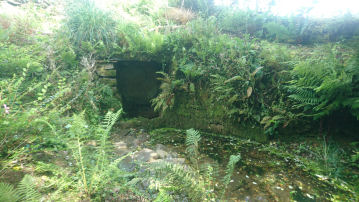
St. Nonna and her Holy Well
Nonna and her Holy Well
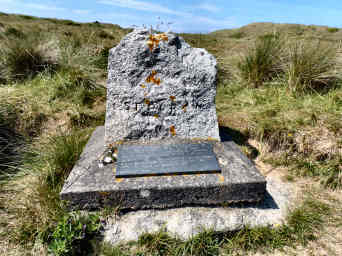
St. Piran - Patron Saint of Cornish Tin Miners
St. Piran is patron saint of Cornish tin miners. It is thought that he was born in Ireland in around AD480, schooled in South Wales and returned to Ireland to found Clonmacnoise monastery, where he was known as Ciaran. He was then captured by heathen Irish who tied him to a millstone and threw him over cliffs during a storm. The storm abated and Piran floated across the sea to Cornwall where he built a hermitage on the vast Penhale sand dunes. He died at his hermitage. St. Piran's Oratory, claimed to be his original chapel although it may date from the 7th or 8th century, was excavated in the 1830s but lost again under the sand. At one time it was hidden under concrete but was later re-excavated. Now a stone and plaque mark its position, about equidistant from a modern cross and the remains of a later St. Piran's church. The oratory was in use until around 1150 when overwhelmed by dunes. The new church was built further inland but abandoned in 1804. An old granite Cornish cross stands by its ruins, subject of an archaeological dig in September 2005. The present church is at Perranzabuloe. A mile away is Piran Round. Only the name has a connection; this is actually the remains of an iron-age farmstead. St. Piran's flag is said to represent white tin flowing from black stone in Piran's hearth.
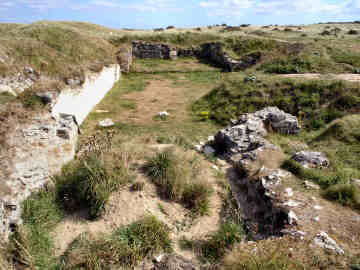
St. Piran's Church - The September 2005 Archaeological Dig
Dig