St. Winwaloe's Church
Winwaloe's Church, Towednack
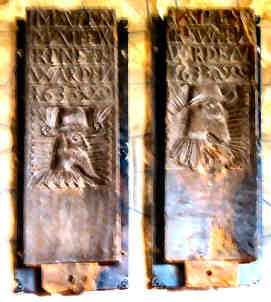
The very first time I saw St. Winwaloe's Church in Towednack was when I was walking a round trail from St. Ives to Lands End and back. This took me out on a lowland route known as the Zennor Churchway and back over the central spine of West Penwith hills on a high level route known as The Old St. Ives Road. On that occasion I crossed a stile out of a field and found myself alongside a small church with a truncated two-stage tower. This was the church of St. Winwaloe. I didn't go in and it was not until January 2017 that I inspected the inside of the church briefly. Two and a half years passed then at the end of August 2019 I had an outing way down west with the specific intention of taking a much closer look at St. Winwaloe's. The very first thing that you notice is a gatepost at the start of the lane to the church with the words "This roadway was constructed and presented to the Parish of Towednack by Sir Edward Hain, Lord of the Manor, 16 November 1914." Walk up the short lane and you come to an open area to the south of the church with a toilet and ample room for parking. On this 2019 visit I noticed a few things that I must have missed the first time round. Although there are none of the carved ends to the benches that you see in so many Cornish churches, there are a couple of bench ends - displayed on a wall. These are the bench ends which were stolen in 1987 but eventually recovered and returned. I also saw a couple of original panels, surprisingly colourful, once part of a rood screen. One is now incorporated in the pulpit steps which are unusually carpeted. Another surprise was to see the Norman font, not in use as such but providing, inverted, the base for the present, more recent, font.
The Stolen Bench Ends Towednack's Colourful Chancel Ceiling Font (or two!)
Trebetherick, St.
Photographs
More in Churches & Holy Sites
St.Breward
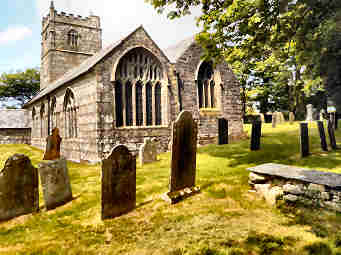
Breward, St. Brueredus,
St.Euny
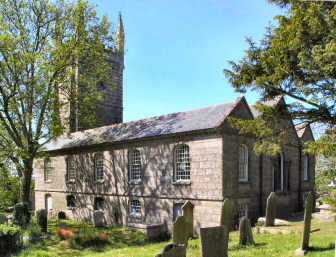
Euny,
Stephen-in-Brannel
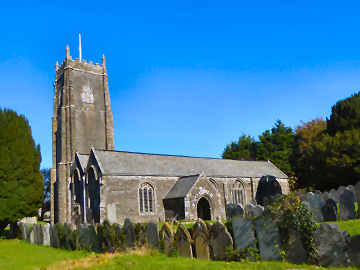
St. Stephen, more of a small town than a village is, perhaps, most notable for having a major car dealer, Hawkins, which is Cornwall's largest Peugeot dealer. It is also notable for being the former centre of the chinastone industry, related to the china clay industry further north. Indeed, back in 2016 I spent an interesting day exploring the chinastone mills, set in hilly woodland. On the same day, I tried to visit the church but it was closed and I had to content myself with photographing its Cornish Crosses. Brief research told me that the church is open on Fridays so I made the trip there on a Friday in mid-June 2019. Unfotunately it turned out to be closed again but an email to priest Emma Childs secured me an appointment to meet a helpful churchwarden in the church. The basis of the present church is 15th century but it is evident from the fine 12th century south doorway that the church's origins were Norman. Major restorations, as with so many Cornish churches took place in the mid and late 19th century. The plan is of chancel and north and south aisles. The interior is spacious. Stained glass includes a charming east window by George Cooper Abbs with scenes from local agriculture and the china clay industry. Choir stalls and prayer desks are 19th century Gothic with with stencilled decoration, reflecting the designs of screens to north and south. The font is late Norman of the Bodmin type, figures at the corners, between them trees of life and animals. The communion rail is early 17th century. In the churchyard is a Cornish Cross, plus the base of what may have been another.