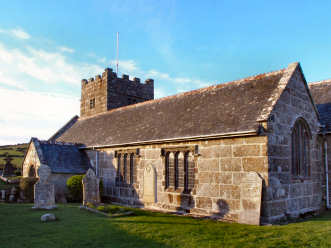
Towednack near St. Ives
, St. Winwaloe's Church
I really only went to see the little church at Towednack because it was used as the location for the wedding of Francis and Elizabeth in the BBC Poldark series. I discovered that it is well worth seeing in its own right. Hidden up a narrow lane, off a narrow country road, roughly between Trendrine Hill and Rosewall Hill, it is a delight with one most unusual feature for Cornwall: its stumpy two-stage tower carries no pinnacles. The present church seems to date from 12th to 16th centuries but the site, a raised one, is almost certainly far earlier than that and might even be a pre-Christian one. The Winwaloe connection is an interesting one. Apparently he was a 6th century Breton hermit, and is also known by two diminutives, Winnow and Wednack, so there may well be connections with St. Winnow near Fowey, Gunwalloe Church Cove and Landewednack Church Cove on the Lizard and Poundstock Church near Bude. Inside is simple and charming, wagon-roofed, the aisle divided from the nave by a fine arcade. The chancel arch, of around 1400 is said to be unique in Cornwall. Two unusual features are a rough granite altar, bearing five carved crosses, and the font, the bowl of which is dated 1720, the base being an upturned Norman font. Outside the porch are remains of two Cornish crosses; in the graveyard is a primitive table tomb. I was delighted to see this lovely little church and can understand why it was used for Poldark.
Towednack's charming little church
Tinners Way passes through here More notes and images
More Notes and Images of St.
More in Churches & Holy Sites
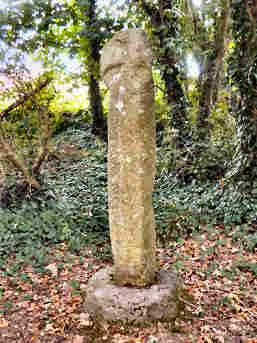
Tregaminion
I first encountered the little church of Tregaminion, in the middle of nowhere about 2 miles from Fowey, while walking the Saints way from Fowey to Padstow in early summer 2006. I visited it again, in early September 2018, at the beginning of a day seeing St. Andrew's Church in Tywardreath and St. Fimbarrus Church in Fowey. The church was built in 1815 as a Chapel of Ease to St. Andrew's at Tywardreath. It was closed each time I tried to visit. Notable features, visible from the outside, are a small bellcote and the old arms of the Rashleighs, unearthed when the church was being built. To the right of the church, on a bank, is quite a tall Cornish Cross. To the left, also on a bank, is a short Cornish Cross.
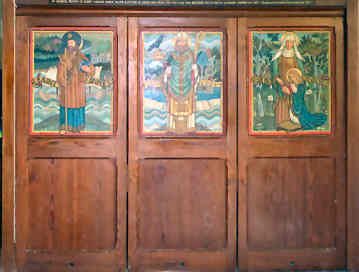
Tregony, St. Cuby's Church
I had a busy last Saturday of March 2018, visiting three churches in the direction of Truro: St. Cuby, Tregony; St. Cornelius, Cornelly; and St. Keyne at Kenwyn on the northern outskirts of Truro. Tregony village, a nice place with most amenities including Post Office, shop and pub, is a long one street village on a steep hill from the infant River Fal up to the church at the very top of the hill. I had been inside Tregony church previously but, on this occasion I was there primarily for the inscribed stone built into the south-west corner of the south aisle. The inscription apparently reads "Nonnita ercilini rigati .....tris fili ercilini", but is very difficult to decipher. From the lych gate, an avenue of tombstones leads to the porch with its vaulted roof and door with elaborate ironwork. Inside are nave and south aisle. The royal coat of arms, unusually, is of James II. The font is late Norman, with heads at each corner, as at Bodmin. The hexagonal pulpit incorporates medieval bench ends, part of the reason there are no old ends on the present benches. A wall monument of 1644 commemorates Hugh Pomeroy. The organ casing incorporates a screen with paintings of saints. Attractive kneelers include one of roses, one of an RNLI lifeboat and one of sheep in a field.
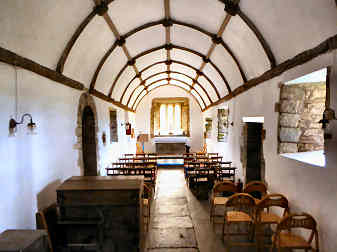
Tremaine
by coincidence, my first visit in the following September was to another St. Winwaloe's, this one just outside Tremaine, to the north of the road from Davidstow to Launceston. This is an unusual little church. Standing quarter of a mile to the north-west of Tremaine village it also stands on a lann, a raised, probably Celtic, site. It is a small, simple two-cell church, its nave and chancel totalling only 45 feet overall. Its stubby three-stage tower is buttressed and topped by crocketed pinnacles. The north wall dates from Norman times and has a small blocked doorway up a couple of steps. The church was partly rebuilt at the turn of the 13th century and windows were replaced at the turn of the 15th century. The interior has a charming simplicity. The 15th century wagon roof is ceiled and plastered with moulded ribs, a carved wall-plate and a variety of carved bosses. Windows vary; a simple two light window in the nave, a Gothick three-light window in the chancel. In the north wall a narrow flight of steps may have led to a former rood loft. The Norman font is circular with cable moulding. The chancel has dark marble paving and the simple altar is of dark stone.