Tremaine
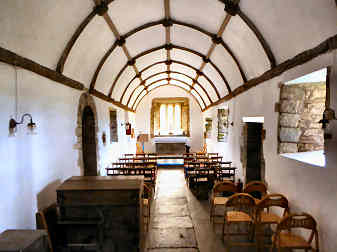
by coincidence, my first visit in the following September was to another St. Winwaloe's, this one just outside Tremaine, to the north of the road from Davidstow to Launceston. This is an unusual little church. Standing quarter of a mile to the north-west of Tremaine village it also stands on a lann, a raised, probably Celtic, site. It is a small, simple two-cell church, its nave and chancel totalling only 45 feet overall. Its stubby three-stage tower is buttressed and topped by crocketed pinnacles. The north wall dates from Norman times and has a small blocked doorway up a couple of steps. The church was partly rebuilt at the turn of the 13th century and windows were replaced at the turn of the 15th century. The interior has a charming simplicity. The 15th century wagon roof is ceiled and plastered with moulded ribs, a carved wall-plate and a variety of carved bosses. Windows vary; a simple two light window in the nave, a Gothick three-light window in the chancel. In the north wall a narrow flight of steps may have led to a former rood loft. The Norman font is circular with cable moulding. The chancel has dark marble paving and the simple altar is of dark stone.
St. Winwaloe's Simple Wagon-roofed Nave
The Church on its Lann
Simple Two-light Window
Photographs
More in Churches & Holy Sites
Tresillian, Holy Trinity Church
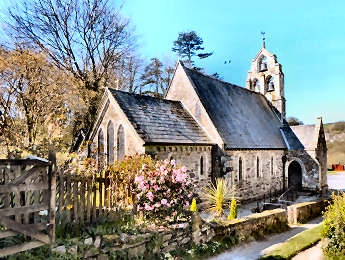
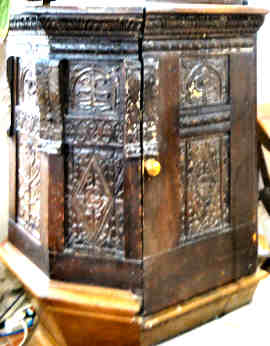
Situated as it is on one angle of a double bend, Holy Trinity Church in Tresillian, on the road from St. Austell to Truro, is very easy to miss. However, if you can find somewhere to park, this small church is well worth a visit. You will, however, need to go to "A Church near you" to make arrangements for a visit, as Holy Trinity is firmly locked normally. I did make such arrangements and was pleased that I did so. Viewed from the road (best from the Truro direction) Holy Trinity is not unattractive, its nave topped by a triple bell-cote. Also from the road, do note the small Cornish Wayside Cross head below its (approximately) west front. Holy Trinity dates from 1904 and is by W D Carὅe in an Arts and Crafts style. While the exterior is perfectly pleasant, it is not outstanding, particularly as it can be difficult to see for traffic. What is important is the collection of fittings inside which were brought from the abandoned church at Merther, a couple of miles to the SSW of Tresillian. These include the 12th century octagonal-shafted Pentewan stone FONT; the 17th century polygonal Jacobean oak PULPIT with carved panels; the 15th century figure of ST. ANTHONY carved in Catacleuse stone; the wheel-head CORNISH CROSS which stands at the roadside in front of the church; and, of the trio of bells, prominent in the bell-cote above the end of the church, two are from Merther, the third from the detached bell-tower at Lamorran. More images of Holy Trinity, Tresillian
Tresillian, Holy Trinity Church
Tresillian, Jacobean Pulpit
Treslothan. St. John's Church
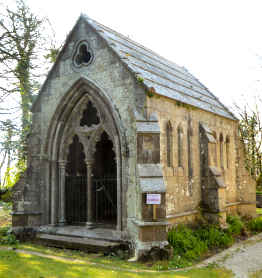
When I walked from Beacon to Clowance on the Land's End Trail I was really surprised by Treslothan hamlet. All very grey and Victorian othick but all most beautifully maintained. This was the estate village of nearby Pendarves House and survived intact when the Georgian home of the Pendarves family was demolished in 1955. All built in the 1840s by architect George Whitwick, the church, house and former school are all of the same silvery grey granite and surround a war memorial. Contrast the number of names on the memorial with the smallness of the village; these must mostly have been workers on the large but dispersed Pendarves estate. Next to the church is the Pendarves Mausoleum. Buried in the churchyard is self-taught Camborne poet John Harris. On a corner by woods is the former village well. From here a footpath heads roughly south, first passing the former schooll, now a private home, then continuing through fields and woods to the road from Troon to Carwynnen. If you are visiting Carwynnen Quoit, re-erected in 2014 by the Sustainable Trust, this is as good a route as any, turning right on the road towards Carwynnen, then right into a gate into a field. Inside the gate is a storyboard; the quoit is across the field.