Warbstow, St. Werburgh's Church
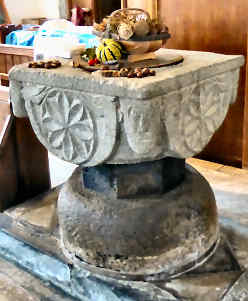
Towards the end of October 2019 I had an outing to the north of the county to visit two churches, St. Mary the Virgin at Week St. Mary and this church, St. Werburgh's in Warbstow. Here I was fortunate: the church is normally closed but I hit it at a time when churchwardens were busy preparing the church for the following day's Sunday service. The first thing to note about St. Werburgh's is that it is set within a fairly steeply sloping lann, a probably pre-Christian enclosure; main entrance to the churchyard is to the south but a further entrance crosses a coffen stile from a farm track to the north. The next thing to note is that the church differs a little from the usual pattern; in this case the porch in use is not in its usual southern position but here is on the north side of the church. It is a little difficult to date the church precisely; it is unsure how much, if any, of the present structure may date back to a 12th century chapelry to Treneglos thet stood here, both belonging to Tywardreath Priory, far away near Cornwall's south coast. The plain, unbuttressed, tower is only of two full stages, topped by very simple pinnacles. Pevsner describes the porch in use, unusually on the north side, as "ambitious" and, indeed, its interior door and its Polyphant stone surround are quite impressive. The present church consists of Nave and 15th century north aisle only, a south transept having been removed in a restoration in 1861. There is some good 3-light Perpendicular tracery, especially in the east Chancel window. The chancel also has a trefoil-headed lancet in the south wall. The south wall of the nave has glass by Arthur Bradley of Minster Glass. The aisle arcade has Cornish standard piers and 4-centre arches. The font is an Altarnun type with faces at the four top corners. It stands on a truncated pillar of probably polyphant stone. Its base appears to be an early upturned font. The organ case has a rather amateur look to it. Two litany desks are quite attractive. The pulpit is simple and rather amateurish looking. Pews, too, are simple with, disappointingly, no carved bench ends.
Warbstow's elaborate font
The unused South Porch
The simple Pulpit
Photographs
More in Churches & Holy Sites
Warleggan
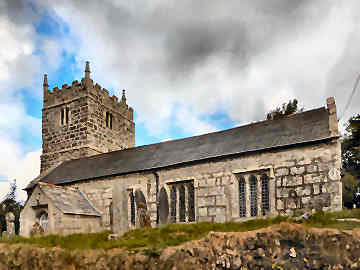
I visited Warleggan's church on the same day in late July as I visited that at St. Winnow. The locations could not be more different. St. Winnow overlooks the Fowey River and looks across the river to dense woodland. Warleggan's church is well inland and is not far from the southern extremity of Bodmin Moor. The first time I was in Warleggan was in June 2006 when Jane and I attended an "Open Gardens" day. The next time I was on my own and on foot. I was following Stage Four of Mark Camp's Circular Copper Trail and parked at the southern end of Colliford Lake followed a route over Carburrow Tor and by way of Whitewalls, Wheal Whisper, Wooda Bridge and Warleggan on the way to Mount. I also remember another walk in the area on which I arrived at Warleggan up a remarkably steep and rocky so-called byway up from Barleysplatt Wood. On this occasion, however, in late July 2018 I was in Warleggan solely for the church. I had been there before but only for the Cornish Cross and had not then been in the church. St. Bartholemew's stands on a mound at the top of a hill and parking is possible there. It is a small low church with a Cornish Cross near the porch. The battlemented tower once had a spire but that fell in 1818. The nave and chancel are 13th century and an added south aisle is 15th century. Granite piers are carved with designs from nature, one of a man with a spear, one of a bear, a third of a hare and leverets. The 14th century font has an octagonal stone bowl. On the north wall the royal coat of arms is of good plasterwork. An alms box is 18th century. A slate monument of 1618 is to Richard Bere. Stained glass is late Victorian. The altar has three simple carved wood panels, a similar reredos above. The simple wooden pulpit stands on a granite base. On the organ casing are wooden panels forming war memorials.
Week St. Mary, Church of St. Mary the Virgin
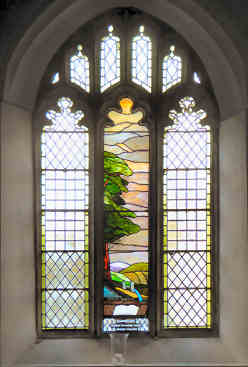
On the same day late in October that I visited St. Werburgh's in Warbstow I also visited nearby St. Mary the Virgin in Week St. Mary. Where St. Werburgh's is built on an ancient site and is almost isolated, St. Mary the Virgin, described by Pevsner as "large and dignified," is at the north end of an extended village, beyond the village square and adjacent to skeletal earthworks known as "the castle." The church, described by Pevsner as "large and dignified," is something of a mix of late medieval centuries, all subject to the usual restoration by the inevitable J. P. St. Aubyn. The first thing to take your attention is the second stage of the tower where a Virgin Mary figure is set in a canopied niche. The tower is 15th century with a high degree of decoration with carved figures on the plinth and above and below the string courses. Inside, the north aisle is 15th century, the south aisle late 14th century and the south arcade has piers of Polyphant stone. The wagon roofs of the north and south aisles were restored by J P St. Aubyn in 1879-81. The font is octagonal, late Gothic in style with coarse carving. Glass in the north aisle is of 1857 by Kempe. There are some excellent carved ceiling bosses. The pulpit is covered in crude linen-fold panelling. Rood stair openings are still in polace. An elaborate grave slab, hanging on a wall, is in memory of John Gayer of Whitestone. Wall hangings include a nice one of the Virgin and Child. Kneelers include an unexpected one of an engine house on a cliff-top.
Wenn Revisited
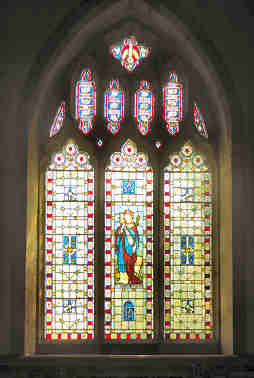
Pevsner's current entry for St. Wenna's church is quite brief, less than half a page. One might therefore expect a church of little interest. I didn't find that to be the case but instead found plenty to enjoy. There is a large free village car park a couple of hundred yards north-east of the church; best to use this and approach the church by road, passing the school on your left and then taking a small gate into the churchyard. The tower is less prominent than it once was. Originally of three stages, the top stage was lost in a partial collapse in 1825. On your way round to the south porch, pause on the south side of the tower to admire some of its detail, including the finely detailed west window over the striking (unused) west doorway. Do note the sundial, not in its usual place over the doorway of the porch but on the west face of the tower; dated 1855, it bears the inscription "Ye know not when." A lot has happened to the church since it was built. The chancel was rebuilt in 1825 and a major restoration was completed in 1889 by J P St. Aubyn (who else?). Compared to Cornwall's grander churches the scale here is relatively intimate. At the east end, the chancel has 19th century decoration, including a reredos of the Last Supper. Glass in the east window is by Powell & Sons and is a striking grisaille with the figure of the Good Shepherd at its centre. The font is possibly of the 12th century, of the Bodmin type with zig-zag decoration, standing on a plain central shaft and supported by four narrow shafts, each topped by a carved head. Rather surprisingly, some fine decorative panels, bearing the Lord's Prayer and the Creed, are hidden away in the vestry. The Lady Chapel is maintained as a Children's Corner and there are a couple of attractive modern hangings.