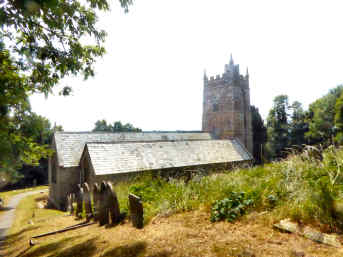
Whitstone, St. Anne's Church
I had originally intended, on the June Saturday when I visited North Tamerton Church, to take a close look at St. Anne's church in Whitstone. Unfortunately it was closed but, when photographing the church, I noticed on an exterior south wall an attractively carved slate, dated 1712, commemorating Thomas Edgcumbe. Set below the church, on its south side, is the restored St. Anne's Well. The well house is in good condition, probably restored in the late 18th century, and is in water. I could find no convenient allocated parking so I backed down the lane to the lych gate and parked there. Although unable to gain entry this time, I believe there may be a local keyholder and I shall check for that next time I visit Whitstone. Notes from Pevsner: 15th century roofs over nave and chancel. Encaustic floor tiles. A chair incorporates 16th century bench ends. A circular Norman font has a leaf frieze. Stained glass is late 19th century. The lych gate dates from 1882.
Revisit: I returned to Whitstone in July 2018 and found a keyholder - just before he left for the day. I was glad that I did: the interior of St. Anne's church held unexpected treasures, not mentioned in Peter Beacham's revised 2014 Pevsner. The first thing I noticed was the fascinating porch: a Cornish wagon roof has one boss of a carved face and the granite door surround is quite striking. The interior has much to commend it, too, Nave and two aisles have differing roofs, the north aisle being a much lower Cornish wagon roof. The chancel is approached through an elaborate screen, topped by a rood. Inside the chancel a three light window is contained within a massive surround, as if this were once an entrance. The chancel ceiling is of the wagon type with multiple bosses. There is a priest's chair and an unusual litany desk with attached chair. The carved oak pulpit appears to carry mason's symbols. The altar has three arches with elaborate carving and lettering. But the most striking feature of all may be very recent as it gets no mention in Pevsner. This is the series of thirteen "Stations of the Cross" paintings in elaborate frames that line the walls. All in all a fascinating church which I was really pleased to visit.
St. Anne's Church, Whitstone More Whitstone images
St. Anne's Well
More
Photographs
More in Churches & Holy Sites
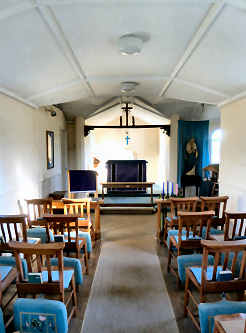
Widemouth Bay, Church of Our Lady and St. Anne
On a fine sunny Monday in early December Jane and I decided to have an outing to Bude, one of our favourite small towns. On our way there we stopped off at a tiny church, serving Widemouth Bay, the Church of Our Lady and St. Anne. Its location in Leverlake Road, less than quarter of a mile from the beach, is not its original site, it having been moved from Madeira Road. It serves as a chapel of ease to the lovely St. Winwaloe's in Poundstock. It was erected in 1929 by the Kingdom brothers, to serve as their own private chapel for quiet contemplation and as a quiet place to write their sermons. In the grounds there is also a small, attrative timber summerhouse; this was purchased and erected by the church members in 2006 and is used by both the congregation and the local community for meetings and events. There being no other public meeting place in Widemouth Bay, and thanks to the generosity of the churchwardens, it is a well-used local facility. Widemouth Bay church is very much of "pre-fab" construction but is kept in excellent condition. Externally it is quite photogenic, being white with black supporting timbers and topped by a tiled roof. Viewed from the front, there is a tiny bell-cote over the door, topped by a small cross. Inside, the chancel is simple and lighted by windows on two sides. A statue of the Virgin and Child is quite attractive. There is ample car parking in the adjacent gated field.
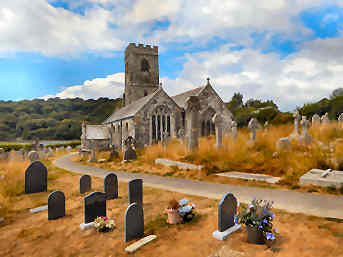
Winnow
I was first in St. Winnow with Jane in May 2004. Later I returned in the course of a round walk from Lerryn that took in St. Winnow and the Ethy Estate. On neither occasion did I venture inside the church. However, I was back there in late July 2018 on a sunny Saturday when the church was being decked out for a wedding. The setting is a delight; the churchyard runs down to the banks of the Fowey River, a little north of its confluence with the River Lerryn. Although there are no ancient Cornish Crosses in the churchyard, there is a good collection of more recent elaborate crosses, commemorating members of the Vivian family. Inside there are very Cornish wagon roofs to the porch, nave and south aisle; the latter has an elaborately carved wall-plate. There is some nice colourful tiling to the chancel floor. The altar table is Jacobean, the pulpit is of later that century. Perhaps the most important feature of the interior is the medieval rood screen complete with rood, a relatively rare survival, restored in 1907. In the south-east window there is important 15th century stained glass. The east window is of the same period. The font, with an encircling inscription, carries smiling angels holding hands. Despite all this magnificence, the highlight for me was the superb collection of 16th century carved bench ends, some of Cornwall's best. More St. Winnow
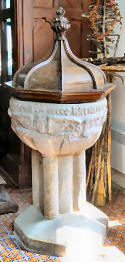
Winnow
I revisited St. Winnow in late July 2019, on a day when I also took another look at the church at St. Veep. Once again I was especially struck by the superb collection of bench ends, so I add a couple of photos of some of the most interesting, as well as one of the lovely font. Bench end motifs include a man drinking from a flagon, a wheel over a jug and a sailing ship.