Winnow
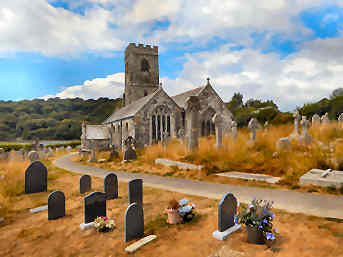
I was first in St. Winnow with Jane in May 2004. Later I returned in the course of a round walk from Lerryn that took in St. Winnow and the Ethy Estate. On neither occasion did I venture inside the church. However, I was back there in late July 2018 on a sunny Saturday when the church was being decked out for a wedding. The setting is a delight; the churchyard runs down to the banks of the Fowey River, a little north of its confluence with the River Lerryn. Although there are no ancient Cornish Crosses in the churchyard, there is a good collection of more recent elaborate crosses, commemorating members of the Vivian family. Inside there are very Cornish wagon roofs to the porch, nave and south aisle; the latter has an elaborately carved wall-plate. There is some nice colourful tiling to the chancel floor. The altar table is Jacobean, the pulpit is of later that century. Perhaps the most important feature of the interior is the medieval rood screen complete with rood, a relatively rare survival, restored in 1907. In the south-east window there is important 15th century stained glass. The east window is of the same period. The font, with an encircling inscription, carries smiling angels holding hands. Despite all this magnificence, the highlight for me was the superb collection of 16th century carved bench ends, some of Cornwall's best. More St. Winnow
St.Winnow Church
Pulpit
Rood and Chancel Ceiling
More St.
Photographs
More in Churches & Holy Sites
Winnow
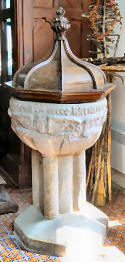
I revisited St. Winnow in late July 2019, on a day when I also took another look at the church at St. Veep. Once again I was especially struck by the superb collection of bench ends, so I add a couple of photos of some of the most interesting, as well as one of the lovely font. Bench end motifs include a man drinking from a flagon, a wheel over a jug and a sailing ship.

Winwaloe
Church Cove on the Lizard, St. Winwaloe's

Withiel Revisited
The most unusual thing about St. Clement's church is that, as you approach it from the east, it stands high above you on a site that was probably a pre-Christian lann site. The tower is striking; in three stages, it is crowned by tall crocketed pinnacles; a stair turret hides on the north-east side. The earliest part of the present church is the 13th century tall, narrow north door, long out of use. Nave and chancel appear to be 14th century. A north chancel, of the same period, was probably originally a chantry for the Brevill family. A south aisle was added in the early 16th century; it bears the arms of Prior Vivian of Bodmin. You enter through a porch carrying a sundial below a small elaborate cross. The porch is entered through a four-centre arch and has a wagon roof with a couple of carved bosses. Above the door to the body of the church is a tympanum with a carved shield; to the right of the door is a holy water stoup. Inside, the south aisle arcade has a carved wagon roof, the nave and chancel have plain wagon roofs. Unlike nearby St. Wenn, which has lost its bench pews, St. Clement's still has its. Several features about St. Clement's stand out: the font, believed to date from 1476, has an octagonal bowl with carved panels and the stem, too, is elaborately carved. Behind the font are painted gothic panels carrying the ten commandments and other texts. The organ is as colourful as any I have seen, painted vivid blue and gold. Windows have fragments of stained glass, including a fragment with the arms of Prior Vyvyan. A slate headstone dated 1811, remembers Henry Vyvyan. In the churchyard, 19th century gates are of cast iron.