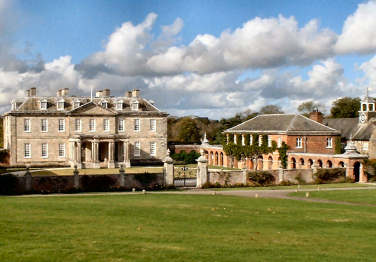
Antony House, Garden and Woodland Garden
Antony House is the ancestral home of the Carew Poles who have been here since the late 15th century. Their present home is a charming early Georgian mansion - but with more Christopher Wren to it than the Robert Adam. Contents, though of no great significance, are most enjoyable - portraits by Reynolds (a local man closely associated with Saltram House in Devon), sporting paintings by Sartorius, Chinese Chippendale furniture, Waterford crystal and Ming dynasty figures. Gardens by the house are pleasant and varied - at one end of an avenue there is an unexpected temple bell from Mandalay - but the best of the garden is the separate Woodland Garden (unlike the house, not National Trust but still owned by the family), a hundred acres with a National Collection of Camellias, the (for Cornwall) inevitable rhododendrons, azaleas and magnolias - and glorious views over the Rivers Lynher and Tamar and across to the tiny harbour of Anthony Passage. Anthony House is on the Rame Peninsula, in the far south-east of Cornwall. It is accessible also by ferry from Plymouth on the the Devon side of the River Tamar; a car ferry runs from Devonport to Torpoint, a passenger ferry runs from Stonehouse to Cremyll. In addition to a shop there is also a tearoom but, if you enjoy a pub, best places to eat nearby are the Edgcumbe Arms in Cremyll and the Halfway House in Kingsand.
Elegant south front of Antony House
2 miles NW Torpoint. More Images - Antony Garden and Estate
More in Historic Homes
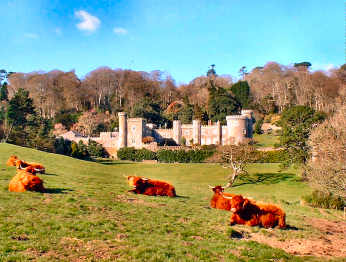
Caerhays Castle
The Caerhayes Estate has only changed hands once in over 600 years. But for the profligacy of the man who built the castle, it might not have changed hands then. The Trevanions acquired the estate - stretching from Portloe to Mevagissey - in 1370. Nothing is known about the homes they built until, around 1805, John Bettesworth Trevanion hired architect John Nash to build the present house. Nash's extravagance bankrupted Trevanion and the entire contents of the castle, even the lead off its roof, were sold. Eventually John Williams - major Cornish mine owner and banker - bought it in a state of dereliction in 1855.
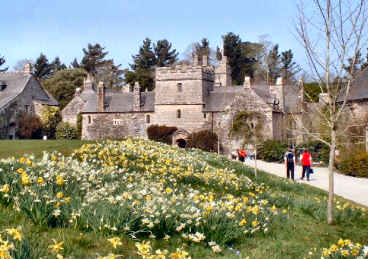
Cotehele House
We had last been at Cotehele in 1988 so, on a glorious sunny March Sunday in 2003, we decided to re-visit, as we have many times since. Set high above the broad River Tamar, Cotehele was in the Edgcumbe family for 600 years until gifted to the National Trust. There is a lot to see - the House, two Gardens, Cotehele Quay - with a small maritime museum and restored Tamar Sailing Barge - and a working water mill. Thanks to the Edcumbes building a new mansion in 1553 on the Rame Peninsula opposite Plymouth, Cotehele remains a little altered Tudor manor. Its small-scale but rambling interior is furnished mostly with Jacobean oak. Walls are hung with rich tapestries and bedrooms have handsome four-poster beds with crewel-work hangings. Highlights include a massive 400-year-old walnut veneered cabinet with Adam and Eve carvings, an ornate mirror painted around 1700 by Boldini and, in the White Bedroom, a 1688 mirror bordered by entertaining stump-work . There is a short introductory film and a good restaurant and shop. In the east wing there is an art and craft gallery. Try to avoid dull days as the National Trust believes in low light, in order to conserve ancient textiles and paintings.
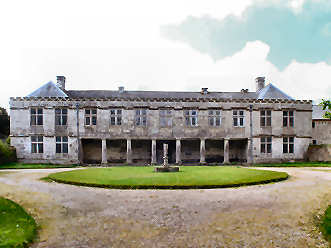
Godolphin House and Estate
The Godolphins were one of Cornwall's great families, wealthy from tin and copper mining and influential at court, but their home degenerated to farmhouse after the line died out in the early 18th century. In 1937 it was bought by Philadelphia Impressionist artist Elmer Schofield. For 70 years the Schofield family struggled to maintain and restore Godolphin but in 2007 it passed to the National Trust. Inside is fine 16th and 17th century English furniture, a good collection of Windsor chairs, and the paintings of Elmer Schofield and his son Sidney. The famous Wootton portrait of the Godolphin Arabian racehorse, one of three from which all thoroughbreds descend, was once here; sadly no longer. We first visited in May 2003, admired the ancient buildings, enjoyed the open part of the house, tended by aged docents, and had a glorious walk. We revisited in 2006 and again in April 2007. We were back again in 2009 to check on progress of the house under the National Trust and to see how restoration of the important medieval garden is going. Also in April 2007 I had a delightful walk from here taking in both Godolphin Hill and Tregonning Hill. It is well worth visiting Godolphin at bluebell time, the woods are absolutely carpeted with them.