Cotehele House
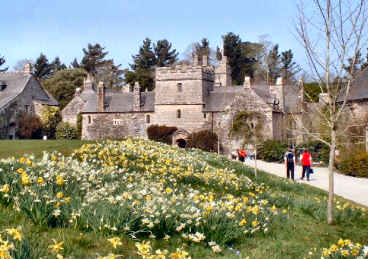
We had last been at Cotehele in 1988 so, on a glorious sunny March Sunday in 2003, we decided to re-visit, as we have many times since. Set high above the broad River Tamar, Cotehele was in the Edgcumbe family for 600 years until gifted to the National Trust. There is a lot to see - the House, two Gardens, Cotehele Quay - with a small maritime museum and restored Tamar Sailing Barge - and a working water mill. Thanks to the Edcumbes building a new mansion in 1553 on the Rame Peninsula opposite Plymouth, Cotehele remains a little altered Tudor manor. Its small-scale but rambling interior is furnished mostly with Jacobean oak. Walls are hung with rich tapestries and bedrooms have handsome four-poster beds with crewel-work hangings. Highlights include a massive 400-year-old walnut veneered cabinet with Adam and Eve carvings, an ornate mirror painted around 1700 by Boldini and, in the White Bedroom, a 1688 mirror bordered by entertaining stump-work . There is a short introductory film and a good restaurant and shop. In the east wing there is an art and craft gallery. Try to avoid dull days as the National Trust believes in low light, in order to conserve ancient textiles and paintings.
Cotehele - the front entrance to the house
Signed by lanes from A390 2 miles W of River Tamar
ON THE ESTATE On the quay on the River Tamar is a Discovery Centre, updating the former museum with contemporary displays about the estate. Nearby is the restored Tamar sailing barge Shamrock. By the limekilns, the Edgcumbe Arms serves teas and light lunches. On the lane towards Bartlett's Bridge is a restored Water Mill with working waterwheel and machinery milling organic flour. There is also a display about a new hydro-electric scheme. There is a dovecot in the spring gardens and, on the path leading to Calstock, is the Edgcumbe Chapel of 1485. The walk along the Tamar to Calstock is mostly on the estate, easy going and very pleasant. We have enjoyed lunch at the Tamar Inn in Calstock.
See also Cotehele Garden
More in Historic Homes
Godolphin House and Estate
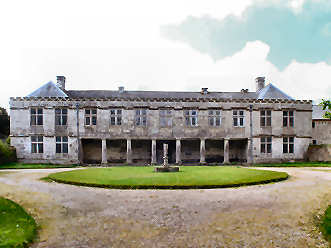
The Godolphins were one of Cornwall's great families, wealthy from tin and copper mining and influential at court, but their home degenerated to farmhouse after the line died out in the early 18th century. In 1937 it was bought by Philadelphia Impressionist artist Elmer Schofield. For 70 years the Schofield family struggled to maintain and restore Godolphin but in 2007 it passed to the National Trust. Inside is fine 16th and 17th century English furniture, a good collection of Windsor chairs, and the paintings of Elmer Schofield and his son Sidney. The famous Wootton portrait of the Godolphin Arabian racehorse, one of three from which all thoroughbreds descend, was once here; sadly no longer. We first visited in May 2003, admired the ancient buildings, enjoyed the open part of the house, tended by aged docents, and had a glorious walk. We revisited in 2006 and again in April 2007. We were back again in 2009 to check on progress of the house under the National Trust and to see how restoration of the important medieval garden is going. Also in April 2007 I had a delightful walk from here taking in both Godolphin Hill and Tregonning Hill. It is well worth visiting Godolphin at bluebell time, the woods are absolutely carpeted with them.
Lanhydrock House, Garden and Estate
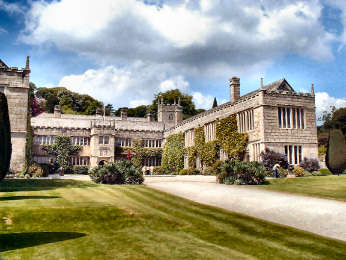
Lanhydrock is the National Trust's most visited Cornish property, though many visitors are locals who come just to enjoy the extensive parkland and woodland gardens (if all you want to do is walk in the park, a public footpath runs through). As a result, the house is rarely as busy as the car park may suggest. The ancestral home of the Robartes family has every appearance of a great Tudor mansion but only one wing is original; the rest was rebuilt in entirely sympathetic style after a disastrous fire in 1881. Inside, the Victorian rooms are impressive but for us the most enjoyable feature was the remarkably preserved 'below stairs', from where dozens of servants ran the house with military precision. There is a small church behind the house, carefully tended formal gardens between the gatehouse and the house, spring gardens behind the church and hilly woodland gardens, filled with bluebells in spring, running down towards the River Fowey. Lanhydrock is just to the south of Bodmin and easily accessible from the main A30 highway (it is well signed). There are three restaurants - one in the house, one in the courtyard, one by the main car park - and a good shop. Parking is a long way from the house but a golf buggy operates a shuttle service for those not wanting to walk. See Countryside page for Walks on the Estate
Mount Edgcumbe
Edgcumbe