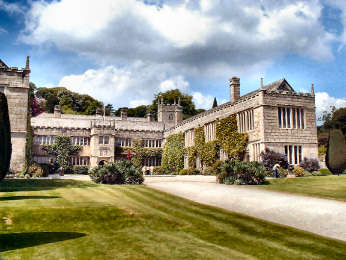
Lanhydrock House, Garden and Estate
Lanhydrock is the National Trust's most visited Cornish property, though many visitors are locals who come just to enjoy the extensive parkland and woodland gardens (if all you want to do is walk in the park, a public footpath runs through). As a result, the house is rarely as busy as the car park may suggest. The ancestral home of the Robartes family has every appearance of a great Tudor mansion but only one wing is original; the rest was rebuilt in entirely sympathetic style after a disastrous fire in 1881. Inside, the Victorian rooms are impressive but for us the most enjoyable feature was the remarkably preserved 'below stairs', from where dozens of servants ran the house with military precision. There is a small church behind the house, carefully tended formal gardens between the gatehouse and the house, spring gardens behind the church and hilly woodland gardens, filled with bluebells in spring, running down towards the River Fowey. Lanhydrock is just to the south of Bodmin and easily accessible from the main A30 highway (it is well signed). There are three restaurants - one in the house, one in the courtyard, one by the main car park - and a good shop. Parking is a long way from the house but a golf buggy operates a shuttle service for those not wanting to walk. See Countryside page for Walks on the Estate
Lanhydrock House
Signed off A38 near Bodmin, E of A30 junction
Mount
More in Historic Homes
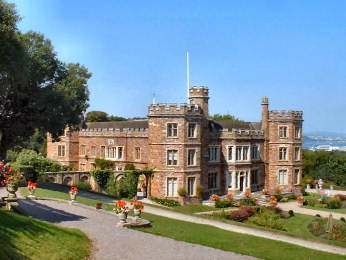
Mount Edgcumbe
Edgcumbe
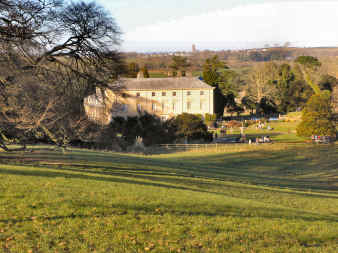
Pencarrow
Pencarrow is our local 'great house' (our friend Caroline was a guide there) yet we first took a house tour as recently as 2004. The fine Georgian house is the home of the Molesworth St. Aubyns - a branch of the St. Aubyn family formerly of Clowance and now of St. Michael's Mount. It has some good furniture but it is the paintings and the porcelain that stand out: landscapes and sea-scapes, portraits by Reynolds, and collections of Meissen, Sevres and Worcester. Our guide was terrific but we felt that the tour was rather too long at an hour and a quarter. Gardens are at their best in May for the rhodos, azaleas and bluebells though the recent 'Mole's' stream garden should be good in all seasons. The tea room, though small, is good but, if you choose to eat outside, you should beware peacocks. There is normally ample parking in a courtyard away from the house, where there is also a shop. The long drive to the house is through lovely beech woods, filled with bluebells in spring, and passes through an iron age fort, a great bonus for those who enjoy antiquities. Our recommendation would be to visit this charming place in late spring when the rhododendrons and azaleas in delightful gardens are at their best.
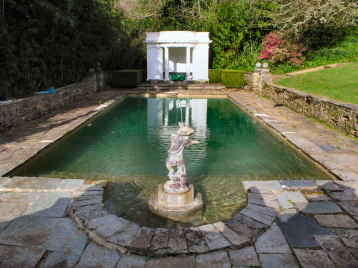
Port Eliot at St. Germans
When the 9th Earl of St. Germans died in 1988 the inheritance taxes due were unaffordable. Eventually a deal was done with government accepting 23 paintings, including 14 portraits by Joshua Reynolds, a local man. They remain in the house but have to be shown to the public on 100 days a year. Sensibly the family decided to show not just the 'gift in lieu' paintings but also much of the house and all its gardens and grounds. This is a most impressive place, acquired by the Eliots in the 1540s, at the Dissolution of the Monasteries, and now owned by the 27th generation. The Grade I listed house is partly by Sir John Soane and much of what you see is his work. Most striking is Soane's Round Room, its walls covered with a superb but unfinished mural by the late Plymouth artist Robert Lenkiewicz. Contents include fine furniture, among the highlights a Louis XIV Boule armoire, a Carlton House desk and Louis XIV and XVI clocks. There are too many portraits for our taste but there are also works by Van Dyck, some good nautical paintings and boat models and a casually displayed collection of old lace. The atmosphere is of a much loved and happily unpretentious family home, its grandeur a little faded and worn. The Repton park is also Grade I. We enjoyed wandering the woodland, with its daffodils, camellias, rhodos and hellebores, and walking down to the broad River Tiddy.