Port Eliot at St. Germans
When the 9th Earl of St. Germans died in 1988 the inheritance taxes due were unaffordable. Eventually a deal was done with government accepting 23 paintings, including 14 portraits by Joshua Reynolds, a local man. They remain in the house but have to be shown to the public on 100 days a year. Sensibly the family decided to show not just the 'gift in lieu' paintings but also much of the house and all its gardens and grounds. This is a most impressive place, acquired by the Eliots in the 1540s, at the Dissolution of the Monasteries, and now owned by the 27th generation. The Grade I listed house is partly by Sir John Soane and much of what you see is his work. Most striking is Soane's Round Room, its walls covered with a superb but unfinished mural by the late Plymouth artist Robert Lenkiewicz. Contents include fine furniture, among the highlights a Louis XIV Boule armoire, a Carlton House desk and Louis XIV and XVI clocks. There are too many portraits for our taste but there are also works by Van Dyck, some good nautical paintings and boat models and a casually displayed collection of old lace. The atmosphere is of a much loved and happily unpretentious family home, its grandeur a little faded and worn. The Repton park is also Grade I. We enjoyed wandering the woodland, with its daffodils, camellias, rhodos and hellebores, and walking down to the broad River Tiddy.
House and grounds open afternoons March to mid-June
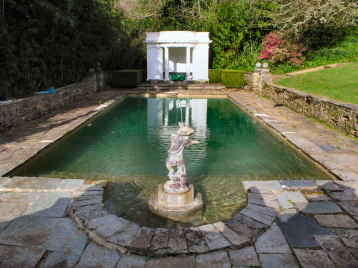
Pool and classical temple near the house
More in Historic Homes
Prideaux Place at Padstow
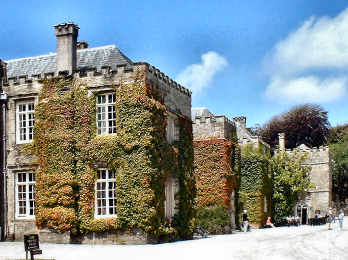
Home to the Prideauxs (now Prideaux-Brunes) since Edmund acquired the property at the Dissolution of the Monasteries, Prideaux Place looks from the outside like an ivy-clad minor Robert Adam castle. Inside it is a riot of totally unexpected Strawberry Hill Gothick with pendant plasterwork in brilliant white, only the Great Chamber and Grenville Room not conforming. In the former a superb 16th century plasterwork ceiling tells the story of Susannah and the Elders; the latter has an interior brought from Stowe House near Bude, demolished in the 18th century. Contents include armorial Worcester porcelain, heraldic glass, painted panels by Verrio and Cornish artist Alec Cobbe. Our favourite rooms are the Morning and Drawing rooms, charming, comfortable, well lit and clearly in family use. Gardens are under restoration and there are exhibitions in the stableyard, where you should walk through the dairy to see its gothic disguise. Long views east across Prideaux's deer park take in Rough Tor and Brown Willy on Bodmin Moor. When we first visited in July 2004 we parked at Daymer Bay, walked to Rock and took the ferry over the Camel estuary, lunching first at Rick Stein's fish and chip shop. If you park in Padstow, you can walk up the hill to Prideaux Place though there is parking by the house. One serious criticism: our chatty Welsh guide told us too much of himself, too little of the house! In the grounds are a Cornish Cross and St. Petroc's Holy Well.
St. Benet's Abbey near Lanivet
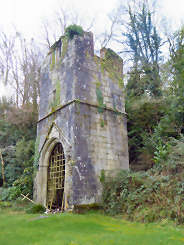
Benet's Abbey near Lanivet
St. Michael's Mount and its Garden
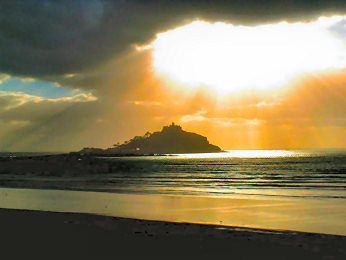
The first sight of St Michael's Mount is breathtaking; the house seems to grow out of the rocky bluff that tops the tiny island. Access is unusual; at high tide by boat, at low tide by a long stone causeway from Marazion. The path to the house is winding but steep and rough. A place of pilgrimage from AD495 when fishermen claimed to have seen St. Michael, in the early 11th century Edward the Confessor founded a Benedictine monastery here; at the Dissolution of the Monasteries, it became a fortress. In 1659 it was acquired by the St Aubyns of Clowance (related to the Molesworth-St. Aubyns of Pencarrow) and became an unusual home; the family still lives here but the house is in the care of the National Trust. You would scarcely expect to find a garden at all on such a small, steep rocky island, exposed to gales. None the less, a 20 acre 'Maritime Garden' covers terraces below a 300 foot cliff. Planting is mostly of weather tolerant exotics. Amongst great granite rocks are yuccas, agaves, geraniums, hebes, fuchsias and, in spring, wild narcissi. The garden is not National Trust but opens under family auspices on less days than the house. Allow at least a half-day for the time to and from the island, an exhibition and movie, the most enjoyable house and the steep garden. The National Trust operates a good restaurant just above the attractive little harbour.