St. Benet's Abbey near Lanivet
Benet's Abbey near Lanivet
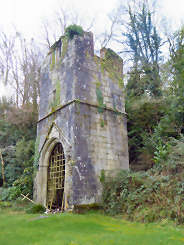
I was unsure how to classify St. Benet's but, since it does B&B, I felt that "house open to the public" was best. However, hedging my bets, I have also included it on my "Holy Sites & Churches" page. I have passed St. Benet's a thousand times on the way to Bugle, St. Austell and the south coast. Recently I read that there is a Cornish Cross in the front garden so, on my way back from a visit to St. Pauls Church in Charlestown, I called in at St. Benet's, just off the road near Lanivet. It is now a Bed & Breakfast, with nine en-suite rooms, run by J.J. and his wife. St. Benet's has had a mixed history. It was founded as a chapel in 1411, at that time used as a retreat for lepers - a lazar house - but dissolved by Henry VIII in 1549. What you see here is relatively minor remains comprising gatehouse and domestic range. The detached and degraded tower behind is all that remains of the chapel; between it and the back of the house are the remains of a well. It was owned in the 16th century by the Courtneys of Tremere, related to the Earls of Devon; their monuments are in Lanivet Church. After it was purchased in 1855 by the rector, Rev. W. Phillips Flamank, St. Benet's had a considerable makeover so that it now appears to be a sort of Regency Gothick. As you face the house, the left hand end was the gatehouse of the original establishment and retains its octagonal stair turret. What is now a three light window was once the carriage archway. Above is an oriel window with what appear to be atatue niches to each side. In the garden to the front of the house is what I had gone there to see, a small round-headed Cornish Cross, believed to be of the 13th century or earlier, which has been attached to a more modern shaft.
Chapel Tower
St. Benet's
Cornish Cross
Photographs
More in Historic Homes
St. Michael's Mount and its Garden
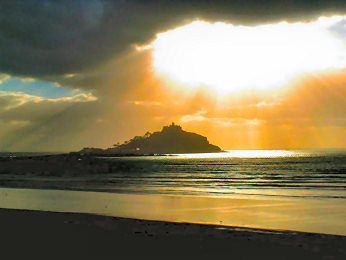
The first sight of St Michael's Mount is breathtaking; the house seems to grow out of the rocky bluff that tops the tiny island. Access is unusual; at high tide by boat, at low tide by a long stone causeway from Marazion. The path to the house is winding but steep and rough. A place of pilgrimage from AD495 when fishermen claimed to have seen St. Michael, in the early 11th century Edward the Confessor founded a Benedictine monastery here; at the Dissolution of the Monasteries, it became a fortress. In 1659 it was acquired by the St Aubyns of Clowance (related to the Molesworth-St. Aubyns of Pencarrow) and became an unusual home; the family still lives here but the house is in the care of the National Trust. You would scarcely expect to find a garden at all on such a small, steep rocky island, exposed to gales. None the less, a 20 acre 'Maritime Garden' covers terraces below a 300 foot cliff. Planting is mostly of weather tolerant exotics. Amongst great granite rocks are yuccas, agaves, geraniums, hebes, fuchsias and, in spring, wild narcissi. The garden is not National Trust but opens under family auspices on less days than the house. Allow at least a half-day for the time to and from the island, an exhibition and movie, the most enjoyable house and the steep garden. The National Trust operates a good restaurant just above the attractive little harbour.
Trerice - A Small Cornish Manor near Newquay
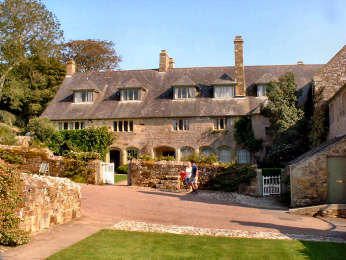
Trerice must be one of the National Trust's smallest homes. A former seat of the Arundells, well connected Cornish gentry, also of Efford in Bude and Lanherne in St. Mawgan, it is a charming unspoilt stone built E-shaped Elizabethan manor, with Dutch looking gables, some elaborate plasterwork ceilings, good oak and walnut furniture, a fine collection of clocks and some good porcelain. Paintings include portraits of the Stuart royal family and others by local man John Opie. The garden is small but pleasing; there are herbaceous borders, climbers, cottage garden plants and an orchard. A stone barn houses a lawn mower museum; nearby a piece of sculpture is assembled from lawnmower parts! The location of Trerice is unexpected; only just outside Cornwall's busiest holiday and surfing resort, Newquay, yet so tucked away down narrow Cornish lanes that it might be in the middle of nowhere. A word of advice for motorists. Beware narrow Cornish lanes! What seem to be hedges on earthen banks actually hide rock walls - this is the dreaded 'Cornish Hedge', notorious scraper of paintwork. There is a tearoom in a barn. There is ample parking fairly close to the house.
Trerice Revisited 2007
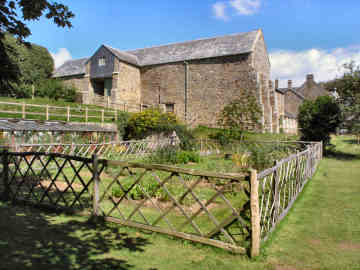
Our last visit to Trerice was, we think, in 2002. The exterior of the house remains, not unexpectedly, unchanged since then. The contents have changed a little, unsurprisingly since the house came to the National Trust with only the great oak table in the Great Hall; all else is from other National Trust sources or on loan. The Great Hall now has an exhibition laid out on the massive oak table; it includes copies of Arundell and Coswarth family memorial brasses - more copies are in a little brass-rubbing centre in the rear courtyard. The most admirable thing that has arrived here since our last visit is a superb collection of Georgian glassware, well displayed in the Drawing Room. We found the guides in the rooms little changed and as helpful as ever. What did seem to have changed quite a bit since our last visit was the gardens, which have expanded. Borders in the courtyard at the east front have filled out and the borders between there and the orchard were looking really good, colourful and well filled. Behind the great barn there are now tables on the Mowbray Terrace for the tea room inside. Below the terrace is a new Elizabethan garden. As well as the house and garden we revisited the mower museum; what an amazing collection - but Lord Screwloose (the sculpture) was nowhere to be seen.