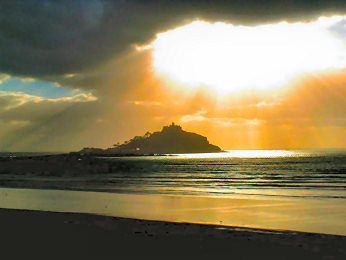
St. Michael's Mount and its Garden
The first sight of St Michael's Mount is breathtaking; the house seems to grow out of the rocky bluff that tops the tiny island. Access is unusual; at high tide by boat, at low tide by a long stone causeway from Marazion. The path to the house is winding but steep and rough. A place of pilgrimage from AD495 when fishermen claimed to have seen St. Michael, in the early 11th century Edward the Confessor founded a Benedictine monastery here; at the Dissolution of the Monasteries, it became a fortress. In 1659 it was acquired by the St Aubyns of Clowance (related to the Molesworth-St. Aubyns of Pencarrow) and became an unusual home; the family still lives here but the house is in the care of the National Trust. You would scarcely expect to find a garden at all on such a small, steep rocky island, exposed to gales. None the less, a 20 acre 'Maritime Garden' covers terraces below a 300 foot cliff. Planting is mostly of weather tolerant exotics. Amongst great granite rocks are yuccas, agaves, geraniums, hebes, fuchsias and, in spring, wild narcissi. The garden is not National Trust but opens under family auspices on less days than the house. Allow at least a half-day for the time to and from the island, an exhibition and movie, the most enjoyable house and the steep garden. The National Trust operates a good restaurant just above the attractive little harbour.
Storm approaches St. Michael's Mount
Off Marazion, 3 miles E of Penzance; park in Marazion
More in Historic Homes
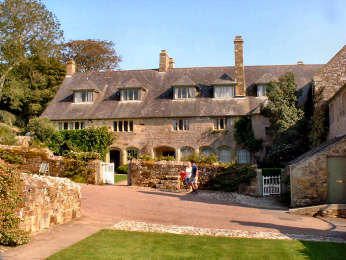
Trerice - A Small Cornish Manor near Newquay
Trerice must be one of the National Trust's smallest homes. A former seat of the Arundells, well connected Cornish gentry, also of Efford in Bude and Lanherne in St. Mawgan, it is a charming unspoilt stone built E-shaped Elizabethan manor, with Dutch looking gables, some elaborate plasterwork ceilings, good oak and walnut furniture, a fine collection of clocks and some good porcelain. Paintings include portraits of the Stuart royal family and others by local man John Opie. The garden is small but pleasing; there are herbaceous borders, climbers, cottage garden plants and an orchard. A stone barn houses a lawn mower museum; nearby a piece of sculpture is assembled from lawnmower parts! The location of Trerice is unexpected; only just outside Cornwall's busiest holiday and surfing resort, Newquay, yet so tucked away down narrow Cornish lanes that it might be in the middle of nowhere. A word of advice for motorists. Beware narrow Cornish lanes! What seem to be hedges on earthen banks actually hide rock walls - this is the dreaded 'Cornish Hedge', notorious scraper of paintwork. There is a tearoom in a barn. There is ample parking fairly close to the house.
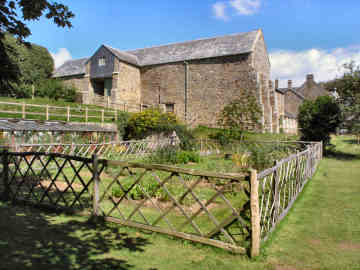
Trerice Revisited 2007
Our last visit to Trerice was, we think, in 2002. The exterior of the house remains, not unexpectedly, unchanged since then. The contents have changed a little, unsurprisingly since the house came to the National Trust with only the great oak table in the Great Hall; all else is from other National Trust sources or on loan. The Great Hall now has an exhibition laid out on the massive oak table; it includes copies of Arundell and Coswarth family memorial brasses - more copies are in a little brass-rubbing centre in the rear courtyard. The most admirable thing that has arrived here since our last visit is a superb collection of Georgian glassware, well displayed in the Drawing Room. We found the guides in the rooms little changed and as helpful as ever. What did seem to have changed quite a bit since our last visit was the gardens, which have expanded. Borders in the courtyard at the east front have filled out and the borders between there and the orchard were looking really good, colourful and well filled. Behind the great barn there are now tables on the Mowbray Terrace for the tea room inside. Below the terrace is a new Elizabethan garden. As well as the house and garden we revisited the mower museum; what an amazing collection - but Lord Screwloose (the sculpture) was nowhere to be seen.
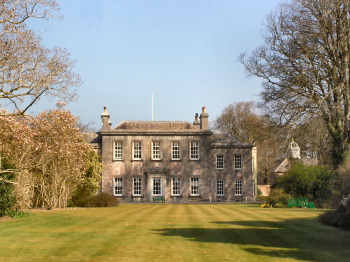
Trewithen
Philip Hawkins, wealthy Cornish attorney, acquired the estate in 1715. He employed London architect Thomas Edwards to build a new house and began a woodland garden to set it off. Descendants profited from Cornish lead, silver, tin and china clay. By marriage, Trewithen passed to the Johnstones in 1841; it was plant hunter George Johnstone, inheriting in 1904, who created the superb shrub garden that you see today. By marriage again Trewithen is now home to the Galsworthys. The view of the house from the south, framed by an avenue of magnolias and rhodos, is quite superb. The excellent 40-minute tour shows just five rooms: the small attractive Library, the dark-panelled Oak Room, the warm and comfortable Drawing Room, the Dining Room and the Smoking Room. Grandest is the Dining Room with its Ionic columns, rococo plasterwork, Imari ware and family portraits. Elswhere all is small scale, comfortable and very family-oriented. Contents include superb oriental porcelain, Chippendale chairs, good clocks and a desk and travelling tea-caddy once owned by Sir Stamford Raffles of Singapore fame, connected to the family by marriage. Portraits are by Reynolds, Ramsey and Romney and fine nautical pictures include a Van Der Velde. There is a 30 minute movie and an estate exhibition. There is ample car parking; a tearoom serves rich cakes and pastries and cream teas. In January 2017 I was surprised to learn that remote Golden is part of the Trewithen Estate.