Trewithen
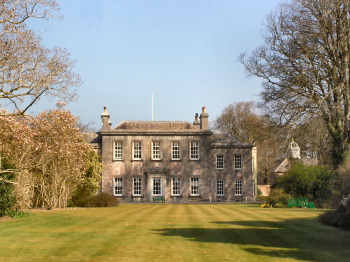
Philip Hawkins, wealthy Cornish attorney, acquired the estate in 1715. He employed London architect Thomas Edwards to build a new house and began a woodland garden to set it off. Descendants profited from Cornish lead, silver, tin and china clay. By marriage, Trewithen passed to the Johnstones in 1841; it was plant hunter George Johnstone, inheriting in 1904, who created the superb shrub garden that you see today. By marriage again Trewithen is now home to the Galsworthys. The view of the house from the south, framed by an avenue of magnolias and rhodos, is quite superb. The excellent 40-minute tour shows just five rooms: the small attractive Library, the dark-panelled Oak Room, the warm and comfortable Drawing Room, the Dining Room and the Smoking Room. Grandest is the Dining Room with its Ionic columns, rococo plasterwork, Imari ware and family portraits. Elswhere all is small scale, comfortable and very family-oriented. Contents include superb oriental porcelain, Chippendale chairs, good clocks and a desk and travelling tea-caddy once owned by Sir Stamford Raffles of Singapore fame, connected to the family by marriage. Portraits are by Reynolds, Ramsey and Romney and fine nautical pictures include a Van Der Velde. There is a 30 minute movie and an estate exhibition. There is ample car parking; a tearoom serves rich cakes and pastries and cream teas. In January 2017 I was surprised to learn that remote Golden is part of the Trewithen Estate.
Trewithen House seen across the south lawn
On A390 St. Austell-Truro at Probus, 7 miles east of Truro
CORNWALL
More in Historic Homes
Antony - Garden and Estate
More Images of Antony - Garden and Estate
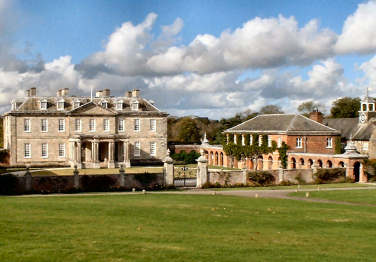
Antony House, Garden and Woodland Garden
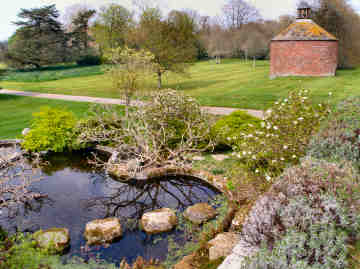
Antony House is the ancestral home of the Carew Poles who have been here since the late 15th century. Their present home is a charming early Georgian mansion - but with more Christopher Wren to it than the Robert Adam. Contents, though of no great significance, are most enjoyable - portraits by Reynolds (a local man closely associated with Saltram House in Devon), sporting paintings by Sartorius, Chinese Chippendale furniture, Waterford crystal and Ming dynasty figures. Gardens by the house are pleasant and varied - at one end of an avenue there is an unexpected temple bell from Mandalay - but the best of the garden is the separate Woodland Garden (unlike the house, not National Trust but still owned by the family), a hundred acres with a National Collection of Camellias, the (for Cornwall) inevitable rhododendrons, azaleas and magnolias - and glorious views over the Rivers Lynher and Tamar and across to the tiny harbour of Anthony Passage. Anthony House is on the Rame Peninsula, in the far south-east of Cornwall. It is accessible also by ferry from Plymouth on the the Devon side of the River Tamar; a car ferry runs from Devonport to Torpoint, a passenger ferry runs from Stonehouse to Cremyll. In addition to a shop there is also a tearoom but, if you enjoy a pub, best places to eat nearby are the Edgcumbe Arms in Cremyll and the Halfway House in Kingsand.
Caerhays Castle
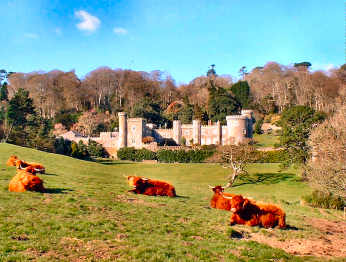
The Caerhayes Estate has only changed hands once in over 600 years. But for the profligacy of the man who built the castle, it might not have changed hands then. The Trevanions acquired the estate - stretching from Portloe to Mevagissey - in 1370. Nothing is known about the homes they built until, around 1805, John Bettesworth Trevanion hired architect John Nash to build the present house. Nash's extravagance bankrupted Trevanion and the entire contents of the castle, even the lead off its roof, were sold. Eventually John Williams - major Cornish mine owner and banker - bought it in a state of dereliction in 1855.