Bridges - Prehistoric, Medieval and Modern
We have a remarkable variety of bridges in Cornwall, everything from the prehistoric age through to the modern era, though we do lack the kind of 21st century 'millennium' project bridges that places like Newcastle, London and Manchester like to boast about.
Prehistoric - No one knows the age of Cornwall's clapper bridges but some undoubtedly can count their age in millennia. They are especially abundant on Bodmin Moor and I must have crossed dozens. The finest examples are those at Bradford and at Delford Bridge, adapted to carry modern traffic.
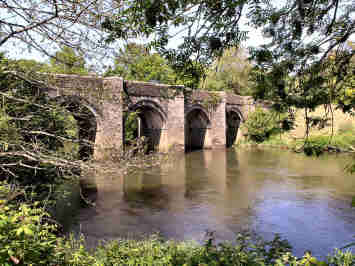
Medieval - A surprising number of these survive unaltered on minor roads. Some, like the famed 'bridge on wool' that crosses the Camel at Wadebridge, have been much altered to carry modern road vehicles. To my mind the finest is Horsebridge, pictured left, over the Tamar near Kit Hill.
Modern - There are a few 20th century road bridges - for instance crossing the Tamar at Plymouth and Launceston - but most are in fact Victorian. The finest is undoubtedly Brunel's justly famed Royal Albert Bridge carrying the railway over the Tamar but I also have a great fondness for the Tamar rail viaduct (not Brunel's) at Calstock and the rail bridge over the Carnon Valley near Devoran, alongside it the piers of Brunel's original bridge.
Medieval Horsebridge over the River Tamar
Brunel's great Royal Albert Bridge
More in Miscellanea
Christmas Lights at Mousehole and Newlyn
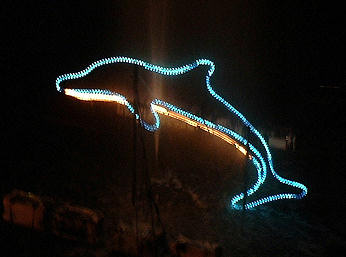
Lights at Mousehole and Newlyn
Cliff Castles
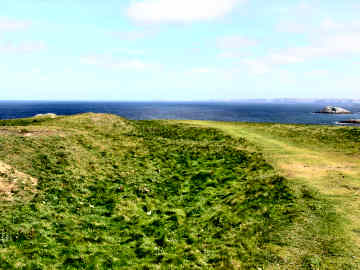
Where other parts have their iron age hill forts - and indeed Cornwall has a number of these, most notably Castle an Dinas and Warbstowbury - Cornwall is unusual in having a vast number of cliff castles. These appear to be exactly what the name suggests, iron age fortifications on clifftop sites. But there is a puzzle. Mostly all you find is a curving rampart, perhaps quarter of a circle, from clifftop to clifftop. What useful purpose, you may well ask, did a fort like this serve. It only encloses a tiny area which surely no one would want to live in or even defend. There is a simple answer. When constructed, as hill forts with a view of the coast, they were as much as quarter of a mile inland. In 2000 and more years the coastline has eroded that much. Some of the smaller ones may not have been forts at all, merely fortified farmsteads. Be that as it may, they are now in stunning locations thanks to coastal erosion. Amongst my favourites are Treryn Dinas near Treen in West Penwith, the Rumps near Polzeath, Griffin Point near Bedruthan Steps and Trevelgue Head near Newquay. But take a look at the Ordnance Survey Explorer maps and you will find dozens, especially on Cornwall's north coast. When you walk the coast path it can be difficult to identify some for growth of scrub and bracken but it's worth trying.
Cornish Crosses
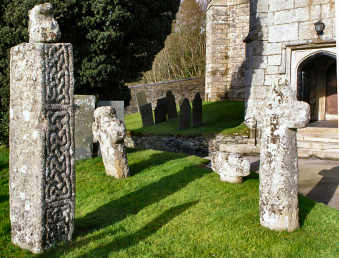
Crosses